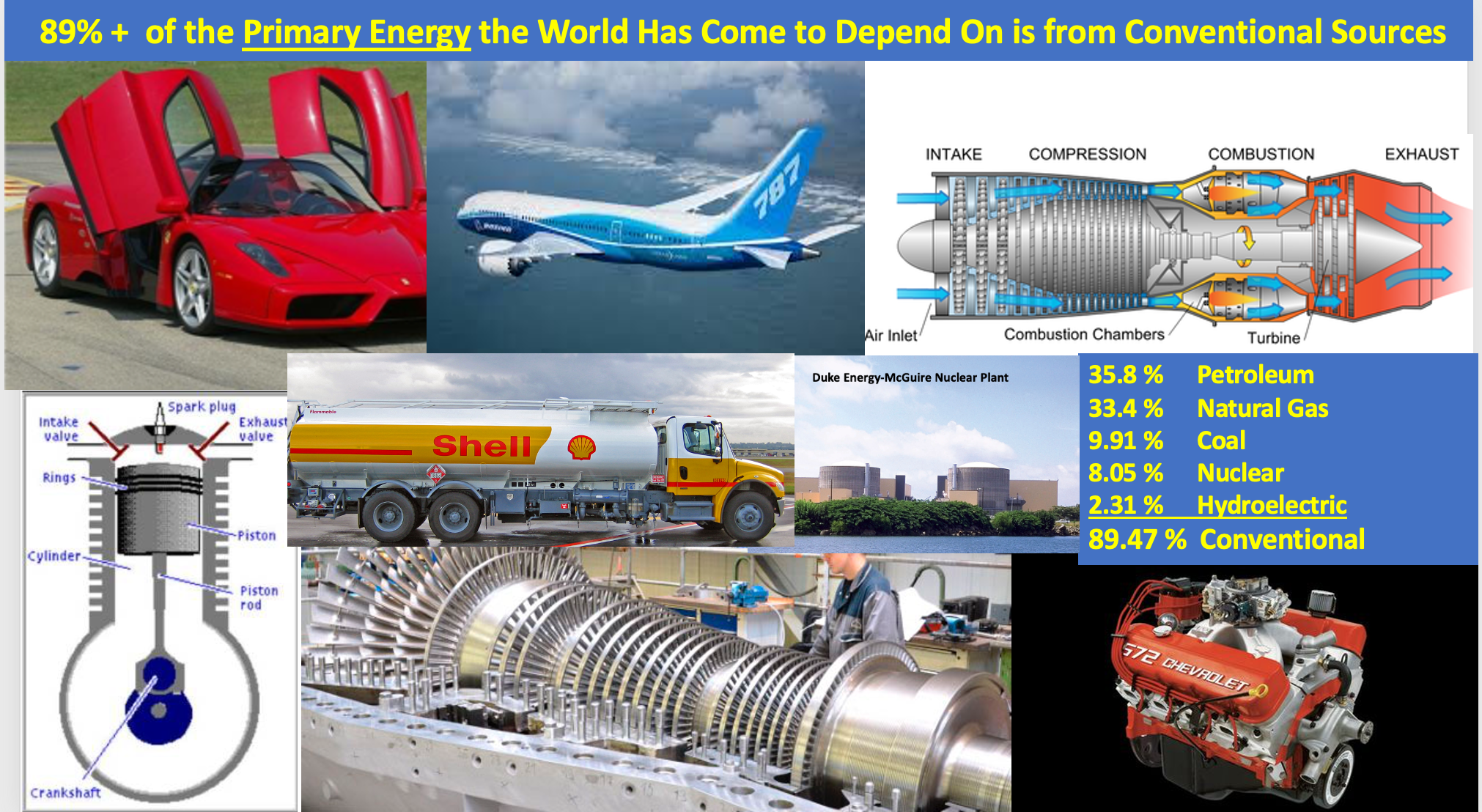
Conventional energy is vitally important for all that we do. Missing from news reports to the general public is an honest communication to try to explain the huge and enormous energy systems that we depend on each day and the impossibility of replacing conventional energy with wind and solar. To start 2024, I thought I would post a series on the Hard Truths of Energy. I borrowed the title from the 2007 National Petroleum Council report, led by Chairman, Lee Raymond, retired CEO of ExxonMobil. Petroleum, natural gas and coal were important in 2007 and they remain important today. The “Energy Density” of fossil fuels makes them indispensable to sustain our economy and our high quality of life.(4)
Fossil Fuels Provide 79% of U.S. Primary Energy
79 Quadrillion BTUs is the amount of energy we depend on from fossil fuels. This is my attempt to try to explain and illustrate what 79 Quadrillion BTUs of energy looks like. The number 79 Quadrillion is from the Department of Energy’s Lawrence Livermore Laboratory for energy use in 2022.(2) Below is a short summary of the amount of natural gas, petroleum and coal that we used in the U.S.A. in 2022.
How Huge is a Quadrillion?
I have discussed the steady U.S. energy demand of 100 Quadrillion BTUs per annum for decades and yes, 100 Quadrillion BTUs is the amount of energy we use each year and it has been steady for over 20 years.(6) Until now, I did not take the time to explain the enormity of a Quadrillion BTUs. Here is what one Quadrillion BTUs of energy is equivalent to:
Coal= About 50 million tons of coal. This would be a coal pile that would be one mile wide, ten feet high and 3.3 miles long.
Oil= 7.14 Billion gallons. See Lee Raymond quote below on the quantity of motor fuels used in the U.S. in a year
Natural Gas= 1 Trillion cubic feet. This is equivalent to 200 aircraft carrier sized LNG Tankers. More on the enormity of an LNG ship below.
It is a fact, in America, we use and need about 100 Quadrillion BTUs of energy each year.
36 Quadrillion BTUs of Petroleum
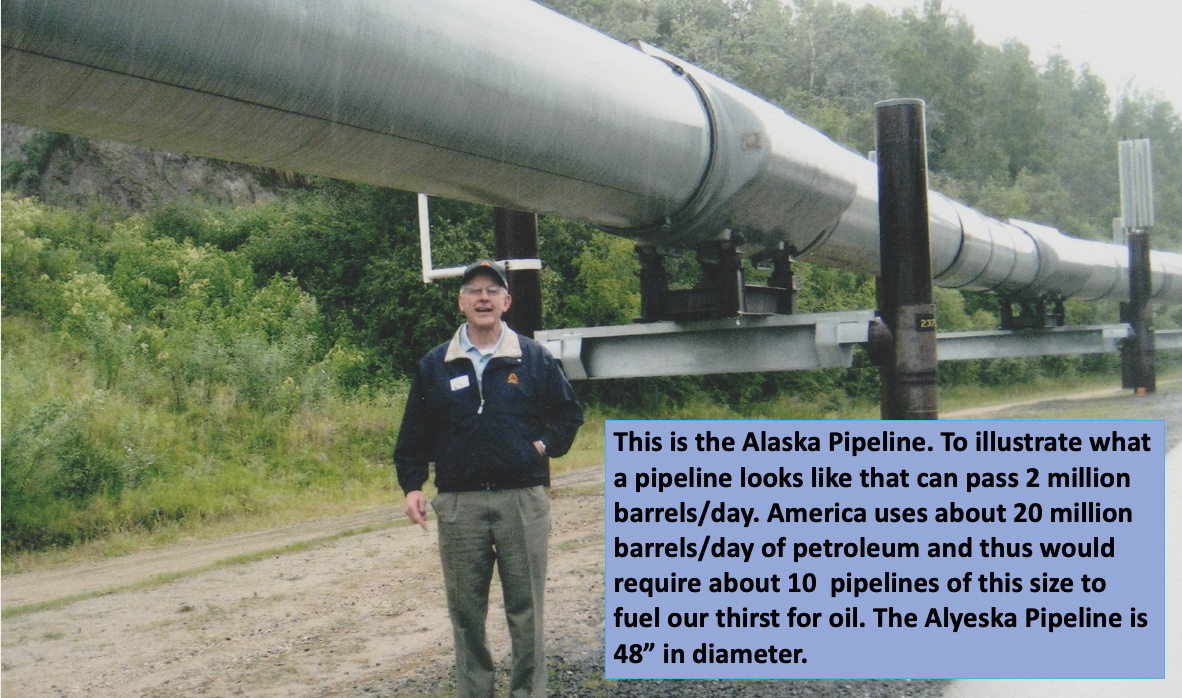
The single largest form of energy that we depend on is petroleum. About 20 million barrels per day. To visualize what 20 million barrels per day would look like, take a look at the photo of me and the 48″ Alyeska pipeline in Alaska. At its peak flow, about 2 million barrels per day flowed through the Alaska pipeline. So, to visualize 20 million barrels per day, picture in your mind, ten of these 48″ pipelines installed side by side.
Photo credit, Dick Storm circa 2007
Another illustration was offered by Lee Raymond, retired CEO of ExxonMobil when introducing the National Petroleum Council report “Facing the Hard Truths of Energy” in 2007. This explanation is offered by Mr. Raymond on You Tube, here. Mr. Raymond explained that the amount of motor fuels used in 2006 was about 150 Billion gallons. He then went on to state that if each gallon was placed in a one gallon tin can as he used in his youth to fill his lawnmower, the length of 10″ high cans, if placed end to end would circle the earth 1,000 times. That is the enormity of 150 Billion gallons of motor fuel. Mr. Raymond stated, (among other important points), “To replace current energy systems it will take a an enormous effort and a long period of Time.”(5)
The gasoline and Diesel motor fuels used in the U.S. has increased from the 150 Billion gallons consumed in 2007, to about 209 Billion gallons in 2022.
33 Quadrillion BTUs of Natural Gas
America used 33.4 Quadrillion BTUs of natural gas during 2022. Most of the natural gas used by the U.S. is distributed by a vast network of unseen, underground pipelines. Therefore, hard to visualize. So, let’s imagine that if we were to use all of our natural gas from shipments of LNG, (Liquified Natural Gas) how many huge LNG Super Tankers would it take? Such as the vessel Pan American shown below:
This LNG tanker holds 174,000 cubic feet of liquified natural gas. LNG is 1/600th the volume of the gaseous state. The ship is over 977 feet long and the gross tonnage is 114,966. This is a ship about the size of a U.S. Navy aircraft carrier. The energy equivalent of the cargo is about 6 trillion BTUs.
Now, imagine 6,600 ships like the Pan American above all lined up along the east coast. If the ships were placed touching, end to end, this would be about 1,220 miles of ships from New York City to south of Miami, Florida. That is the number of aircraft carrier sized LNG tankers that it would take to provide 33 Quadrillion BTUs of natural gas fuel. The 33 Quadrillion number is from 2022, the actual demand. The future will likely require more than 33.4 Quadrillion BTUs.
10 Quadrillion BTUs of Coal Power
Coal power has been important to the U.S. since the days of Thomas Edison, Nikola Tesla and George Westinghouse. The American electric system, referred to as the “Grid” was built on the foundation of reliable, affordable, domestically supplied and environmentally clean steam power generation fueled by coal. This took over 125 years to build and has been described by the Smithsonian as, “The Largest Machine Ever Built”. Video here. As recent as 2011 about 50% of America’s electricity was produced by steam turbines with steam generation from coal fuel. In 2022 the coal powered electricity generation dropped to about 20%. Much of the total electricity generation which was once powered by coal fuel, has been switched to natural gas fuel.
As recent as 2011 America used about a billion tons of coal. In 2022 coal use declined by about 50% to about 512,000 million tons. Coal is important because of it’s enormous energy density. Another important fact, is that weeks and months of primary energy can be safely stored on site. Coal provides Dispatchable power and it is proven to be affordable. America has the largest coal reserves of any country. The U.S. is the Saudi Arabia of coal.
How much coal is 512,000 million tons? This is enough coal to fill about 5,000,000 coal cars such as the one shown below.
How long would a single train of 512,000,000 tons of coal be? About 50,000 miles, long enough to circle the earth two times at the equator.
Conclusions
The so-called energy transition from conventional to wind and solar is simply not possible with today’s technology. As Mr. Raymond stated in 2007, changing from our conventional energy systems to something else is an enormous effort that will take. a long time.
Net-Zero Carbon by 2050 is impossible. A previous blog post is here.
The largest energy density and provider of the greatest quantity of carbon-free energy is nuclear power. However, replacing the existing electric generation with nuclear will take decades to accomplish and massive roll back of Federal Regulations. It took about 40 years to develop, manufacture, construct and perfect the 93 operating commercial nuclear units in 54 plants. These currently provide about 20% of America’s electricity. Most of these are now over 30 years old and the last two units built by Southern Company (2,200MW capacity) took over ten years to build. A previous blog post discusses “Without New Thinking on Nuclear Power, Net Zero Carbon is Impossible”, here.
Electrifying Everything is not possible, even electrifying transportation is not practical for every vehicle and if they were, much more electricity would be required.
The so-called energy transition from conventional forms of energy to wind and solar is impossible and attempting to do so by forced laws (such as the IRA), increased Regulations and the continuing war on carbon will destroy our country.
It is my hope and prayer that after the next election some sanity to energy policy will return.
Much has been written on the importance of energy to power a nation’s economy and to continue to provide a high quality Human Development Index. The purpose of this post is to focus on the importance of Fuel Diversity for electricity generation. There is a proven concept for energy storage for electricity generation. It is coal fueled power plants with a 30-60 day supply of coal in a pile, on site. This is proven to be reliable, low cost and safe.
Energy powers everything we do!
Think about this. You are probably reading this on a computer screen. Have a warm cup of coffee nearby and are sitting in an air conditioned office or home. Your car is sitting outside and at your urging is ready to provide transportation. You get the point. Remember the last hurricane or severe winter storm that killed power for a day or so? Loss of energy sources or electricity is debilitating. Think about the 1970’s Oil Embargoes. If you are too young to remember 1973-1979 check these references, here and here.
Primary Energy Sources-Back to Basics
Lets discuss energy and electricity and the sources and quantity of everyday energy that we depend on.
America has used right at 100 Quadrillion Btus of PRIMARY energy per annum since about the year 2000.
The energy we use is compiled by various government agencies in BTUs equivalent (British Thermal Units). A BTU is enough heat to raise one pound of water one degree Fahrenheit, just as a reminder of High School Physics. Each BTU converted to work is equivalent (at 100% efficiency) to 778 Foot Pounds. Therefore, the energy production and consumption is converted to BTUs so that all forms of energy can be reported on a like basis. I wrote an article on the basics of energy for Middle School students here if you are interested, also on “Demystifying Energy and Electricity” here.
This article is about fuel diversity. Just as I explained above regarding the reporting of energy in BTUs to have a common measurement of energy quantities, in some cases one fuel can be substituted for another, especially in electric power generation. Thermal Power Generation Plants that generate Bulk Power can be provided with natural gas, coal, oil, Biomass or nuclear energy to produce steam to drive a steam turbine generator. The fuel selected is done for reasons of economic or fuel availability. Hawaii is truly an Energy Island and thus cannot interconnect with the lower 48 states. Fuels for Thermal Power Generation needs to be imported. In fact, I wrote on Hawaii’s electricity generation in 2020, here.
The proportions of each form of energy used and depended on to power our lives has changed as technologies for extraction and production have improved. For example for electric power generation coal fuel was consumed for about 50% of power generation in year 2000. Then due to the Shale Revolution of Hydraulic Fracturing and Directional Drilling, natural gas became less expensive than coal on a $/million BTU basis. See my review of Harold Hamm’s book, Game Changer which covers the Shale Gas Revolution, here. Thus, gas was substituted for coal generation by many utilities that could get it. Alaska and Hawaii of course do not have pipelines to connect, but of many utilities in the lower 48 states, gas was an economical and clean fuel of choice.
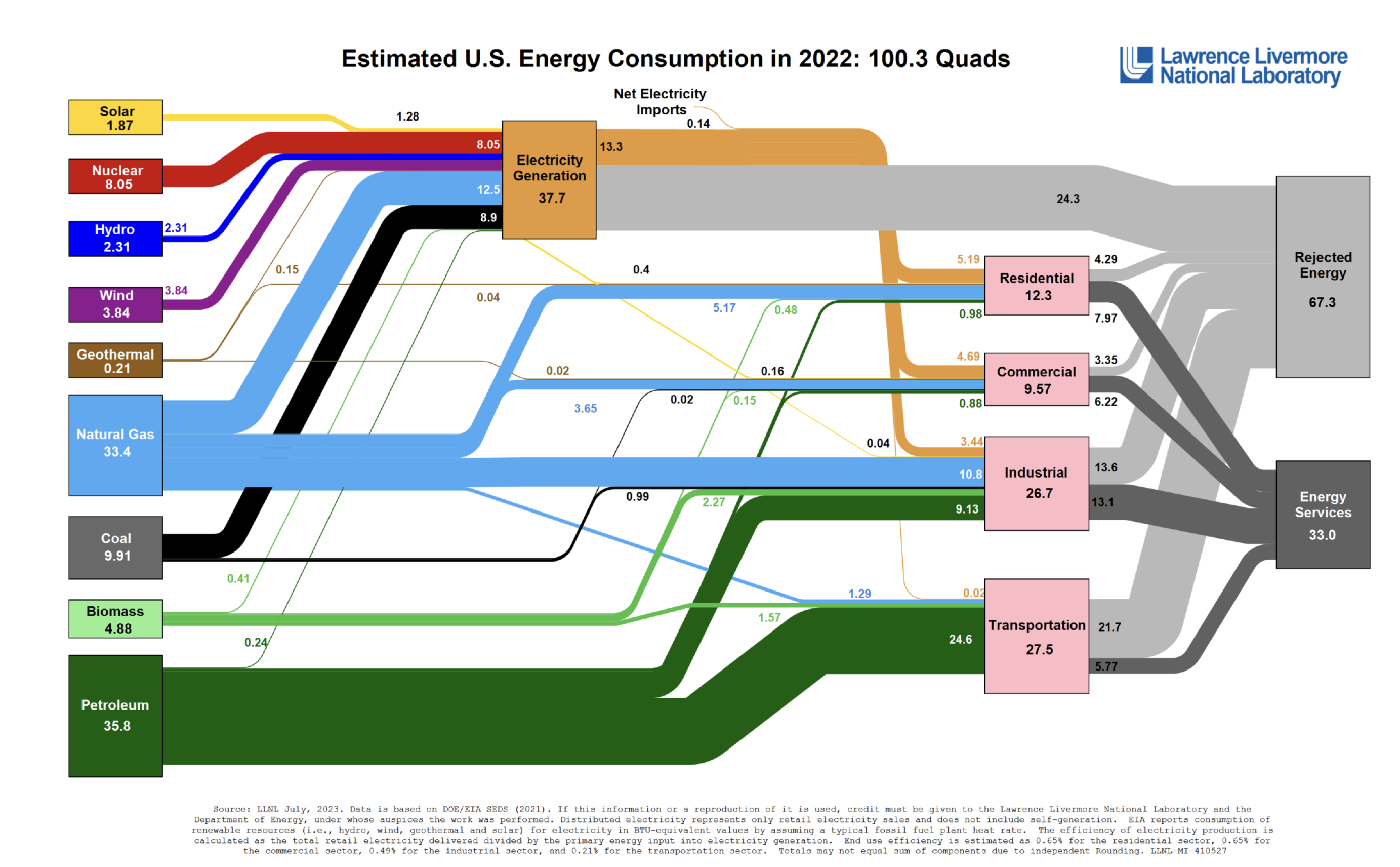
Coal fuel in the U.S. today provides about 23 % of the primary energy to produce Bulk Electric Power over the year. The substitution of coal fuel as primary energy is natural gas which has become more economical as a result of the Shale gas revolution which took off about 2012. Electricity is SECONDARY Energy and must be produced from Primary energy. Electricity is important and in 2022 electricity consumed about a third (37.7% to be exact) of the total PRIMARY energy used in the U.S. The best factual illustration that I am aware, of the sources and consumption of primary energy is the LLNL Energy Flow Diagram, shown below. This is one of my favorite graphics and it is prepared each year by the Department of Energy. The chart above shows the total primary energy used since 1950 and thus supports my conclusion that America needs right at 100 Quads per year to sustain our quality of life, economy and industrial production.
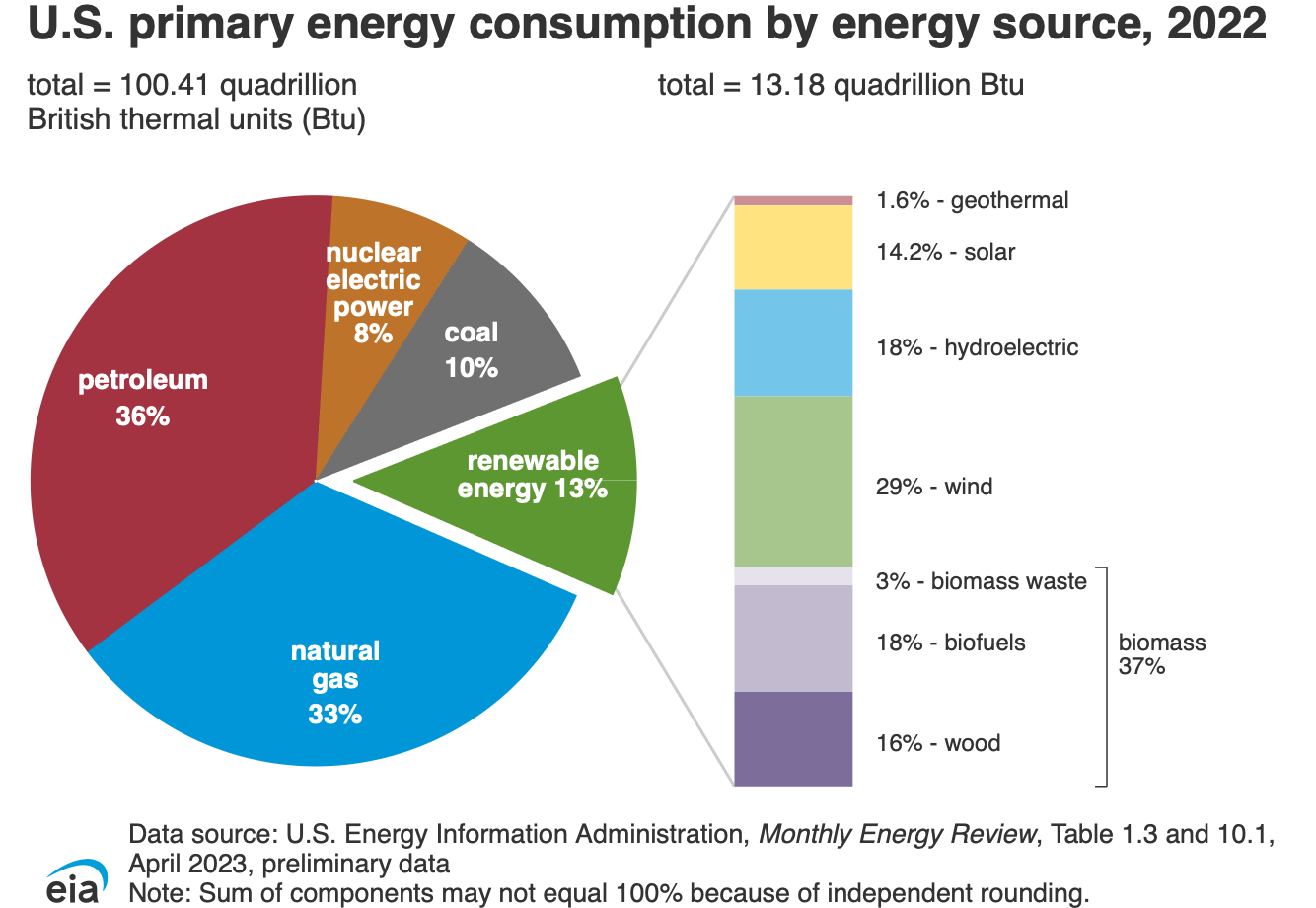
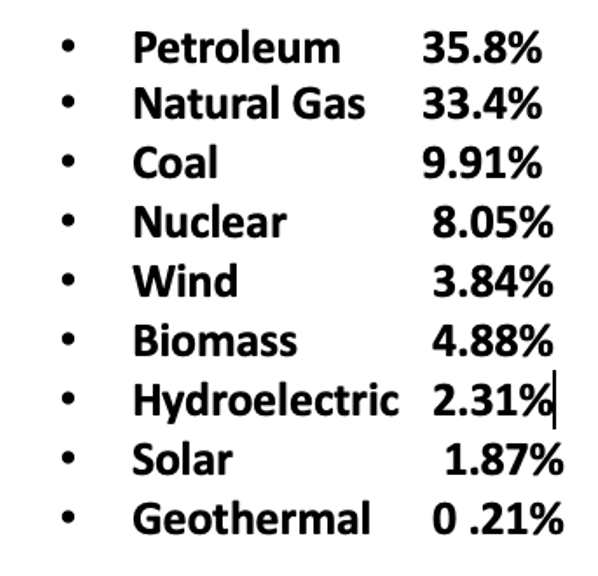
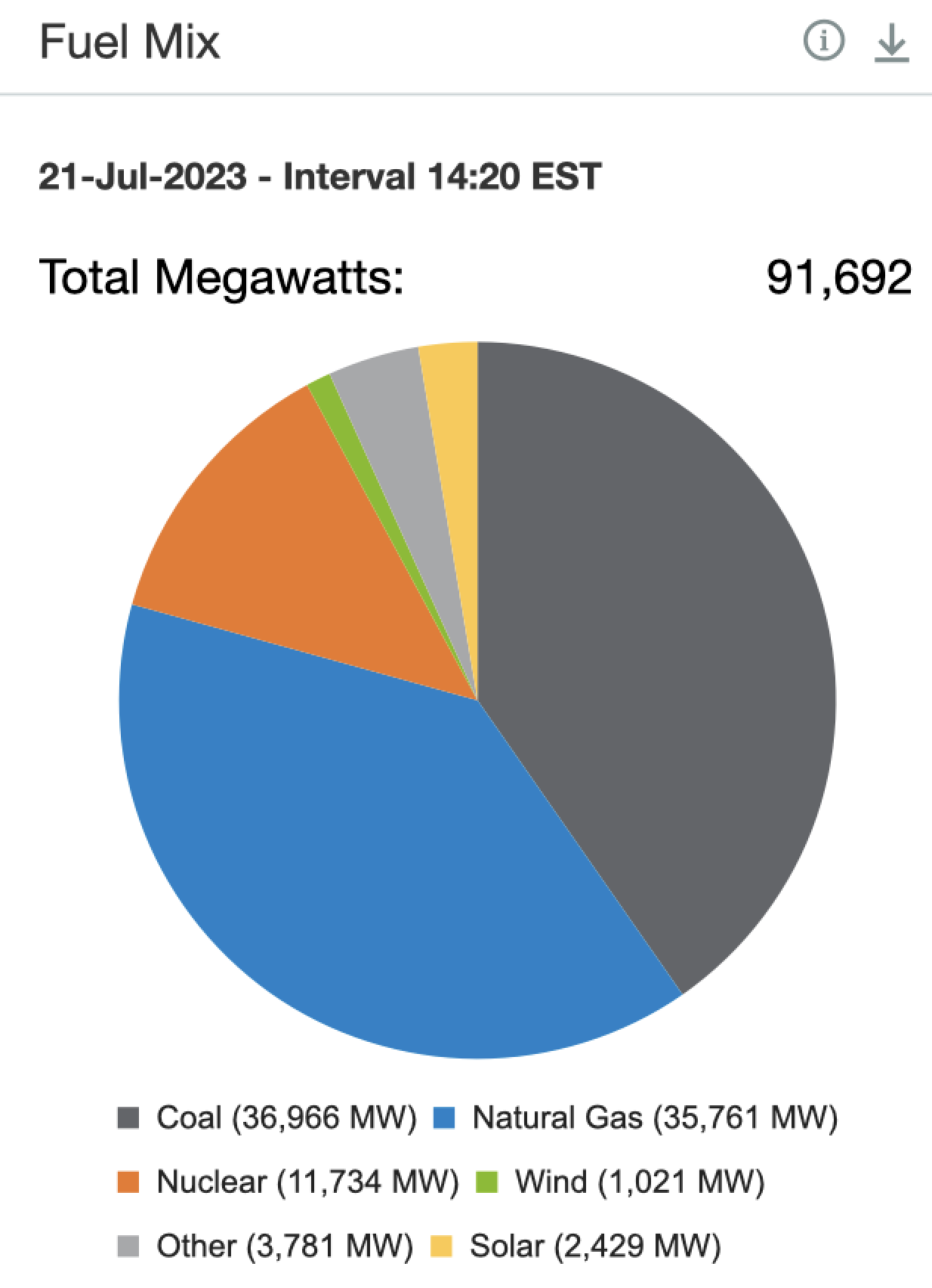
The total Primary Energy used by the U.S. from coal fuel in 2022 was about 10% of the total. (9.91% from data above). That doesn’t seem like much does it? Remember, this is primary energy I am talking about. So, although coal only provided about 10% of our total primary energy it was in fact, Dispatchable, affordable and it provided electricity generation when solar and wind were not available. The chart below is of MISO generation by fuel this past summer. This example shows 40% of total power generation in MISO from coal at this moment in time.
The topic of this article is “The Importance of Fuel Diversity”. The example above of summer Bulk Power Generation depending on coal fueled power generation units is just one of many reasons America should keep our Fuel Diversity. Another example of the importance of coal plants and the consequences of shutting them down is discussed in my blog post discussing the February 2021 Texas Blackout that killed over 200 people. Here.
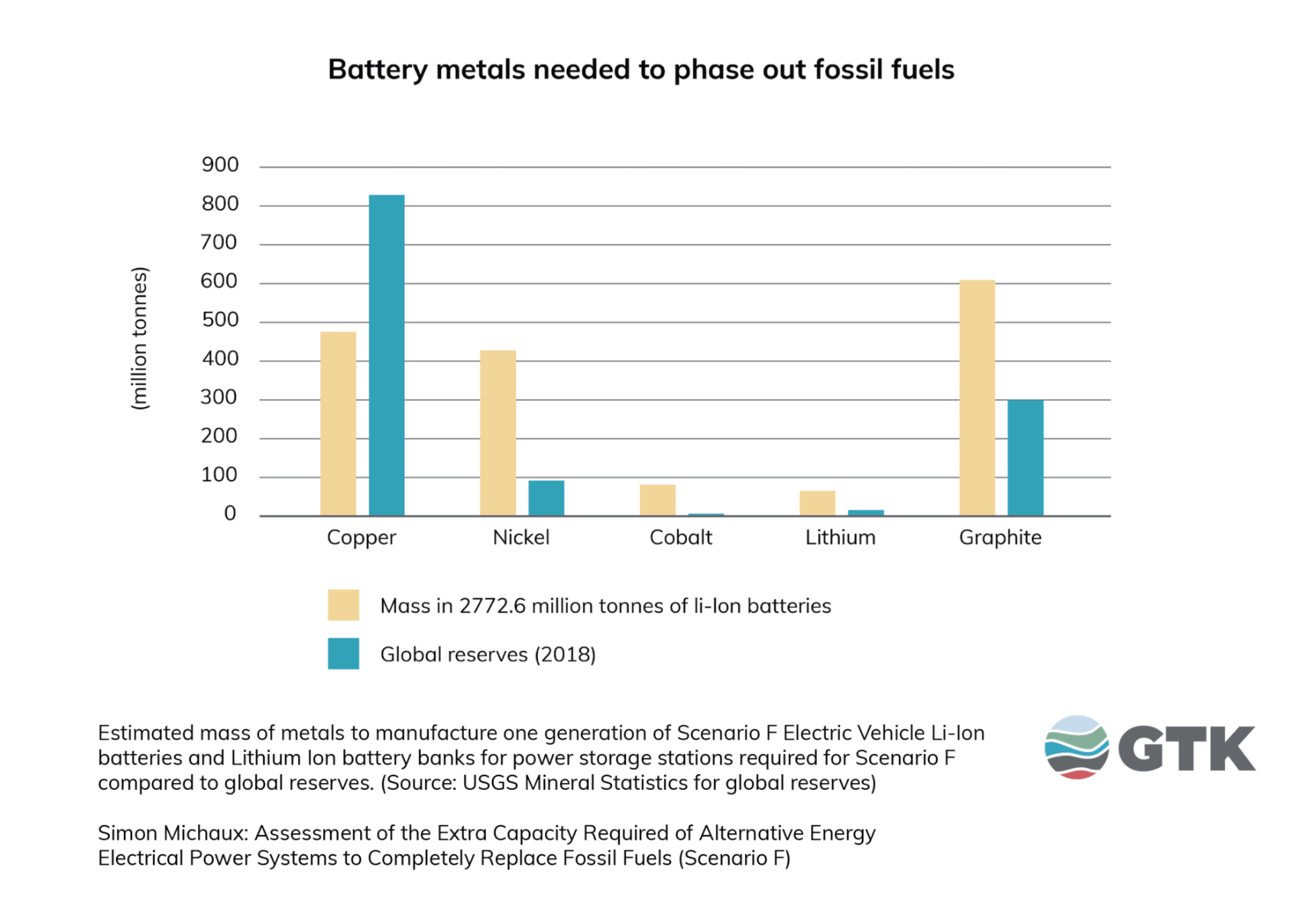
My previous post on De-Mystifying Energy attempted to explain this, here. The difference between Primary and Secondary Energy is important. If everything is Electrified as many suggest we should do, has anyone really thought through where the primary energy to do so is to be sourced? In my opinion, it has not. Wind and solar cannot replace the primary energy currently required. The four charts shown up to here should make that clear.
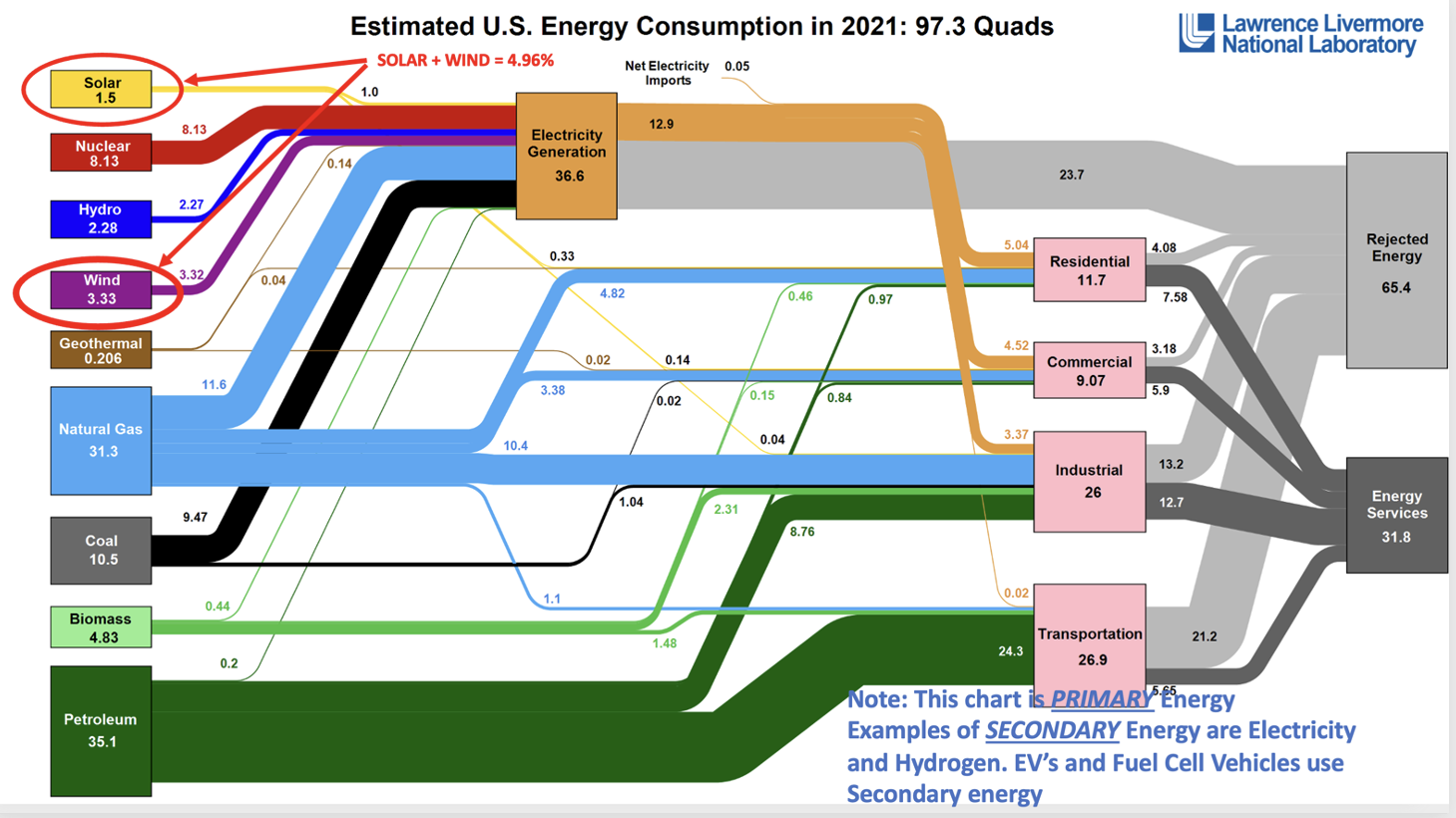
Government policy and many people in the general public believe that renewables can replace fossil fuels and nuclear. The harsh reality is that after decades of government subsidies & tax credits wind and solar provide less than 6% of our total PRIMARY energy. Here below is the LLNL Energy Flow Diagram from 2021 with the 4.96% wind and solar contribution circled.
Public demonization of all conventional fuels including nuclear, coal, gas, gasoline, Diesel are unAmerican and foolish. Wind and solar only provide single digits of the total Primary energy needed to power our lives and it will be impossible to ramp wind & solar renewables up to 100% of our energy needs. The charts above are from the government statistics as published on the Lawrence Livermore National Laboratory Sankey Diagram website, an excellent resource.
Back to Fuel Diversity
Each American citizen, on average is accustomed to using about 315 million Btus of energy per year. I have written separate articles on American energy use here and here. My first point is that we all need on average of about 863,000 to 1 million Btus each day in Total Primary Energy. This number is provided by dividing 330 million citizens into 100 Quadrillion Btus and then dividing that by 365 days/year = 863,000 BTUs per day/citizen of PRIMARY Energy. This is for all uses which (see LLNL chart above) including: Electricity generation, Transportation, Industrial Production, Commercial and Residential uses. The second important point is that providing this energy each day may be from various forms of energy. Depending on which is more efficient or more economical. Let’s take an example of electric generation on July 21, 2023 in the Midwest at about 2:00 PM in the afternoon (example above). It was more economical to use coal fuel for 40% of the electricity generation at that hour. It may have been, I do not know for sure, that only coal generation could deliver the electricity Demand at that moment. The fact is, coal delivered 40% of the electricity at that moment.
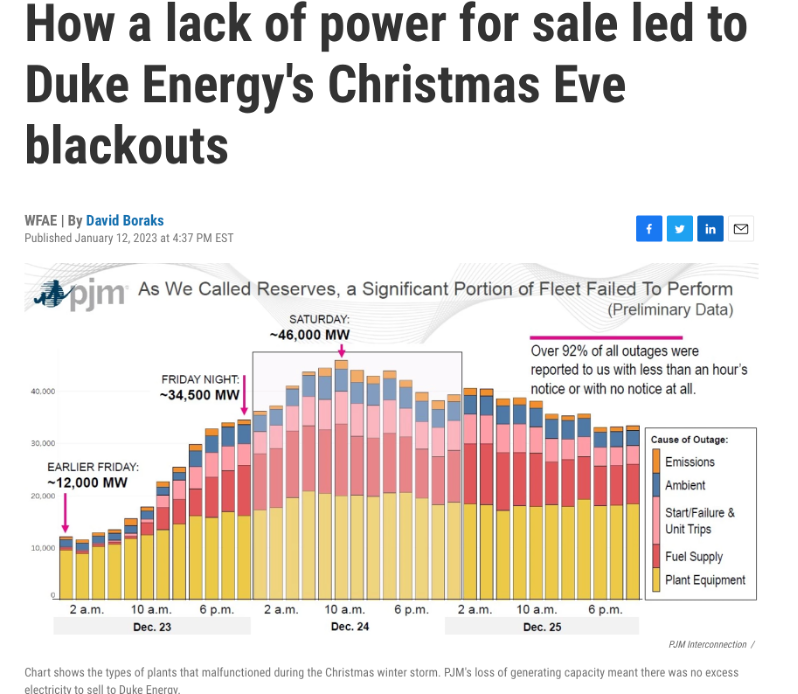
Let’s take another example from last winter. This example below is from Christmas week, 2022.
Fuel Diversity with more coal plants ready to operate and properly maintained could have avoided the Blackouts of Christmas week, 2022. Duke Energy has shut down many coal plants as part of their Net-Zero Carbon plan. So have many other Utilities, both Public and Investor Owned. I presented my views on this at the ENERUM (Columbus Ohio Energy Forum) in August 2022. My presentation is Here. Also, my recent article on the self sabotaging of our energy and electricity generation Grid is here.
Even well respected utilities that were once known for their outstanding leadership and engineering excellence are planning to shut more of their coal plants down in the near future. This works against Fuel Diversity! Here below is a screen print excerpt of the Duke Energy IRP for 2023:
These planned shut downs are in spite of the winter 2022 rolling Blackouts described above. Why? Because the N.C. politicians and top Duke management have agreed to follow a disastrous Net-Zero Carbon path. So has the S.C. Legislature and Santee-Cooper. I wrote about Santee-Cooper in an earlier article, here.
Energy Storage
My first instructor on electricity generation was in class in 1959. The instructor, Harry Park stated, “Electricity needs to be generated the instant that it is needed”. That stuck with me my entire career. Today intermittent renewables are the rage and of course, as Mr. Park stated in 1959, electricity needs to be generated or provided from storage the instant it is needed. That is what built America’s Grid and America’s strong economy. Reliable, affordable electricity available the instant it is needed or in today’s word, Demanded. The published articles I see regarding the justification of higher and higher percentages of wind and solar generation are dependent on electricity storage. The best and largest Bulk Power Storage systems today are “Pumped Storage Hydro”. Such as Duke Energy’s Bad Creek or TVA’s Raccoon Mountain. These work well where the local topography allows it. Bad Creek has about 1,200 ft of elevation change between the upper and lower reservoirs(21). Bad Creek is currently, according to N.C. Business Journal, being uprated to about 2,800 MW. TVA’s Raccoon Mountain provides 1,650 MW of storage. Two other alternatives for storage are batteries and hydrogen. The largest battery electric storage system (BESS) that I am aware is in California. This is at Moss Landing Plant in California. It is being uprated to 3,000 MWH. The “H” after MW means Hour. That means the electricity stored is good at the rated capacity for one hour. Enough time to start gas turbines or buy power from a neighboring utility on the grid. Hydrogen can be a source of storage too. However, it must be remembered that it takes about four times the input of electricity to produce one unit of Bulk Power from hydrogen. An excellent reference on this was published in Gas Turbine World Magazine in August 2022, Here. (22)
The most reliable, proven, safe and affordable form of Energy Storage: A large pile of coal onsite at a clean, efficient coal power plant. When I started in the power generation business in the 1960’s one of my experiences was in conducting a boiler efficiency test at a large power plant in Illinois. As I recall the explanation for the huge coal pile was, “Because of the possibility of Union walkouts at either the coal mines or the railroad, a 90 day supply of coal was required to be stored on site”. Proven, safe and affordable. The photo below is real long term energy storage. A coal pile can store enough energy for a 2,000 MW power plant to run full power for months, not hours as is currently planned for batteries.
These five categories of energy use are shown on the LLNL charts above. Americans with our current population of about 330 million, will need at least 100 Quads per year for the foreseeable future. If we are to sustain our quality of life and freedom to travel, we will continue to need about 100 Quads per year. This article is focussed on electricity generation and the 37% of America’s PRIMARY Energy used to generate Bulk Power. The second part of this article will cover the other 63% of our PRIMARY ENERGY.
Conclusion
It will be impossible to replace fossil fuels with wind and solar any time soon. Attempting to do so will create hardships, economic decline and a general weakness of our country including weakness of our National Security.
The best and most proven energy storage system that I have known through my entire career in power generation is a large coal pile. It was common for coal power plants to have 30 or 60 day supplies of coal storage on the plant site.
On a positive note, I wrote about the preceding 80 years the “Era of Affordable, Reliable Energy and Electricity Generation, Part 1” Here. America really did great things in making energy and electricity reliable and affordable for over 80 years. Coal plants became more efficient and clean, nuclear power came of age and America became energy independent and the largest producer of natural gas in the world. I chose 80 years because that covers my lifetime and I know the history of accomplishments during these times, because I worked in the power generation business for over 50 of those years. Experiences in design, maintenance, operations, tuning, upgrading, capacity improvements, Betterments, Heat-Rate Improvements, fuel flexibility, fouling and slagging reductions and emissions reductions of fossil power systems. I admit, I am not a policy wonk, I am a nuts and bolts power engineer. But, I have been gifted with many years of experiences and have traveled much of the world to witness the relationship of energy and economic prosperity.
The loss of legacy coal plants is threatening Bulk Power Supply Reliability by the loss of over 100,000 MW’s of reliable coal power generation capacity without replacing it in kind is wrong. I wrote on the “End of the Era of Reliable, Affordable Energy and Electricity” a couple weeks ago. It is here. The references included are from NERC, FERC and other reliable people and sources of information. I encourage the reader to check these references to decide for yourself.
Nuclear power generation is the only known technology to produce carbon dioxide free electric power. However, building a new nuclear power generation supply chain will take decades. David Archibald wrote an excellent article on “The Energy Future We Need to Have a Future Worth Having”, here. I also support nuclear for the long term, but the next 30 years are important to work through and hopefully, sustain our high quality of life until future technologies and the needed supply-chains are sufficiently developed for safe and reliable implementation. My previous blog post covered an overview of the needed new thinking (and policies) on nuclear power for carbon dioxide emissions reduction to succeed. here. (27)
This is my Perspective of Proven, Reliable, Affordable & Abundant Energy & Electricity Generation during my lifetime. Here are some of the significant technical advances, changes, regulations, incidents, events and policies that have shaped energy and power generation over the last eight decades. Some personal experiences are interjected during this era just to show where I am coming from in my perspective. Part 2 will cover my thoughts on the impossible transition to renewables.
A Brief History of the Improved Quality of Life Since WWII
Dr. Euan Mearns wrote in WUWT this short summary of the history of energy and the “Energy Transition as Social Vandalism”(19). An excerpt from the concise and well written essay:
“The mid 19th century also saw the development of early internal combustion engines, although at that time there was insufficient fuel for a motor industry. The Spindletop gusher and subsequent discoveries changed all that. The world was now awash with oil without any real market. Then in 1908, Henry Ford rolled out his Model T to begin the age of the car and mass transit. The Wright brothers’ first powered flight in 1908 led quickly to commercial air travel and eventually to the jet age.
Unparalleled development came with the 20th century and the introduction of nuclear power plants whose uranium fuel contains more than 16,000 times the energy content of coal, oil and natural gas. At the same time, hydroelectric power rapidly expanded and natural gas (the most energy dense of the fossil fuels by mass) became more available for electricity generation and home heating and cooking.
The introduction of gas-fired central heating enhanced the well-being of populations. Whole homes would be heated by hot-water radiators, and no longer would families have to huddle round a dirty coal fire. By 2000, life expectancy in world population had risen to 66 years, 78 years in the now developed countries.”
Looking back, I am awed by the progress that was made for the Betterment of the quality of life for Humankind. I am proud of my small contributions along the way.
Some of the Significant Energy & Electricity Mileposts: 1940-2023
Pulverized coal firing for steam generation becomes the predominant method of power generation
Mechanical dust collectors are used for collection of particulates
1941 B&W invents and develops Cyclone Burners to fire low fusion midwestern coal with more than 70% of the ash collected as a molten smelt
1943 Combustion-Engineering invents and develops Tilting Tangential Firing
Electrostatic precipitators are applied to large coal plants
1949 First G-E Gas Turbine for electric power generation in the U.S. installed at Oklahoma Gas & Electric Belle Isle Plant
1951 U.S. Navy Admiral Rickover obtains funding from Congress to build the first nuclear powered submarine, Nautilus
1953 President Eisenhower’s “Atoms for Peace” initiative
Supercritical pressure steam generators become common place
1955 USS Nautilus puts to sea
1955 First “Atoms for Peace Conference” in Geneva
Steam temperatures and power generation from Rankine cycle steam plant efficiency approaches 40% design efficiency
1957 Shippingport Nuclear Steam System, the first U.S. Commercial Reactor is proven
1957-59 Philo and Eddystone Ultrasupercritical Units are placed in service
1970 – President Nixon signs law to form EPA
Coal pulverizer state of the art advances to single pulverizers with over 100,000 pounds per hour capacity
1973 First Oil Embargo
1977 U.S. Department of Energy is formed with the intention to lead America to energy independence
The Strategic Petroleum Reserve is begun
1978 EPA Clean Air Act
1978 President Jimmy Carter signs Energy Policy Act
1979 Three Mile Island Incident
1980 Energy Security Act
1988 G-E Single Cycle Aeroderivative Gas Turbine achieves 41.9% efficiency
1990 EPA-Clean Air Act Amendment
1991-First Horizontal Drilling by Enid Company in OK
Low NOx Burners or other NOx reduction systems are installed on most coal plants across the U.S.
Flue gas desulfurization becomes standard for coal plants
Selective Catalytic Reactors are used to reduce NOx
2010 Hydraulic Fracturing combined with Directional Drilling by Harold Hamm’s company greatly increases shale gas production in ND
2012 The Shale Gas Revolution produces natural gas at lower cost/million Btu than coal
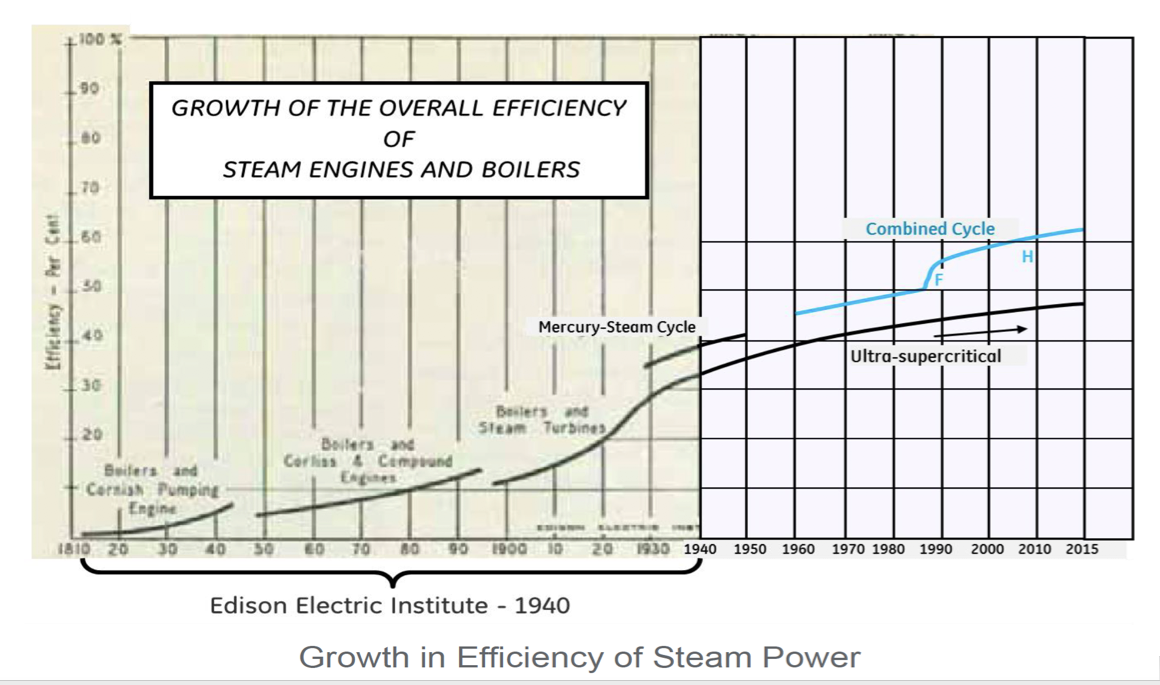
2014 CCGT (Combined Cycle Gas Turbine) units achieve over 60% efficiency
2020 Natural gas electricity generation provides over 38% of U.S. electricity production
2022 U.S. Congress passes IRA Law and Biden signs, it codifies green energy
Reasonable Cost Energy & Electricity Improves Quality of Life
This is a personal story of electricity generation. Here is my take on how “Living Better Electrically” came to be, during my lifetime. Here is a typical TV ad from circa 1962, the year I entered the workforce.
Electricity Generation 1962-2012 Living Better Electrically
This 50 year period was my personal career, most of which I spent working in the electric power generation business. Including equipment design, manufacturing, startup, testing, operations, maintenance, emissions reduction and upgrading of coal power production equipment. My specialty was large electric utility fuel burning and steam generating equipment. Upon graduation from Williamson in 1962 I was employed as an electrician then as a utility engineer at Mobil Oil Corporation. In 1966 I joined Babcock & Wilcox working in Barberton, Ohio as a Technical Assistant to the Project Engineer in the Nuclear and Special Projects Department. Projects that I worked on as part of the B&W team were the Duke Oconee Nuclear Steam Systems, numerous reactors, steam generators and pressurizers for Navy Nuclear Propulsion Systems and large heavy walled, high pressure, pressure vessels for the Petrochemical industry.
Duke, Oconee #1 Reactor Vessel at B&W Shop in Mt. Vernon, Indiana, from Duke Annual Report 1967
In the 1960’s electricity was very reasonable in cost and nuclear power was proclaimed by the AEC Head (Atomic Energy Commission) Lewis Strauss as soon to be “Too Cheap to Meter”. Commercial nuclear power generation had been proven at Shippingport and was growing exponentially in applications all across the country. The two most memorable engineering leaders that I remember visiting B&W’s Barberton facilities (while I worked there) were Admiral Rickover, the Father of the nuclear Navy and commercial nuclear power generation and Bill Lee, who at the time, was Duke Power Company’s VP of engineering. Mr. Lee was said to have favored the B&W Nuclear Steam System because it was slightly more efficient with the Once through Steam Generator providing a small amount of superheat that competing NSS (Nuclear Steam Systems) did not provide, to the steam supply to the turbine. Duke Power at the time, had commissioned some of the most efficient coal plants in the world and planned to extract the highest possible efficiency from their first nuclear powered steam supply system. This was logical to Mr. Lee and one reason he was attracted to the new B&W OTSG (Once Through Steam Generator) which was designed for a few degrees of superheated steam temperature. My previous blog post discussed the B&W, C-E and Westinghouse nuclear power manufacturing facilities here.
The Most Efficient and Largest Supercritical Coal Power Plants Built 1957-1975
The 1960’s were exciting times for coal fueled power plants too. Two Milestone supercritical power plants were built and started up during this time. The 5,000 psi Eddystone Steam Station (Philadelphia Electric) with a steam generator built by Combustion Engineering and the 4,700 psi Philo Plant (AEP) steam generator was built by Babcock & Wilcox.
Soon after these magnificent accomplishments was the 900 MW Combustion Engineering series of supercritical steam generators at Conemaugh & Keystone plants in western PA. Then the 1,300 MW supercritical steam generators built by B&W for AEP and TVA. Certainly impressive to me at the time with furnaces over 100 foot wide and operation at over 3,500 psi with superheated main steam at 1,000 degrees F. and also Reheated steam supply to 1,000 degrees F.
Duke Power designed, installed, operated and maintained the most efficient coal plants in the world with the additions of Marshall Units 3 & 4 on Lake Norman in 1969 and 1970.
Later, the Belews Creek coal plant was installed and between Marshall and Belews Creek competed for the highest efficiency coal plants in the U.S. Belews Creek Steam Station is a 2.24-GW, two-unit coal-fired generating facility located on Belews Lake in Stokes County, North Carolina. It is or was Duke Energy’s largest coal-burning power plant in the Carolinas and when it was operated on coal it ranked among the most efficient coal facilities in the United States. During 2006, it was the fifth most efficient coal power plant in the United States with a heat rate of 9,023 Btu/kWh (37.8% conversion efficiency). In 2008, it was the #1 most efficient coal power plant in the United States with a heat rate of 9,204 British thermal units per kilowatt-hour (2.697 kWh/kWh) or 37.1% conversion efficiency.
A Few of My Personal Experiences with Coal Plants in the 1970’s
My first foray into S.C. was as one of three startup engineers for the SCE&G Wateree coal plant in Eastover, SC. This is a coal fueled, two unit supercritical steam supply plant which uses two Riley Stoker supercritical steam generators. These are the only two supercritical steam generators built by Riley. They have been very successful and in fact, at this writing are still in service 53 years after the startup of Unit #1. After that in 1972 I was assigned as lead startup engineer at the 420 MW Sutton Unit #3 near Wilmington ,NC. This plant is shown below during steam line blowing in June 1972. Steam line blowing was one of my favorite activities in the startup of a new plant. The roar of the exiting steam at supersonic velocity was memorable and provided a sense of the enormous power of steam. Steam line blowing is a one time startup operation to remove grit and foreign debris from inside the superheater and reheater tubes and piping, so that when operation begins, solid particles of debris will not damage the steam turbine blades.
Following the startup of Sutton #3, in January 1973 I joined Carolina Power and Light Company as a senior engineer. My first assignment was as the lead startup engineer on Roxboro Unit #3. This is a 720 MW coal Unit with a unique design of two half capacity boilers and one common feedwater supply train with a blended single stream steam supply to one G-E 720 MW turbine rated at 2,400 psi 1,000 degree F. Superheat and 1,000 degree F. Reheated steam to the last 13 stages of the turbine. The Roxboro plant is shown below in a recent photo by Duke Energy. This plant was started up as CP&L and was later absorbed to be part of Duke Energy.
Reasonable Cost, Abundant, Reliable and Dispatchable Coal and Nuclear Provide the lowest Cost Electricity in the World
The Roxboro plant is still in operation and it is rated at 2462 MW generation capacity. Let me digress with a short anecdote. Back in the time frame of about 1975 I was involved in an ASME meeting in Niagara Falls, NY. As part of the group, we were given a tour of the Niagara Falls Hydro plant on the U.S. side of the river downstream of the falls. I was struck at the time with the realization that all of the water feeding several of the Great Lakes provides (on the U.S. side) about the same generation capacity as the Roxboro Thermal Plant did. A real world lesson in “Energy Density”. Roxboro’s four units are rated 2,462 MW, the Robert Moses Hydroelectric plant 2,300 MW. This comparison is one I find helpful when non-energy trained people ask why are coal plants necessary? It helps to explain the enormous energy density of a coal fueled power plant.
Niagara Falls, Robert Moses Hydroelectric Plant, about five miles downstream of Niagara Falls, From NY Power Authority website
Fuel Diversity Helps Keep Costs Down, All Fuels Are Important
I joined Riley Stoker in 1969 and worked at Tampa Electric on the final acceptance work of the Gannon Station Units 5 & 6. Then on to the SCE&G Waterree plant for the startup of Riley’s first and only supercritical steam generator. Wateree is still running today and it was very successful. After startup of Wateree #1, I was sent to the City of Lakeland, Florida to finish the startup of the 80 MW oil and gas fueled Power Plant #3 (now named McIntosh) The unique and difficult design of this unit was that it was a stand alone, single unit with no steam connections to another unit. It was fueled by heavy oil, #6 or also known as Bunker C. The oil required heating to about 220 degrees F. to reduce the viscosity for satisfactory atomization and complete burning in the furnace. Because there was no gas or steam connections, the startup entailed firing on Diesel fuel until the boiler had at least 1000 psi drum pressure. Then the stored energy of the boiler would be used to heat and circulate oil from the Heavy oil supply tank. It sounds simple enough, however when the new controls and safety interlocks were all in startup mode, unproven and with numerous glitches, steam pressure would be lost and the operation on diesel fuel would need to be repeated. Any field engineer with experience in oil firing Utility boilers knows the importance of steam or compressed air cleaning of the Ljungstrom regenerative air heaters to prevent fires. That is the reason I was sent to Lakeland. The previous startup engineer was not careful about airheater cleaning and both airheaters were destroyed by fires. I was sent to replace that unfortunate startup engineer.
Oil firing was common in the 1970’s because it was competitive with coal at $0.50/million Btu. After Lakeland I was sent to lead the startup of Jacksonville Electric Authority’s Northside #2. A 325 MW heavy oil fueled boiler. Then off to CP&L Sutton #3, a 420 MW fueled at startup with heavy oil and with provisions for future coal fuel. America’s power demand was rapidly growing, especially in the south where air conditioning and heat pumps were taking off in popularity. As I recall peak load growth was about 10% per year. To illustrate the rapid growth in electric demand, here is my recollection of the units added at CP&L over a five year period:
Robinson #2, 700 MW, 1970 (Nuclear)
Asheville Unit #2, 200 MW, 1971 (coal)
Sutton Unit #3, 420 MW , 1972 (coal/oil)
Roxboro Unit #3, 720MW, 1973 (coal)
Brunswick Unit #1, 836 MW, 1975 (nuclear)
During this time period (1970-1977) CP&L was a regional Utility separate from Duke Energy. The total installed capacity of CP&L back during this time was about 6,000 MW. Therefore, the rapid system load growth is illustrated by the addition of five generating units totaling 2,876 MW in generation capacity in just five years. It was a great time to be involved in the power industry… And then came the Oil Embargo and some difficult times for the industry.
City of Lakeland, Power Plant #3, Now there are three Units, including a 360 MW coal unit #3. Picture by Dick Storm about 1971
During 1973 the U.S. government supported Israel in the Yom Kippur War between Israel and the Arab nations.
At the time of the first oil embargo, 1973-1974, the EPA had been creating needed air pollution rules to reduce emissions from coal fueled power plants. Amongst the first pollutants to be addressed, was particulates. Before the Oil Embargo coal cost and oil cost per million Btus was about the same, right at $0.50 per million Btu. Therefore to reduce emissions fast, Utilities had an economic choice of converting coal plants to oil fuel which has nearly zero ash content or install millions of dollars of backend equipment, including electrostatic precipitators. Carolina Power and Light Company took the path of installing electrostatic precipitators on the newest units (Asheville #2, Sutton #3 and Roxboro #3) and converting the older, smaller coal units to being fueled by oil. Many utilities to the north, including VEPCO, PEPCO, Philadelphia Electric and others, chose the fuel oil conversion route to reduce particulates with less capital cost than installing electrostatic precipitators. This could be done with much lower costs to the consumer because the coal and heavy oil costs were about the same on the fuel cost/million BTU. About $0.50/mmb. Fuel cost is the largest single component of electricity production cost. Comprising between 75 and 92% of the production cost. Thus, when fuel costs escalate, so does the electricity production cost increase.
The Oil Embargo made an immediate fuel supply shortage for all petroleum products and including residual #6 heavy fuel oil. This is when, in my recollections, that major “Wheeling of Power” across state lines became common. The Utilities in the states to the north of CP&L were; VEPCO, PEPCO, Delmarva and Philadelphia Electric. They could receive coal generated electricity from Duke Power, CP&L and other southern Utilities across state lines using existing Transmission interconnections by wheeling power. This was before RTO’s (Regional Transmission Operators) were created.
The 1973-1980 time frame was difficult for Utilities and some had to cut once reliable dividends to stockholders and some went Bankrupt (Consolidated Edison in NY had a particularly difficult time) due to the volatile fuel costs.
National Energy Act of 1978
The energy shock of the oil embargo prompted Congress and the President to act on energy policy. Also during this time the Alaska Pipeline was approved and built(15). Jimmy Carter signed the first Energy Act in 1978.
America’s electricity supply has remained reliable and of reasonable cost for all of my lifetime. Below is a chart of world electricity prices in 2009 which shows the comparison of U.S. electricity prices to other industrialized countries of the world.
Shown on the chart of electricity costs above is Denmark and the Netherlands which were two of the first countries to implement wind farms for significant portions of their power generation.
America up to about 2012 used coal fuel for over 50% of our electricity production. Reasonable cost, reliable, abundant and dispatchable coal, generation powered the largest economy in the world. Reasonable cost electricity and GDP tend to parallel each other as shown on the graph below.
Coal Plant Efficiency Rankings
Up until the war on coal, coal plant designers, operators and maintenance personnel took pride in striving for the best overall efficiency. The best yearly coal plant efficiencies were typically from well run supercritical steam pressure units. Duke Power, PEPCO and AEP typically held the top positions. Duke Power’s Marshall and Belews Creek had repeatedly good years. Here is a typical ranking from 2013, Power Engineering Magazine:
I personally remember many meetings with Utility engineering management where the topic of discussion was modifications to the boilers and fuel burning equipment so that fuel changes could be made to reduce the production costs of power and at the same time, reduce emissions. One fuel change that was popular in the 1990’s was to convert coal plants designed for eastern Bituminous coal to fire western Powder River Basin fuel. This reduced emissions of NOx and kept production cost of power reasonable.
The Shale Gas Revolution
The combination of Hydraulic fracturing and Directional Drilling created an enormously large boost in U.S. natural gas production beginning about 2012. Natural gas prices at the Henry Hub dropped from a high of over $12.00/million BTU to about $2.00/million BTU in 2012. This abundance of natural gas fuel at this price, was competitive with well run, efficient coal plants. Then, the E.P.A. ramped up restrictions on coal plant emissions but the consumer was insulated from electricity price hikes because many natural gas CCGT (Combined Cycle Gas Turbine) plants were being built and fuel diversity allowed the Utilities to switch generation from coal plants to new, highly efficient CCGT generating units.
The vastly increased supply of natural gas drove the price of gas down to below the cost of coal on a unit heating value basis. Gas dropped to below $2.00 per million Btu. Also during this time period, gas turbine-combined cycle plant efficiencies increased to the range of 60%. Power generation efficiencies over the years is shown on the graph below. The combination of low cost natural gas and enormous efficiency advantage of CCGT plants greatly increased the use of natural gas fuel for power generation. Keep in mind, the advantage of natural gas fuel is only an advantage when there are pipelines to provide the fuel and there is an abundant natural gas supply. This does not work well in all states, such as Massachusetts and Hawaii.
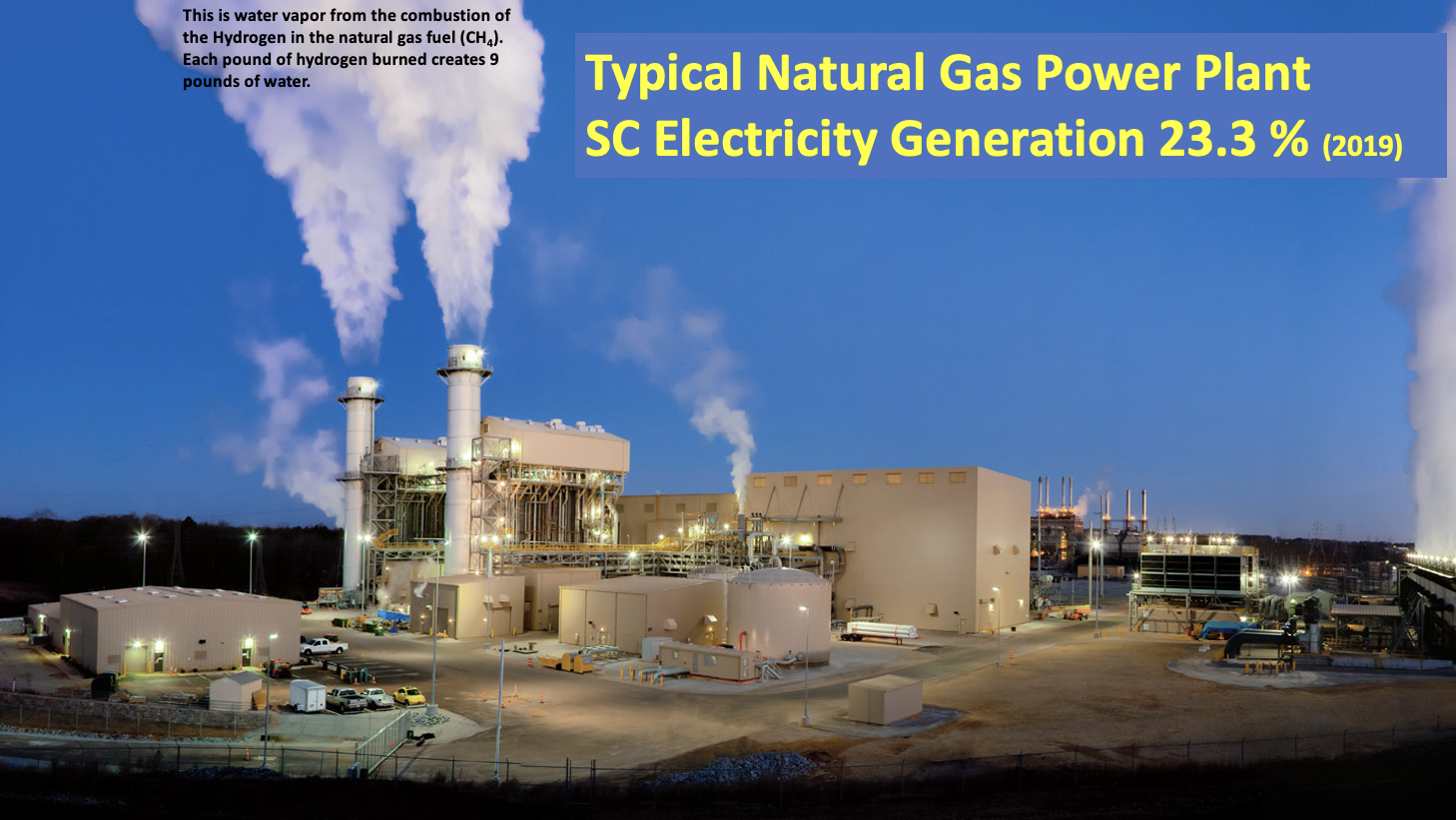
The combinations of low fuel cost, low Capital cost, low environmental emissions controls cost and greatly increased efficiency together made natural gas fuel more economically attractive than coal for new generating plants. The fuel of choice became natural gas for Utilities that had pipelines and sources of natural gas fuel. Coal fuel accounted for 50% of electricity generation in 2004 but was reduced to 23% by the increased use of more economical natural gas by 2019.
Duke Energy, Buck Station CCGT Plant
America is Blessed with Enormous Energy and Mineral Resources
America has plenty of Coal, oil, natural gas and nuclear fuels to power our economy and our life styles. I have written other blog posts on the relationship of energy and economic prosperity. Specifically, our lifestyles and our industrial production requires on average, about 315 +/- 15 million Btus of energy each year per person This equates to about 100 Quadrillion Btus of energy per year for our country. This level of energy requirement has held steady for about twenty five years. More on the need for 100 Quads of energy/year are here,here, here and here (20, 21, 22, 23) . Up until the manufactured climate hoax and war on carbon, America enjoyed reasonable cost, reliable electricity and also gasoline, Diesel and Jet Fuel supplies. America became energy independent in 2020.
Energy Growth and Clean Air Too!
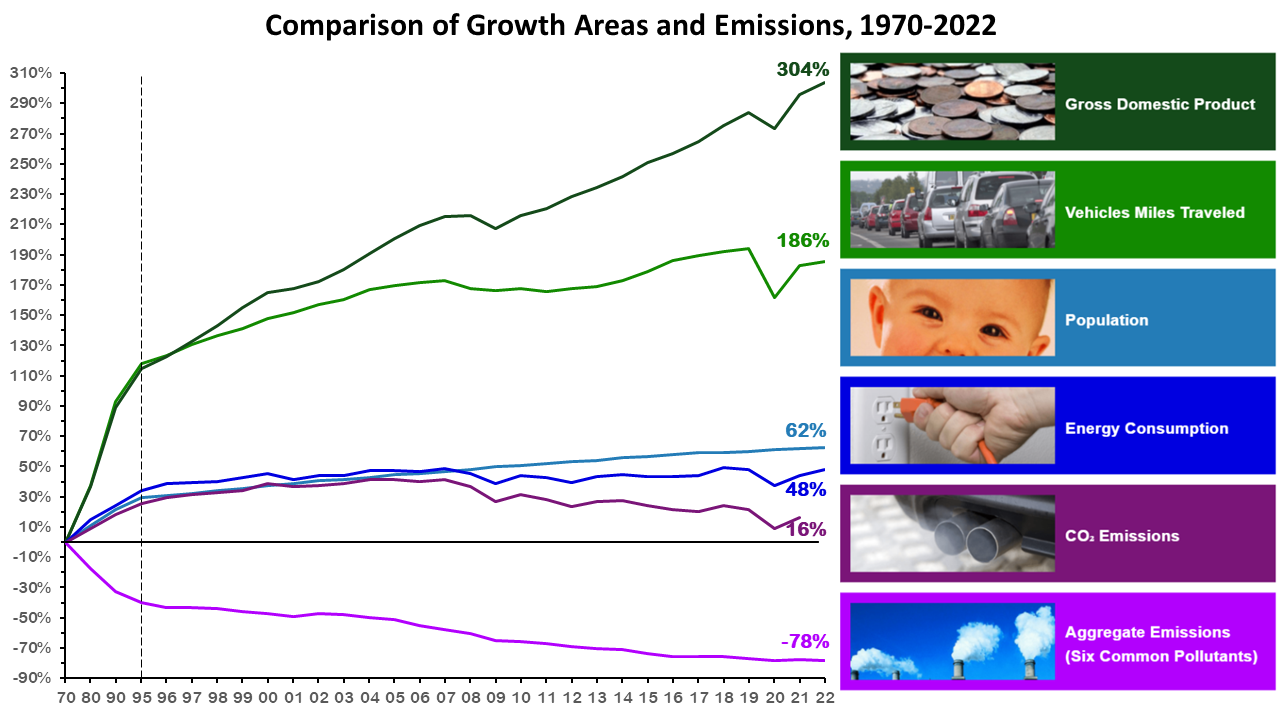
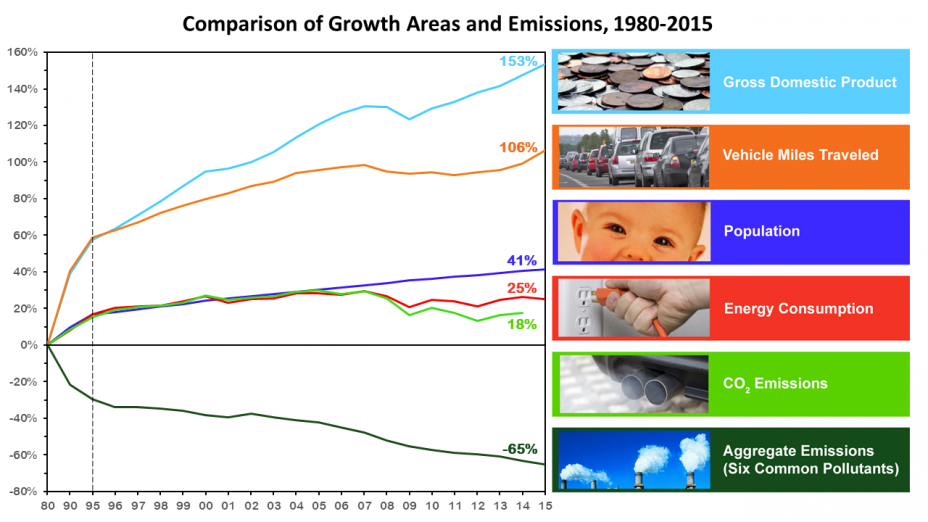
Protection of the environment is important to all of us, including me. In fact, much of my career was invested in improving efficiency and reducing emissions of coal generating plants. There has been steady progress in cleaning the air and water of the U.S. and I would be remiss if I did not show that during the preceding eight decades in spite of population growth, increases in the number of miles driven and the growth of the economy, the real pollutants have been drastically reduced from the levels of the 1950’s, 1960’s and 1970’s. The chart below was prepared by the EPA.
Two of the Last Clean Coal Plants Built in America
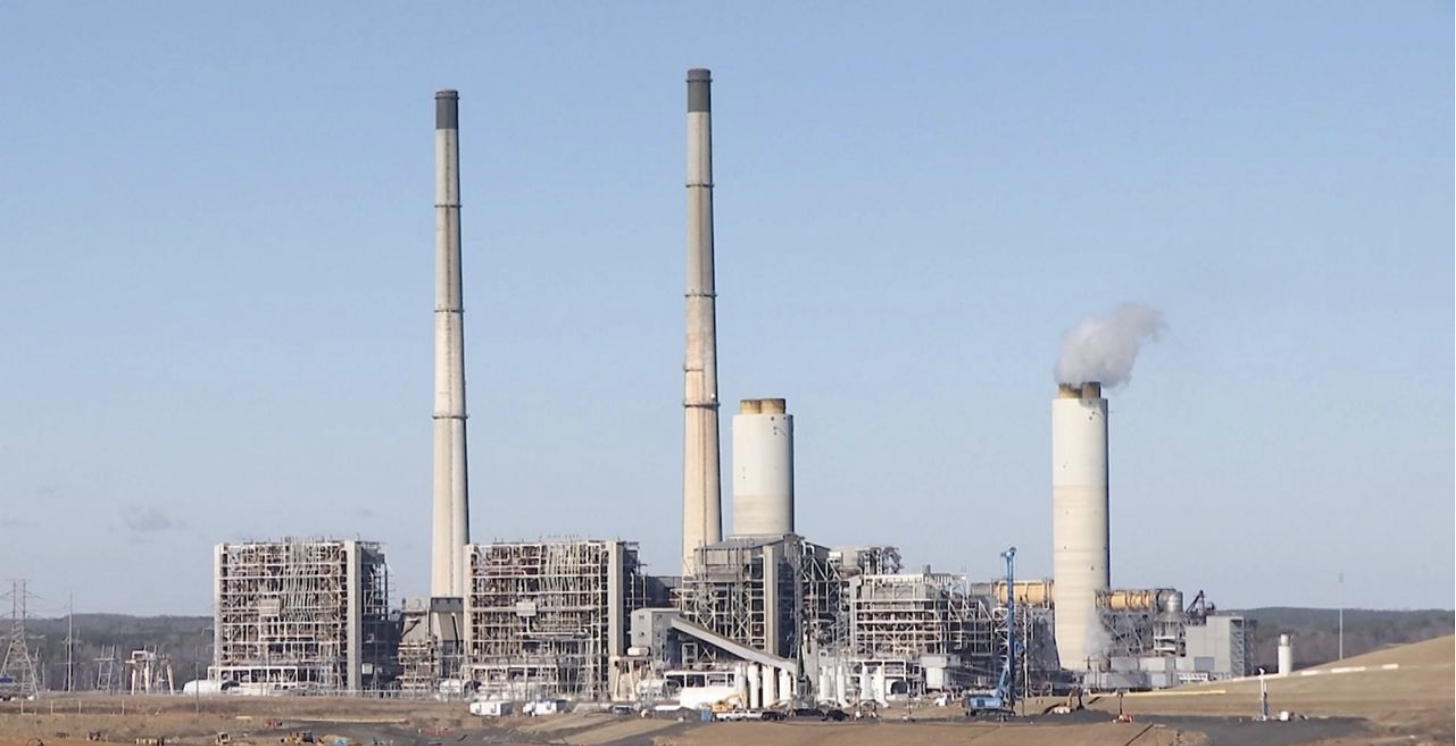
Coal plants are robust, reliable and when properly maintained can run safely and reliably for over fifty years. Several of the plants that I have personal experience with were mentioned above. However, newer designs with greater efficiency and improved emission controls should be built to replace the aging plants. In 2008 there were plans for dozens of new, clean coal plants to be built. Two magnificent examples are the John Turk Plant and the (then called Cliffside) #6 Unit at Rogers Energy Center in S.C.
Duke’s Rogers Energy Center Unit #6 Startup 2013AEP-John Turk Plant, Arkansas
Example of Many New Coal & Nuclear Plants, Planned and Should Have Been Built 2012-2022
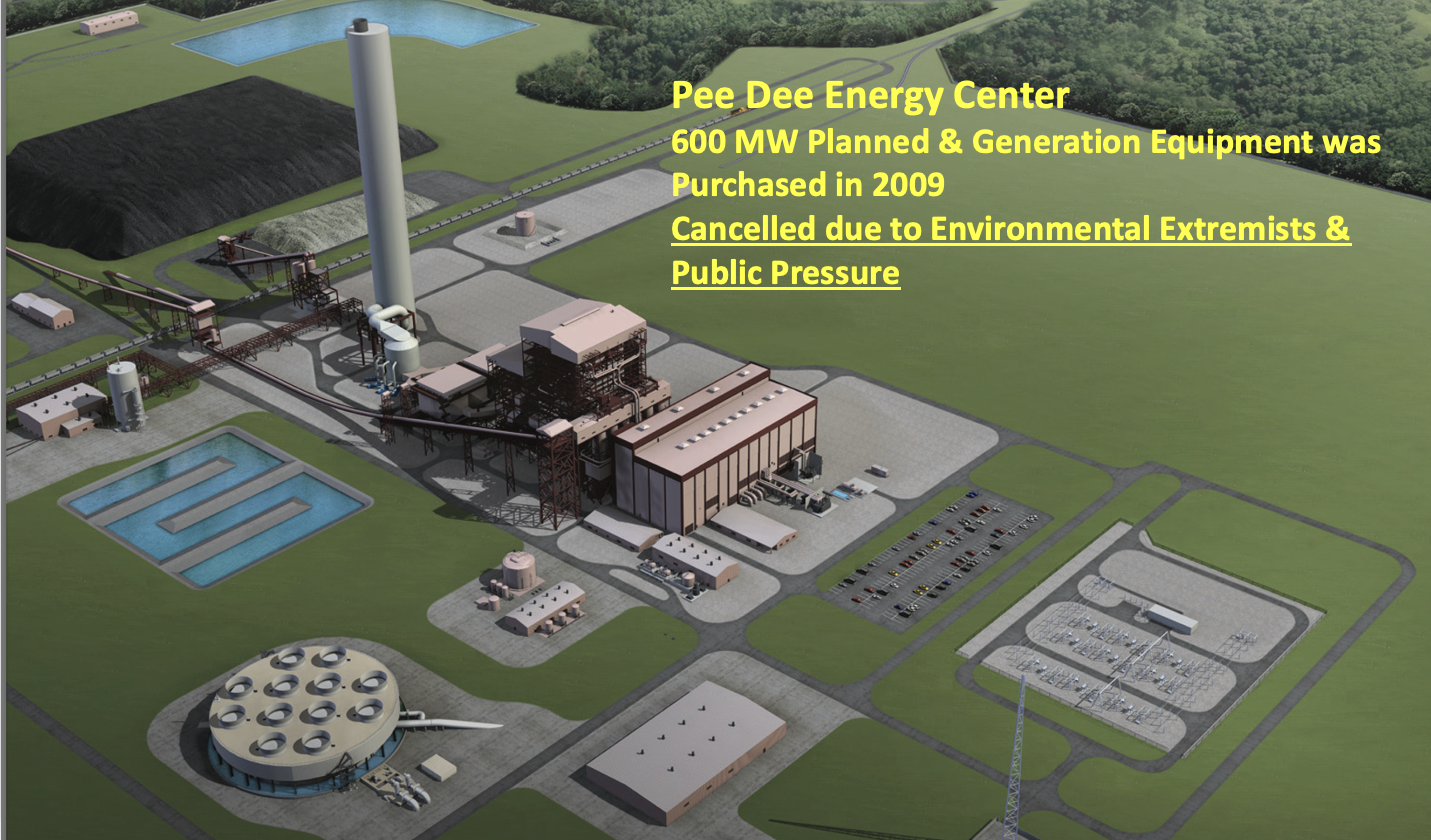
Santee-Cooper Pee Dee Plant, Planned to Be Built near Florence, SC
The Pee Dee Energy Center is one example of dozens of new, clean, efficient coal plants that were planned but cancelled due to political pressure of the environmental activists. I predict that these plants will be sorely missed during the winter peak power generation periods in December 2023 and January 2024. So will the Summer Nuclear Units #2 & 3 be missed.
Slide of Summer 2 & 3 and Vogtle Plant Construction from Dick Storm USCB-OLLI Course
Summary
My contribution to the progress made in the last 80 years was very modest and I will quickly admit that. However, because I worked with many talented and visionary engineers and in hundreds of generating plants around the world, I had a very good position to observe the progress of the giants in our industry. Engineers with a Vision of abundant, clean and reasonable cost electricity generation. To mention a few of these giants: Admiral Hyman Rickover, Bill Lee of Duke Power, Mendall Long of CP&L, Bill McCall of Santee-Cooper and many more fine engineers like them. What were their goals? To improve the quality of life, security, safety, economic growth, ensure that reasonable cost power could be produced for decades into the future, provide Bulk Power at the lowest possible cost to attract industry, increase industrial output, provide good paying jobs in their service territory, and design power plants that provide environmental protection for all of the citizens.
During the last 80 years nuclear power became a reality and today about 19% of our electricity is generated from clean, carbon free nuclear power plants. Many are now over fifty years old, but still reliable and inexpensive producers of vital electricity.
Natural gas generation has progressed from the first simple cycle unit built by G-E in 1949 at about 25% efficiency to today’s combined cycle gas turbine plants that at optimum load points can operate at over 60% thermal efficiency. They are amongst the most efficient machines ever built, of any kind.
Ultra-supercritical, clean coal plants such as Turk and Rogers #6 have been developed to provide reliable, reasonable cost, clean and importantly, Dispatchable power generation. There should have been built more like these Why? Because fuel diversity is important when one fuel becomes short in supply. For example, the 1973-74 Oil Embargo. Today most of the Dispatchable electricity generation is from natural gas which of course, flows through pipelines. Pipelines are reliable but, fuel storage is not practical. Coal plants, on the other hand, can store several months fuel supply on site.
Fuel Diversity is important for electricity generation reliability. I am proud to have worked during these years to do my best to make a small contribution to the great progress that was accomplished.
Part 2 will describe the self induced end of reliability, affordability and dispatch ability of electricity generation. As Dr. Euan Mearns recently wrotein “Watts Up With That”….The “Energy Transition is Social Vandalism”(19)
It is my best hope that America and our politicians will wake up and understand the importance of primary energy from conventional sources.
Yours very truly,
Dick Storm, October 4, 2023
References
You Tube video of a “Living Better Electrically” ad hosted by Ronald Reagan, who was with the G-E Theater on Sunday nights for 8 years 1953-1962: https://www.youtube.com/watch?v=u5Lz1C53RwI
The University of South Carolina provides OLLI programs (Osher Lifelong Learning Institute) which include Geopolitics, Science and many other courses. I am an instructor on energy and electricity. Two other instructors that I respect and have enjoyed their courses are retired senior military officers. General Craig Whelden served in the Pacific and has taught several courses on the “Rise of China”. I took notes from his courses and combined his information with my experiences in the relationship of energy & electricity generation. These thoughts are posted here. Retired Navy Captain, Greg Blackburn has taught several courses on Economics and the “Fate of Nations, Their Rise and Fall and Rise Again”. I took notes on Captain Blackburn’s and General Whelden’s courses and posted my thoughts as of January 2021 here.
As I read a LinkedIn post by CS Krishnedev earlier this week, these three OLLI courses came to mind. (Rise of China, Fate of Nations and Energy & Electricity) Mr. Krishnadev’s post is here. In his post, Krishnadev discusses how China is far ahead of the west in the design, construction and deployment of nuclear power plants.
Photo from Krishnadev, CS Post on LinkedIn, August 13, 2023
Leaders in Heavy Manufacturing of Nuclear Power Plant Reactors and Steam Generators
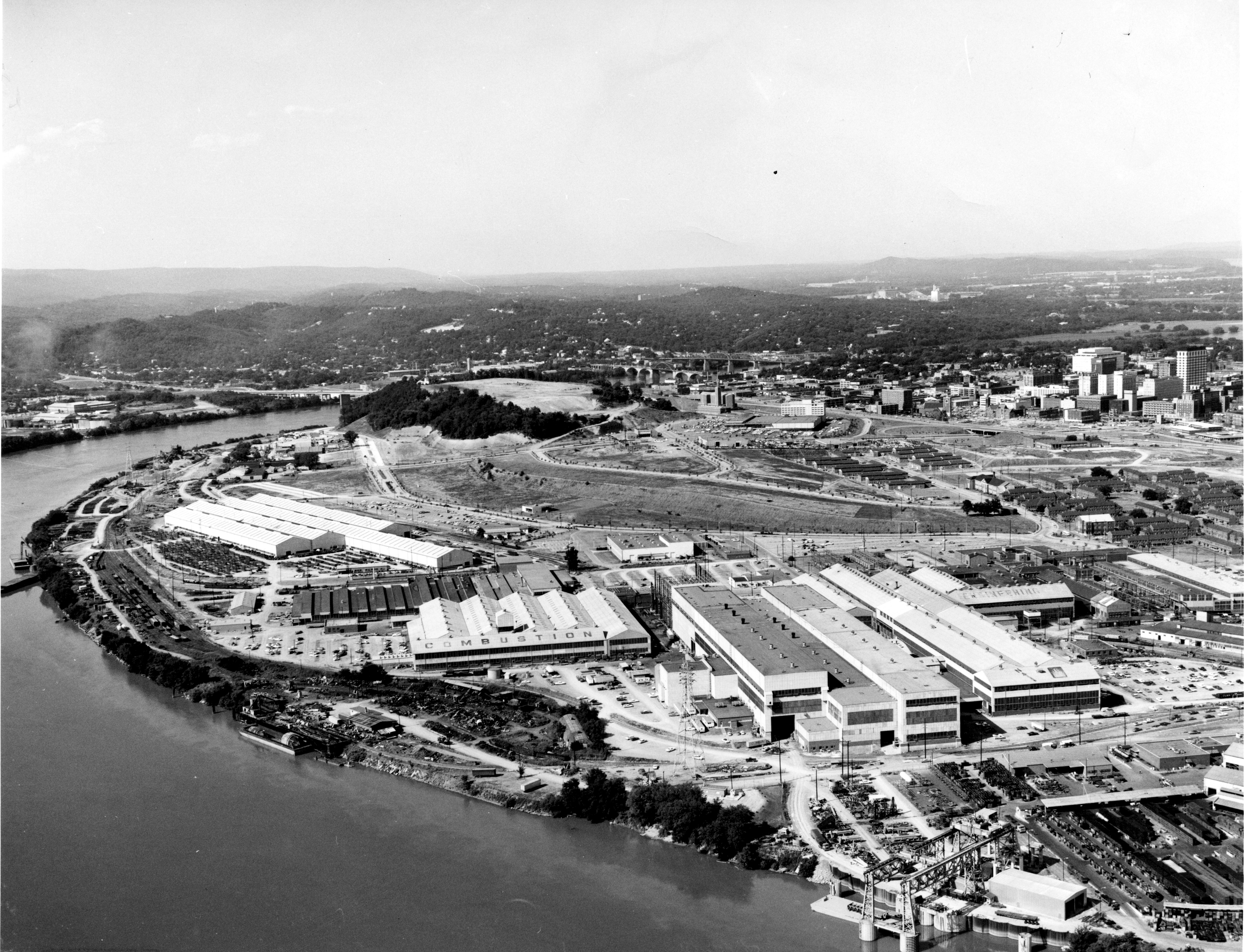
America invented nuclear power and held the lead for many years in the design, manufacturing, construction and operation of nuclear power plants. The Combustion-Engineering Chattanooga facility comes to mind as one of the most capable and advanced nuclear and fossil manufacturing facilities in the world. That was then.
Of course, the magnificent C-E Facilities are gone now. So are the thousands of talented and experienced engineers, technicians and craftsmen. Westinghouse is a fine American name but was sold off long ago. Babcock & Wilcox is still based in the U.S. and involved, but the company is downsized from the 35,000 or so employees that worked there in the 1960’s and 1970’s. I started my power generation career with B&W in 1966, so it is with personal knowledge and experiences that I remember this. The photo below is a Reactor vessel being loaded onto a barge from the Mt. Vernon Indiana manufacturing facility.
From “B&W Steam, It’s Generation and Use”. 39th edition
Specialized manufacturing tools, such as the Gun Drill shown below is used to drill approximately 16,000 precise holes through a 24″ tube sheet to manufacture a steam generator, such as the one below for the B&W Once Through Steam Generator.
From B&W “Steam, It’s Generation and Use” 39th Edition, 1978
The highly successful B&W Once Through Steam Generator as used at Oconee, Three Mile Island, Crystal River and other Nuclear Steam Systems is shown below.
Nuclear Steam Generator from B&W Steam, It’s Generation and Use” 39th edition
View inside the Containment building showing the Reactor and Once Through Steam Generators. To provide a reference of the size of these, the nozzle at the top of the steam generator in the upper left of the photo below is 36″ diameter.
B&W “Steam, It’s Generation and Use” 39th edition
These pressure vessels were built using the most advanced manufacturing, welding and non-destructive testing techniques in the world. However, after the 1979 Three Mile Island incident, very few new NSS’s were manufactured in the U.S.A. Eventually the Combustion-Engineering manufacturing facility in Chattanooga was shut down and B&W downsized. The Westinghouse Electric Corporation which was the pioneer designer and manufacturer of nuclear power plants (starting with the U.S. Navy Nautilus and Eisenhower’s “Atoms for Peace” Initiative) was broken down into numerous business units and sold off. The nuclear power business unit was sold in 1999.
The World Nuclear Association lists the current major manufacturers of heavy pressure vessels. This list is shown below. Much of the heavy manufacturing equipment such as Electroslag Welding, 15,000 ton presses, precision gun drills and other heavy manufacturing equipment once available in Chattanooga and other locations in the U.S. has been lost.
Here are the Heavy Pressure Vessel Manufacturers listed by the World Nuclear Association that are capable of fabricating nuclear reactor pressure vessels, today.
The enormous presses, rolls, welding, machining and forging apparatus that the U.S. once was a leader in are now gone and will take a huge government policy commitment and large capital investments to replace. A new workforce of tens of thousands of engineers, technicians and craftsmen will have to be trained as well. In other words, the entire Supply-Chain, including education will have to be rebuilt. This, if accomplished would be on a scale of President John F. Kennedy’s “Moon Shot” commitment of 1960.
Summary & Conclusions
If the U.S. was really committed to “Electrifying Everything”, that is, everything possible. Then the most practical and proven fuel to provide carbon free electricity is nuclear. An excellent OpEd was published in the TN Star Tribune newspaper a couple years ago on this. I copied it, along with my thoughts, onto my blog, here.
The Net-Zero Carbon path if continued, will further weaken the U.S.A. and strengthen the CCP. I do not have anything against the Chinese people and the many millions that have been lifted from poverty by China’s Development of many coal, nuclear, hydroelectric and renewable power production power plants. However, I am frustrated that the current U.S. leaders, have put the U.S. on a path of decline in manufacturing and economic strength. Also, a decline in influence in the world and a decline in military capability. Much of the decline is due to energy policies that are at a literal “War on conventional forms of energy”. The “Green New Deal” (aka Inflation reduction Act) incentivizes the myth of renewable power in an impossible to achieve replacement of fossil and nuclear fuels.
I have been a supporter of “All Fuels are Important” and that the U.S. should be utilizing all fuels that are available within our borders. Including coal, oil, gas and uranium. It is a myth to believe that wind and solar can replace coal, oil, gas and nuclear fuels. One of my blog articles on the impossibility of reaching Net-Zero Carbon is here. The government’s policies which penalize conventional fuels and incentivize renewables, if continued, will weaken the United States.
The course taught by my friend Greg Blackburn, “The Fate of Nations”, comes to mind. A screen shot of one of the slides he used is copied below. The current U.S. Climate Policies are contributing to the Rise of China and the Decline of America. It is my hope that the voters will elect members of Congress and a new President that will wake up and stop the madness.
The Bureaucratic Agencies of the Biden Administration since Biden’s inauguration have created ever worsening Regulations that are weakening our country and literally forcing the economic decline of our nation. It is as if the Biden policies are being dictated by Xi Jinping and Vladimir Putin. The Biden policies are weakening America, day by day from within. I have used the term, “Self-Sabotage”.
America has the largest coal reserves in the world, about 22% of the world’s coal. America also has all the uranium needed to fuel our nuclear plants and enough oil and gas to provide the primary energy America needs for decades. So, why have we allowed a minority of people and leaders to smear and demonize the conventional fuels that we depend on every day? Worse yet, allow them to weaken our country.
Introduction
Are Blackouts and Gas Lines Inevitable? Is that what it will take for American Voters to Wake up and Elect Leaders to Reverse the Atrocious Policies of the Green New Deal? (aka “The ridiculously named, “Inflation Reduction Act”)
Last week I was having a conversation with a friend who is developing a proprietary process to reduce the CO2 emissions of coal and with a goal to make coal combustion as clean or cleaner burning, than natural gas. My friend Steven asked me, “If we reduce carbon dioxide emissions by 70%, reduce all other pollutants to near zero and basically make coal as clean or cleaner than natural gas, Do you think we could get public acceptance?” I thought about my answer and paused. As I recall, my answer went like this. “That will be hard to do, because there has been 50 years of indoctrination and demonization of first coal and now all fossil fuels, including gas. However, as people experience energy shortages, gas lines, food shortages, inflation and Blackouts, their perceptions should change”. Energy provides Life as we have come to know and enjoy it!
Energy shortages and energy poverty is the path our government has set us on, unless, somehow, we change the perceptions of the sources of energy that America has within our borders. Sustainable living, by my definition, is to sustain the 21st Century life-style that science and technology has made possible over the last 100 years. We enjoy very high quality of lives, including reasonable cost food production for us to share with less fortunate countries. Our quality of life and existence depends on energy. Think about how you missed energy during the last hurricane or winter storm when you might have been without adequate energy for a day or two. That does not happen very often in the U.S., but if current climate policies which demonize and restrict conventional forms or energy are continued, then energy shortages could become the new normal.
Perceptions Matter
On the topic of clean coal combustion I remembered a presentation to the American Coal Council membership that I presented in 2008. The title of the presentation is “Enhancing the Perceptions of Coal”. The purpose of the presentation was to stimulate interest amongst the members of the American Coal Council to encourage ACC members to become more engaged in public energy education. This has been a concern and passion for me since the 1990’s when the “War on Coal” was accelerated by the EPA of the Clinton Administration. Back then, we thought “New Source Review” was as bad as it would get for coal power. (EPA-NSR info here. Check this list of 31 Utilities that were wrongly forced to pay enormous cash settlements and/or shut down coal plants).
How Did We Get Into This Mess?
I was mistaken on the power of government to proceed with such un-American policies and I along with many others underestimated the harm to public perceptions that Obama, the Environmental Extremist/Activists, Liberal Democrats, NGO’s, the World Economic Forum, the Main Stream Media and “Woke corporations could cause. My blog post on my view of the history of the U.S. War on Coal is here and David Blackmon’s sub stack post “Carbon Fascism, Where it Came From”here. The “Shale Gas Revolution” came to fruition after 2008 and abundant gas supplies provided reasonable cost electricity generation from quickly built gas turbine combined cycle power plants. Here is a chart of natural gas prices over a five year period 2006-2011 leading up to the Shale Gas Revolution in electric power generation.
From 2012 Presentation by Storm Technologies to a Florida Utility with the purpose of explaining why Excellence in Operations & Maintenance of Coal Plants is Important Remain Competitive. Data from EIA
The cheap Shale Gas ( I hate the word Cheap, but feel this is an appropriate place to use it) created a domestically available, abundant Primary energy fuel that electric Utilities could and did burn instead of coal and at no increase in production cost to be passed on to the consumer. When gas prices dropped below about $2.25/million Btu.
The production cost component of electricity from the primary energy source, natural gas is about 90% fuel cost. Also, gas turbine combined cycle plants could be permitted easily and rapidly built for much less cost than a clean coal plant. About $1,000/kWh capacity vs. about $3,000/kWh capacity for coal. Of course, permitting a coal plant was and remains nearly impossible with strangling Federal Regulations. Therefore, as gas prices tumbled due to an enormous supply increase, gas became less cost than coal as a power generation fuel. Many GTCC plants were built during this time.
Therefore, the Shale Gas Revolution provided cover for the Green Policies that became very extreme during the “Reign”of Gina McCarthy, The EPA Administrator, During the Obama Regime
Here is a graphic from one of my OLLI courses on power generation by fuels, 2004 and 2019.
Five points of my ACC 2008 presentation: This presentation summarized the timeline of Perceptions of energy 1950-2008 and suggested actions to change the perceptions of the public on coal.
Have We Passed the Tipping Point? Are We Doomed to Energy Poverty and Unreliable Electric Power Generation, Blackouts & Brownouts? Can Politicians Fix the Flawed Policies? Will They?
I read the Hill article criticizing Donald Trump’s speeches where Trump stated that if elected, “I will end green new deal atrocities the first day”. At first I was encouraged at the headline but then reading the article it went on to explain that the “Green New Deal” is codified as public law, enacted by Congress and signed into law by President Biden as the so called, “Inflation Reduction Act”. Therefore, according to the Hill and my rudimentary understanding of how laws are created or changed, it will take both Congress and the President to shut down what President Trump refers to as “Green New Deal Atrocities”. I agree with Trump, but getting Congress to take action seems like a tall order.
The Consequences of Continuing the Net-Zero Carbon Path
Frequent disruptive energy shortage events such as Blackouts, gas lines, loss of industrial productive capacity, deindustrialization,
food shortages and massive job losses. These are All possible with a shortage of energy.
When these occur, Congress may wake up? It should not take energy shortage emergencies to engage Congress. This time, energy shortages are likely to be worse than the 1973 and 1978 Oil Embargoes. In my lifetime I remember the 1973 Oil Embargo and Congress providing a clear path for the Alyeska pipeline to be built in record time of two years 1975-1977.
A coming energy crisis worse than 1973 is likely and it is not just me saying that. Fatih Birol head of the IEA, Daniel Yergin of Cambridge Energy Associates and others have stated this warning.
If we do have energy shortages worse than the mid 1970’s, then Congress may reign in the EPA and other government Bureaucrats? But with Biden as President, it will be hard. I have written other posts on the importance of energy here and here. America has been moving forward on energy policy like a Train Wreck in slow motion. Michele Bloodworth of America’s Power wrote in her Commentary“Are We Headed for A Reliability Train Wreck” in POWER Magazine.
Happening In Plain Sight!
Watching this is frustrating, painful and wrong. America is the strongest nation in the world with millions of smart technically trained engineers, it is not necessary for our great country to experience energy shortages. Yet, that seems to be the path that the government has chose.
The high quality of living that we have been accustomed to requires a lot of primary energy. About 300-330 million Btu’s per capita/year. Previous posts hereand here cover my thoughts on the energy we use and depend on. All totaled this is about 100 Quadrillion Btus/annum for the entire population of the U.S.A. This has been steady for about the last 25 years. Note the chart below from the EIA:
The fuels that provide this needed energy are about 93% conventional fuels, natural gas, nuclear, gasoline, Diesel, Jet Fuel, Nuclear and Coal. These fuels and their importance is described in my posts here and here.
Self-Sabotaging America’s Energy Infrastructure, Specifics
Some of the specific actions by the government as part of the misguided War on Carbon:
In 2008 I was worried about the “Perceptions of the Public on Coal. The harm done by indoctrinating the public and literally demonizing carbon has now put America on a path of energy poverty as we had in 1973 and 1978 with the oil embargoes.
Electric Vehicle Mandate (BTW This started in 2012 with the Obama Administration and the impossible to achieve Fleet Mileage mandate of autos required to achieve 54.5 mpg by 2030)
EPA Rules to Shut Down Coal Plants
Formation and expansion of RTO’s which have destroyed accountability for generation reserves from Regional Utilities. Such as PJM, ERCOT & MISO
BLM Rules to Restrict Mining
Biden Order to Shut down Keystone Pipeline
U.S. Refining Capacity is Reduced 5%, yet demand has been increasing
Federal ESG guidelines to restrict investments in fossil fuels
EPA Rule is proposed (in spite of SCOTUS past ruling) to Require CO2 Capture of Gas Power Generation Plants by 2040
Biden rescinded Trump era reductions in Federal Regulations on American energy production
Biden Executive Order to Reduce Fossil Fuel Production on Federal lands and increase Green energy to tackle the Climate Cris. Full EO here.
EPA aggressive enforcement of “New Source Review” (NSR) to penalize coal plants
Sweetheart deals between NSR settlements and EPA Lawsuits brought against coal plant operators, to fund NGOs that continue to influence further Self-Sabotaging Regulations. Example of one of last clean coal plants built in U.S. here.
Many more…..
The American Energy Alliance published a list of 100 ways the Democrats and Biden have made producing energy in America more difficult. The is as of May 2022 and the war on carbon continues. The AEA list is here.
So, what are we going to do about it?
To be perfectly honest with you, I am frustrated that our government is controlled by elected, appointed and career Bureaucrats, many who believe believe in the misguided green energy myth. To put the number in perspective, there are about 19.23 million state and Federal government employees, according to Statista.
Back to my ACC presentation in 2008. One slide I used is copied below. This quote, was used by President Kennedy in one of his famous speeches and he attributed it to Edmund Burke:
Yes, it is a small minority of leaders that have waged a very effective war on carbon. It is not only a matter of demonizing carbon, their goal is to control our lives and to de-industrialize, de-populate and downsize the energy use to lead to a smaller population on the planet. Donn Dears, Dr. Tim Ball, myself and many others have written about the U.N. Agenda 21 and the U.N.-IPCC. My blog with references for further reading is here. The small number of “leaders” have influenced electric utilities, the Entertainment Industry, the MSM and many “Woke” businesses and corporations to promote Green Propaganda. Again referring to David Blackmon’s excellent piece, “Carbon Fascisim, Where it Came From” here, Blackmon enumerates the small number of people who have initiated the ludicrous (some would say, evil) policies on the Free World. The frightening aspect of Federal rules and laws is that only 435 members of Congress plus nine Supreme Court Justices can codify anti-American energy policies that will be very hard to reverse. Congress, in my view, has been negligent in delegating full authority for the protection of public health to the EPA. It started out well in 1970. However, since then the EPA employs, about 15,000 and like other government agencies, have been weaponized against the best interests of America by Biden and Democrats in Congress. The war on conventional energy began with Clinton, continued with Obama and now has reached criticality with the Biden Administration.
It is this reality that concerns me to ask the question, “Are we doomed to face Energy Poverty?” What about the 3 Billion souls in Developing countries that use less electricity a year than we use to power our refrigerators for a year and cook over open fires fueled by cow dung or firewood? Then there is the concern of fertilizer production which is crucial for food production. Dr. Samuele Furfari has written an excellent article in European Science here. Another Blog on Substack, “Carbon Myopia” by Robert Bryce is here and Liberty Energy’s report on “Bettering Human Lives” is here.
Dr. Furfari’s article is entitled “Agriculture: Who Wants to Replace 22 Billion Human Equivalents?” The basic message from Dr. Furfari is, “energy has replaced muscle power over the last 120 years and the simple math to arrive at the muscle power of 22 Billion people is: A steam horse is worth 736 watts and an average man is worth 100 watts, so we have 30 million tractors x 100 horsepower x 7.36 = 22 billion“
Slide from Dick Storm presentation to Rotary Club on “Demystifying the Importance of Energy”
Furfari’s article is worth reading for some excellent background on the importance of energy to produce food for the world. More articles and books by Dr. Furfari are included in the references below.
What are the Western World leaders thinking?
They Certainly do not understand the basics pf energy and electricity generation. Check these Blogs of Robert Bryce (Carbon Myopia) here and David Blackmon’s (Carbon Fascism) here. Also, as noted above, the books and articles by Samuel Furfari, Donn Dears and Vaclav Smil are all very well researched and well written.
So Why Am I Worried?
Even my conservative red state of S.C. is headed for a path of electricity shortages. I wrote about this on my blog here. The Federal laws that have been enacted by Congress and approved by President Biden plus extreme anti-carbon based rules by EPA Regulations, in my view, these are simply un-American. Why? To be polite, I chalk it up to our leaders being ignorant in the fundamentals of physics and energy. A darker reason is if a number of the elected officials and NGOs that influence the EPA and government officials may have been influenced by NGO’s and including foreign Dark money. The next post on this blog will be an Appendix to include references for further reading to support my assertions.
In Our Republic, The Citizens Get The Leaders They Deserve! (Really, Do we?)
About 25 years ago when Bill Clinton was President, I remember working at a Canadian Utility. I made the mistake of commenting on my views of the EPA anti-coal policies of Carol Brower, who was then the head of the EPA in the Clinton Administration. My Canadian friends remarked, “In a Democracy you get the leaders you deserve”. I was humbled, embarrassed and thought, that was dumb of me to complain of U.S. politics amongst Canadians. My mistake and I attribute the gaff to just feeling at home with friendly folks that just happened to be Canadian citizens, only a two hour flight away. The point is, the remark, “In a Democracy We Get What We Deserve” has stuck with me. In our Republic, “Do We Get the Leaders We Deserve?” Let’s take a look at some reasons to be concerned. All of my energy engineer friends know how foolish and wrong the “Green New Deal” is. One friend, Donn Dears, told me privately, “This is a battle America must win!” Dears has written about a dozen books and is an acknowledged expert on energy and energy policies. Other energy and environmental science experts have also written extensively. Amongst them are Dr.’s Vaclav Smil, Judith Curry, Richard Lindzen, Steve Koonin, the NASA Right Stuff Team, CO2 Coalition, Heartland Institute, CFACT, American Energy Alliance and dozens of others that have written on energy and climate policy. My previous blogs have outlined the flawed science and reasons for destroying the energy infrastructure that powers America. However, the elected officials of the political party that favors these un-American, anti-conventional fuels policies are in power now and may in fact, win again in 2024. Some of the major influencers are mentioned in my post here. Why am I concerned? Because the carbon haters have done a very effective indoctrination (Scare Mongering) of millions of voters. Please read on…
Elections Matter and Here are Some Reasons of Why I am Concerned
Energy illiteracy in America is widespread. The indoctrination and demonization of carbon and nuclear energy has created a perception that many reasonably well educated people favor the “Myth of Green Energy”. I say this based on the successful indoctrination/Demonization of carbon by the U.N. , the World Economic Forum, The Sierra Club, The Natural Resources Defense Council, many other Environmental NGOs. Here is a figure I created for a presentation to the ENERUM, energy forum in Columbus and a couple other public meetings. A short review of “Demystifying Energy” is here.
Planned parenthood which is over 40% funded by Taxpayer dollars, the MSM, Entertainment and the entire Democrat Party which is strongly supported by all of the above. From what I have read about the 2020 voting patterns of suburban women, many voted on the single issue of abortion, based on the recommendations of “Planned Parenthood”. In my previous post, I showed publications that connected Planned Parenthood with the Sierra Club and other “Green Energy” supporting organizations. If you are curious, check the previous post here. Ken Braun of the Capital Research Center provides documentation of the sources of funding for the war on fuels. Names of Foundations from such well known wealthy donors such as Bloomberg, Bezos, MacArthur Foundation, Ford Foundation and others. One Sierra Club and Planned Parenthood alliance letter is here.
The anti conventional energy activists are funded with Billions and Billions of dollars. Check the links to the Capital Research Center’s Ken Braun article here. Then there is this report of the great American name “Ford” Foundation and how they have cooperated with the CCP, here.Henry Ford would not approve as this is against everything he stood for. So much for Donor Intent.
My point is, public indoctrination on green energy is widespread and well funded. The mis-perceptions are fueled by a distorted & fake science that carbon and nuclear are harmful. The gullible public with a general energy ignorance has accepted the 50 year indoctrination.
Next time you are in a social setting, just gently ask the average, educated persons you are with, how many Btus are there in a kWh? (3412.6), or how many Btus are there in a gallon of gasoline (about 125,000). Harder yet, how many foot pounds of energy at 100% efficiency is one BTU equivalent to? (778). More simply, “What is the difference between Primary and Secondary Energy? See what I mean. Now take a look at the U.S. Demographics to elect new leaders.
The 2020 election outcome by counties. The figure below was/is reported in the U.S.A. Today after the 2020 election. Here
The majority of the people in most of American counties favored the policies of Donald Trump. Thus the vast amount of red counties that are shown on the map above. However, land and counties do not vote, people do. Therefore the people of the cities with the minority of land area has the majority of voters. Many of these voters are strongly indoctrinated with propaganda from NGOs, Planned Parenthood amongst them and have been traditionally Democrat strongholds. Over 50% of Americans live in cities and although cities use enormous amounts of energy, the (D) voters not being energy savvy, tend to vote for Democrat candidates, regardless of the foolish and un-American policies they stand for. This is one reason I wrote on the importance of Energy Education here.
If the popular vote determined the outcome of a national election, it would be controlled by just three or four large Metropolitan areas such as NYC, LA, Chicago and Atlanta. Ironically, on an energy use basis, these cities use much more electricity than Rural areas. But the voters in these large Metropolitan areas have typically chosen Democrat candidates that are against conventional energy and they are for the most part, trained in Political Science, no in energy and electricity generation. Most do not know the difference between Primary and Secondary energy, yet they will proclaim as Energy Secretary Jennifer Granholm has implied…., “Electrify Everything”. Here is the unauthorized Biography of Jennifer Granholm’s by Ken Braun. Granholm, trained as a lawyer is typical of the creators of American energy policy.
My Conclusion: We have a lot of work to do to Educate the Public on the True Facts of Energy and Electricity Generation
I urge my friends and associates to get involved in educating your neighbors, friends and every person you can on the true facts. I know it is hard for anyone employed full-time to do extra curricular presentations to civic clubs, schools, Colleges and any gatherings of more than 25 people who will listen. But if not those of us that understand energy and electricity generation, then who will do it?
We must change the “Perceptions of Conventional Energy”, not only coal. Also, oil, gas and nuclear.
Respectfully and very truly yours,
Dick Storm, July 30, 2023
Green Energy Crisis, Part 4 – Appendix Will be uploaded as a separate post at a later date. This will include extensive Reference Links, Books and Information for those who are interested in further Research
The purpose of this post is to show a few of the warnings that Congress has been unresponsive and the Executive Branch and EPA either clueless or Intentionally Causing the coming energy crisis. Paul Harvey’s classic radio commentary of 1964 comes to mind, “If I Were the Devil”.
Typical Coal Plant Demolition. This one in NSW Australia, but we in the U.S. have performed similar demolition of important power generation stations capable of generating reliable, affordable & Dispatchable power 24/7 during all weather conditions. It is heartbreaking for those of us who understand energy and electricity generation. But, it is cheered by about 50% of the world’s population because those who do not understand the importance of conventional forms of energy have been indoctrinated on the demonization of fossil fuels.
Introduction
Many of us who have been closely associated with energy production and electricity generation have known the day of reckoning is coming. In this post I will lift up some past posts, presentations and published articles to show the foolishness of the “Green New Deal” which has been codified in the so called, “Inflation Reduction Act” or IRA.
Below are two of the slides I presented to the ASME Annual Meeting in 2011. Yes, I have been an advocate for Common Sense Energy Policies for a long time.
The year 2011 was during the Obama Administration and the “War on Coal” was being escalated by the EPA and Activist NGO’s such as the Sierra Club, Natural Resources Defense Council, Environmental Defense Fund, Wild Earth Guardians and many more environmental extremist organizations. Shale gas was coming onto the market at ever increasing volume and low prices. Thus, as much coal generation was replaced with natural gas fuel, the consumers and industry had no concerns for the future. But, those of us associated with the power industry knew the crisis was coming.
Let me point out the graph on the second slide above, this correlates Coal use and GDP 1970-2010. Yes, Life was very good for us and our country’s electricity was generated by about 50% coal power generation. Blackouts were very rare. Brownouts were very rare. Let’s fast forward to the claimed great success of the carbon hating Bureaucrats and their allies in the NGO’s. I will show a screen print from the Sierra Club website below. They continue to be very proud of their accomplishments in the war on coal, which really is a war on the consumer.
This is from the Sierra Club web site. Note above they are literally bragging about shutting down 372 coal plants with 158 plants to go. Not only shut down, but completely demolished. Both the environmental activists and the U.S. Government top officials have a goal of shutting down all coal plants by 2030.
Let me direct your attention to the slide below. This is also a screenshot of the Sierra Club web site. Notice that not only do they want to shut down coal plants, they also want to kill natural gas production and pipelines. Not clearly shown today, but in their’s and other activist goals has been the opposition to nuclear power.
At the end of this post I will provide many references for further reading on the war on coal-natural gas and nuclear. This is serious folks. These people and their organizations do not understand energy and appear to have no concern for the harm they are causing to the citizens of the U.S.A.
Part 2 of this post will be a summary of how these Un-American Climate Policies have come to be and to list some of the policies, organizations and people that have contributed to the Clean Energy Crisis that our country and the Free Western World is facing.
Closing
The coalescence of environmental activists, government officials (both elected and Bureaucrats), the United Nations, the World Economic Forum, the Main Stream Media, Entertainment, Woke Businesses & Industries and leftist activist organizations have put our country on a path of weakness and decline. It must be stopped. But before it will be reversed there will be many industries, businesses and citizens who will be harmed. It did not have to happen this way. (2) Kindly read the references listed below for support of my conclusions.
History has shown that countries rise, fall and rise again. The economic decline of the U.S. should not be hastened by self destructive and unnecessary environmental restrictions.
The true facts on the importance of conventional forms of energy are well described in many books. Especially the books by Donn Dears(19) and Vaclav Smil(95) these provide excellent insight into the importance of conventional forms of energy. Mr. Dears provides a very enlightened summary in about 100 pages.
Yours very truly and on this Memorial Day, We should pause and remember those who fought and died to secure our freedom. May God Bless America,
Dick Storm presentation to the American Coal Council, 2008 on “Perceptions of Coal” This is not posted online that I know of. I can send a copy upon request.
Long story shortened, the only way I know to stop the destructive policies is through an intensive energy education program of the general public. The ad below was typical of many in business and industrial trade magazines of the 1950’s and 60’s. It represents the culture of those times.
Introduction
Parts 1 through 4 of this series are my attempt to explain where we are on energy policy and how we got here. Here below are my additional thoughts on “How to Fix” Americans perceptions of the importance of energy in our lives.
Energy Education: The Best Solution of How to Fix Public & Political Demonization of Carbon
This post was started a couple months ago and after I was thinking about “What is a positive approach to correct the indoctrination?” The solution to the problem (Self Sabotaging Madness) is Energy Education of the public. Those of us folks who were born before 1950 remember the Public Utilities energy education programs from the 1950’s through the 1970’s “Living Better Electrically”. One example is the Sunday night TV program, “General Electric Theatre” showcased by none other than future President, Ronald Reagan as a spokesperson for G-E, to showcase new electrical appliances that were making a Mother’s work easier and living better electrically a reality for all Americans(4). Reddy Kilowatt was the mascot for the programs by the Investor owned Utilities. Living better electrically was shown on TV, electric bill inserts, newspapers and perhaps more importantly, in public schools. Local electric Utilities had regular programs in High Schools to teach not only Home Economics and how to cook using electric stoves, for the girls, but also “How Electricity is Generated” for the boys. I know, today that sounds wrong and politically incorrect, but back when we referred to Boys and Girls. People also had a better understanding of where our electricity came from. In fact, I was one of them that as a 16 year old (in 1959), I became enamored with coal power generation. A true fact. And I was not exactly a standout scholar, but I knew how electricity was generated as a teen. Here is a reminder of the correlation of GDP and coal consumption 1970-2010. (148)
In my view, this is what America needs again. Improved energy education for all ages to teach the importance of energy and the various sources of Primary energy that can meet our needs.
This is a tall order. Better energy education of the public has been an idea I have had for at least two decades. When living in N.C. I did weekly “Energy Fact Minutes” on the radio with my old friend Matt Smith and also placed full page advertisements in the local Stanly News and Press newspaper. I have written to the CEO’s of several Utility companies, including Lynn Good of Duke Energy and the CEO of our Electric cooperative (Palmetto Electric) to suggest such energy education programs to be reinstated. The letters and message were ignored and in fact, not answered. Those Utilities and Coop’s are what I consider “Woke”…. and they are Promoting the myth of green energy instead of educating the public on the true facts of energy and electricity generation. Speaking of misinformation and “Wokeness” below is a screen shot from the NextEra Energy web site. A plan for Net Zero, really? Electrify everything? This and other once fine Utility companies have gone “Woke” and are promoting solar and wind power when they fully know it is not possible to replace the 100 Quadrillion BTUs that America needs every year. Why? Two reasons: 1. Follow the money through government subsidies and 2. Avoid the wrath of punishment of well funded (Billions of $) environmental extremist groups. Below is a screen print of the NextEra Energy website as an example.
I do a lot of complaining regarding the government, NGO’s, Woke Industries and public education, so it seems reasonable that I should at least offer a positive suggestion of a solution. A suggestion “How to Correct” the 50 year indoctrination and demonization of the fuels we depend on, Improve energy education.
An informed and energy savvy public will be capable of making the best choices of candidates when voting in the 2024 election. The best hope for America, is that informed and energy savvy candidates will change the destructive Net Zero Policies forced on industry and the citizens.
Did you ever wonder how the misconceptions of energy started? Well, stick with me and read on.
What Went Wrong With the Living Better Electrically Programs of the 1950’s-1970’s? Why was Energy Education Stopped?
The public energy education programs went pretty well up to about the mid 1970’s. The Arab Oil Embargoes(5,6) of 1973 and 1978 created financial stress on electric utilities (and everybody else too!). I was working on the startup of the Roxboro Unit #3 a 720 MW coal plant for CP&L back then (I joined CP&L in Jan. 1973) and I remember it clearly. In 1973 the Roxboro plant expansion was for two 720 MW coal units to be completed in 1973 and the second one 1974. I was the senior startup engineer for the two units. Shortly after unit #3 began commercial operation in June 1973, the first oil embargo took place. Raising investment capital by selling stock to investors became a challenge and CP&L like many other utilities during that time had to cut back spending. Those of us that were adults in 1973 remember some electric utilities actually selling power plants to the state or other drastic measures. The period 1973-1978 was very tough on investor owned utilities.(149,150) These spending cut backs included CP&L shutting down construction on Unit #4 and then reducing operational & maintenance expenses. The first budget items to be cut (not only CP&L but most Utilities) were tree trimming near power lines, then painting and any maintenance that could be deferred. A crucial budget cut which has had long term consequences was halting the Public Energy Education programs. Yes, the “Living Better Electrically” public education programs were slashed from the budget. Not only at CP&L but pretty much industry wide. CP&L has since been absorbed by Duke Energy. This was a mistake that is easy to see from my vantage point, because I lived through it and it impacted me personally.
What is to come with the consequences of Net Zero Carbon, if we continue this dangerous path, will be in my view, worse than 1973-1978
So, what replaced the “Living Better Electrically” PR programs? Sadly, the void of public energy education was filled with biased anti-fossil fuels and anti nuclear propaganda by Environmental activists. Piling on was population growth organizations such as Margaret Sanger’s Planned Parenthood which became affiliated with the Sierra Club(151). Many of the environmental and anti population growth organizations coalesced after the first “Earth Day” in 1970. The (then) recently published books by Rachel Carson, “Silent Spring”, Paul Ehrlich’s “Population Bomb” and the Club of Rome’s, “Limits to Growth” all became popular with the Leftists and NGO’s. These, in my life experiences are the roots of the current war on carbon. More will be provided later. I gave a presentation to the American Coal Council in 2008 on the “Perceptions of Coal”(15). In this presentation I used one graphic to attempt to show the decline of energy education and the enormous rise of funding resources for environmental extremism. This is shown below:
The point of the graphic was to show how the progression of the perceptions of coal power by the public from the time line of 1950 to 2008. In the 1950’s, 1960’s and 1970’s “Living Better Electrically” was the theme promoted by the MSM and in public schools. Also, the funding for TV, magazines and newspaper advertising was generous by such Fortune 500 companies as General Electric, Westinghouse, Allis-Chalmers, Babcock and Wilcox, Combustion Engineering and many more. One of my favorites by B&W is shown below.
Then, as the Environmental Activism started in the late 1960’s, the funding for advertising (Indoctrination) changed from those who were creating the products to live better electrically….to those who objected to the use of fossil fuels and nuclear. The Sierra Club, NRDC, EDF and many other NGO’s became more and more well funded. Today collectively they have billions of tax sheltered funds to use for public indoctrination and election campaigns of candidates that favor the path of “Woke” Climate Policy. They have used the funding to demonize conventional forms of energy and they have been very successful. However, they may not understand the harm they are causing to our country? Even successful but energy ignorant Billionaires fund the NGO’s to indoctrinate the public and influence elections(16,17). It is a war on consumers energy costs but the left uses carbon as a scare tactic. This war on consumers is described by Hayden Ludwig in the article by Capital Research Center.
Here is a recent post by the Sierra Club, in essence, bragging about how their war on coal has gone so well. Their goal is to kill all coal plants in America by 2030.
Coal plants are being retired and demolished without replacement of new reliable capacity which makes the promoters of renewable power very happy. Not only extremists that hate coal, but also some Utilities and Private sector companies that are investing in “Green Energy” as the expression goes….”Follow the Money”. Below is from a screen print of a portion of NextEra Energy’s website. I consider this un-American and an example of a “Woke” corporation.
Meanwhile, as we fast forward to 2023 the new government and main stream media Mantra is “Electrify Everything” Missing in today’s woke advertising and PR programs by the proponents of electrify everything is a basic understanding of how electricity is generated and the details of how reliable, affordable and Dispatchable generation is accomplished. This gets back to the general public’s (and government Bureaucrats) mis-understanding the differences between Primary and Secondary energy.Also, “Nameplate Capacity” and actual “Capacity Factor” of Bulk Power Generation Resources. Just for the record, I have done my best to educate the public with energy and electricity courses at USCB-OLLI and presentations to public schools, Colleges and Civic Clubs. We need more of us experienced and energy savvy engineers to do this!
Getting Back to Basics: Electricity is Secondary Energy and must be Generated from Primary Energy
When I meet intelligent and successful people who have a great general understanding of business and industry but have not worked in the energy or power generation business, they are often stunned when I explain the facts of where our electric power is generated and the fuels used to power our economy and high quality of life. They usually say in essence: “I can’t believe that there is not a planned transition from fossil fuels to renewables?” A student of one of the courses I taught at USCB-OLLI stated, “You mean electricity has to be generated from coal, gas and nuclear power to charge my Tesla?” The misconception of Primary Energy and Secondary Energy is one of the largest causes of misunderstanding by the general public. Partly because of the general public’s lack of interest in educating themselves and partly because of indoctrination by the well funded Environmental Extremist NGO’s, government, the entertainment industry (ex. Disney), Public Schools and by public Education/Indoctrination,
America Has Some of the Cleanest Air in the World
Environmental Progress in Cleaning the Air
We all want clean air and clean water. And, in 1970 some attention to cleaning discharges to the air and water of the United States was badly needed. Sulfur Oxide and Oxides of Nitrogen were causing Acid Rain, particulate emissions were unacceptable and heavy metals were a valid concern for public health. Thus, the EPA began in 1970 and did a very good job of cleaning the air and water after 1970. The great job is shown on the chart below.
The air in the U.S. is truly amongst the cleanest of all industrialized countries. The great progress in cleaning the air is a fact as shown on the EPA chart above. So, why is the EPA continuing to force more and more coal plants to shut down? In my view, it is not about clean air, it is about following the environmental extremist NGO’s policies of Degrowth, Deindustrialization, One World Government and Socialism policies of the U.N. , the WEF (World Economic Forum) and the world’s “Greens”.
Sadly, these influential people and organizations have done a very thorough job of scaring and indoctrinating over 50% of the people in America and also other Free Western World countries.
The Growth of Worldwide Environmental Extremism
In the foregoing paragraphs I have tried to show the path of public education on energy matters (Public Energy Education was Good up till 1973) and the growth of environmental extremism and indoctrination from the late 1960’s through present day. There are some green organizations that are Global and these have infiltrated the leadership of the United Nations. Some of the environmental activists have coalesced with Socialists and organizations concerned with population growth. All together, the International Green movement has become comprised of followers of stopping population growth, abortion, environmental extremists, anti-nuclear power activists and socialists. Together these organizations have gained wealth and influence over much of the free western world. Alarmingly, many of the 192 nations that are members of the U.N. are aligned with the so called “Climate Policies” of the U.N. except for China & Russia. In fact, most of the BRICS nations which comprise about 40% of the world population are aligned with UN Climate Policies which are, in my opinion, slanted toward weakening America and strengthening China. Read the PA Pundits essay on the CFACT Blog here.
The Climate Policies are Not About Environmental Concerns. They are about Control of Our Lives, So, Why is America Self Sabotaging Our Reliable Electric Power Supply?
This post is to attempt to show the coalescence of various activist groups that have been growing in influence since the 1970’s. Basically, since the 1973 Oil Embargo. Those of us that were adults then remember the disruptions to our life styles and the economic pain which was inflicted on us by having our energy supply disrupted. Friends, the 1973 and 1978 oil embargoes were a problem but the electricity shortages that America is faced with in the future will be worse unless we turn away from the destructive path of Net Zero Carbon which is focused on use of renewable wind and solar to replace fossil fuels. It is impossible to do so by 2050. Not without severe disruptions of our economy and our lives.
America Does Not Have an Energy Policy to Transition to Carbon Free Energy
The Climate Policies and the Paris Agreement have little to do with protection of the environment. However, if clean energy sources are desired, then nuclear power is the one source of carbon free energy that can significantly reduce emissions with reliable, affordable and base load capacity.
I invite you to refer to my other Blog posts and the references listed below for further reading and information that will support my conclusions.
Yours very truly,
Dick Storm, August 8, 2023
Here are References for further reading and research, More will be posted in the Appendices for the “Green Energy Crisis” series in the next week.
Video of 22 year old Belgian Climate Activist to European Union: Anuna De Wever Van Der Heyden is a 22-year-old Belgian climate activist. She delivered this speech at the Beyond Growth conference in the European Parliament on May 19th. Here is a link to a post-conference panel discussing the EU adoption of degrowth policies: https://lnkd.in/g68-PJ4d
Dick Storm presentation to the “American Coal Council” 2008, “Perceptions of Coal”
This is an update on my comments to the IRP development for my local Regional Utility, Santee-Cooper. The last draft IRP has been published for comment and the figure below shows the expected load growth up to 2042. This Figure is from page 28 of the IRP presentation updated in April 2023. Shockingly, there is serious planning to shut down all coal plants by 2034 without having a Balanced Portfolio of replacement Bulk Power Supply that is Dispatchable, affordable and of reliable supply. Some energy news/issues authors, when discussing energy policy, speak metaphorically of “Falling off the Cliff” The illustration of projected load growth for Santee-Cooper is an example of planning to “Fall off the Cliff” by (NOT) Balancing Bulk Power Supply & load Demand. (The graph reminds me of the old saying, “Failing to Plan is a Plan for Failure”. How? By not providing adequate new generation capacity as older, reliable, dependable and Dispatchable coal units are retired. This is typical all across the U.S. and the western free world(6,10,14,15,15,17,18,19,20,21,22,23,24,25,27)
I had hoped that the more conservative, level headed General Assembly of S.C. would have better sense than to follow the “Woke policy” of the U.S. government and other states. There is still time to wake up to reality. (5,8)
The slide below is from my ENERUM presentation, August 2022. Data and chart are from the July 2022 NERC Report.(10) This shows 102 GW of Dispatchable & Reliable coal and nuclear plants shut down since 2011. This is shown to illustrate the fact that Santee-Cooper seems to be following the same destructive path as other utilities in the U.S.
Can a Great 80+ Year Record of Reliability and Affordability be Sustained While Retiring Coal Plants? Is S.C. Self Sabotaging our Great Record of Reasonable Cost, Reliable Bulk Power Supply? Why? Can the Legislature Stop the Madness?
It is my understanding, that the management of Santee-Cooper has been directed to formulate a plan to achieve Net Zero Carbon by 2050. Anyone that knows me, knows that I do not agree with this plan and my posts on this blog and my public presentations have clearly shown my analysis of the madness of Net Zero Carbon & the War on Coal. I have written letters to Santee-Cooper, the Governor, Congressional representatives and my S.C. Senator. Most of these have been made public. Myself and others that have knowledge of energy and electricity generation know that the path to Net Zero carbon is not possible by 2050.(4,5,6,7,8)Not without severe disruption of our way of life, our economy, industrial output, controlling inflation and national security. It is important for our state to generate electricity reliably, with high quality frequency and voltage control, from Dispatchable generators to meet customer Demand and do this 24/7 affordably under all weather conditions…..This has been done by Santee-Cooper for almost 90 years. Thanks to the reliability of coal, nuclear, natural gas generation and hydro-electric. Why would the Legislature force this fine Utility to sabotage its great record? The chart below is from the 2020 IRP. This lists the Dispatchable, Reliable, Affordable generating assets that have created and continue to provide a great record. In essence, the apparent path of the IRP update is to replace 61% of the reliable coal generation with “Intermittent” solar and wind generation.
Path to Jeopardizing S.C. Bulk Power Affordability, Reliability and Dispatchability
The S.C. Legislature has directed Santee-Cooper through “Act 90” to meet a net zero carbon goal by 2050.
The slide above is copied from the Santee-Cooper IRP presentation. My understanding is, that this is the direction ordered by the legislature. A plan to achieve Net Zero Carbon by 2050.
There is active planning to not only shut down the 1,150 MW Winyah coal plant in 2028 but also to shut down the 2,350 MW Cross Coal plant about five years later so that in 2034 all coal plants will be shut down. This is shown on the slides below. Shutting down all coal plants by 2034, in my opinion, will jeopardize the very favorable record of reasonable cost, reliable and Dispatchable electricity Bulk Power Supply that has become associated with Santee-Cooper’s great reputation. Even more importantly, South Carolina’s excellent record of attracting and keeping a thriving industrial base within this region. Electricity intensive industries such as aluminum and steel manufacturers/Recyclers have thrived here as manufacturers in other states have ended operations and ceded U.S. manufactured steel and aluminum capacity to China.
Let me digress and quote Vaclav Smil’s statement on decarbonization. From Professor Smil’s book, “How the World Really Works” This applies to S.C. Too!
“The real wrench in the works: we are a fossil-fueled civilization whose technical and scientific advances, quality of life, and prosperity rest on the combustion of huge quantities of fossil carbon, and we cannot simply walk away from this critical determinant of our fortunes in a few decades, never mind years. Complete decarbonization of the global economy by 2050 is now conceivable only at the cost of unthinkable global economic retreat, or as a result of extraordinarily rapid transformations relying on near-miraculous technical advances.” Smil continues….
But who is going, willingly, to engineer decarbonization while we are still lacking any convincing, practical, affordable global strategy and technical means to pursue the latter? What will actually happen? The gap between wishful thinking and reality is vast, but in a democratic society no contest of ideas and proposals can proceed in rational ways without all sides sharing at least a modicum of relevant information about the real world, rather than trotting out their biases and advancing claims disconnected from physical possibilities.”
I have written other posts on this Blog to express my thoughts on competition with China and the importance for America to reshore U.S. manufacturing. This my friends, is in our backyard, our neighborhood, our state. This is a fact as stated above10). Premature retirements of reliable coal plants has been occurring at an alarming rate all across the U.S. Do we have to follow the same foolish self sabotaging policies of NY, Hawaii, Germany, the UK and Texas? I hope not. (12,13,14,15,)
Future Bulk Power Generation Capacity, The Apparent Plan to Self Sabotage Reliable Bulk Power Supply
Expected Outcome of Adding Over 4,250 MW of Non Dispatchable, Intermittent Bulk Power Supply
If all of the coal plants are retired and the portfolio shown above is used. Her are my predictions, based on the experiences of Hawaii, California, Texas, Germany, Denmark and the UK.
California is thought by some in government to be a model for the U.S. with regard to renewable energy policy. I do not agree. Here is a recent post by the CEO of the Electric Power Research Institute on how the California electric load (as reported by CAISO) has morphed from a “Duck Curve to a Canyon Curve”. Here is a screenshot of Dr. Mansoor’s post:
The “Canyon” curve represents high renewable generation during the peak sunshine of the day where California has bragging rights to sourcing almost all of their electricity from solar collectors. This is great until folks come home from work, mom starts dinner in her totally electric home and Dad plugs in his EV for charging. By early evening, electricity demand skyrockets out of the Canyon and must, for the sake of reliability, be generated to meet demand from Dispatchable sources.
Battery storage is not Bulk Power Supply. Batteries store electricity they do not generate electricity. Batteries are capable, depending on the size of the installation, of providing minutes or hours of backup. The largest battery storage in the U.S. is the Vistra Energy, Moss Landing facility in CA. The CAISO load for April 27 is expected to be about 30,000 MW. Note the largest battery storage facility in the world, Moss Landing, is 1600 MW which is about 5% of the Demand and only capable of providing minutes or hours of stored electricity.
Here is another post from another energy expert on LinkedIn. This graphic shows the electric generation through the day which includes battery storage.
The Moss Landing Storage facility is rated at 400/1600 MW and is capable of storing excess renewable generation for hours so that it can be used as the sun sets and kick in as the “Canyon Curve” and CA power supply and Demand Curves above become reality of demand. Emphasis should be on “Hours” it is not capable of backup during a days long cold severe winter storm, such as NC and SC experienced over Christmas week, 2022. Another example is the 150 MW Battery storage designed for Queensland, Australia and an artists depiction below. This is from an essay reviewing the NY electricity future written on the Blog, Watts Up With That.
Battery storage such as shown above is very costly. For example, the 150 MW facility above is projected to cost $250/kWh. Therefore for 12 hours of storage for 450 MW, the cost would be about $1.35 Billion dollars. Keep in mind, this is for 12 hours storage of only 450 MW of power. Winter storms such as the Christmas 2022 storm lasted longer than 12 hours and even very conservative, steeped in energy expertise Duke Energy, also with a great reputation for reliable electric service, had rolling Blackouts. Ditto for TVA(18,19,20,21,22,23).
When the sun is not shining and the wind not blowing, then the generation must be purchased from neighboring Utilities or generated with Dispatchable natural gas generation. The plan shown above includes 4,316 MW of natural gas generation. This combined with the 322 MW of Summer Unit #1 nuclear power totals 4,638 MW. The wind generators, though intermittent, could generate another 400 MW to total 5,038 MW. The projections of up to 9,000 MW Demand in 2050 (according to Santee-Cooper projections) then will require additional Dispatchable generation which is likely to be natural gas CT’s or Combined Cycle facilities. Think for example of the uncertain growth of Electric Vehicles. If much of transportation is “Electrified”, then the high range projections of about 9,000 MW peaks can be expected in 2050 or before. So, why would we kill the coal plants that have served South Carolinians so well?
This reminds me of my experiences working for CP&L in the 1970’s when the manager of Fossil Plant Engineering pointed to an oil fueled CT and proclaimed to me, then a young engineer, “That young man is a monument to poor planning”. Yes, as CP&L (That was before CP&L merged with Florida Progress and was later absorbed by Duke Energy). I see history repeating here as so much faith in renewables today is somewhat like the high expectations of nuclear being “Too Cheap to Meter” beliefs of the 1970’s. However, nuclear power eventually delivered. Wind and solar are not capable of replacing coal, nuclear and gas fueled Bulk Power Generation. In the 1970’s the Bulk Power Supply gaps were made up with quickly installed, oil fueled CT’s. Today, thanks to reliable, affordable natural gas, the backup generation, when solar and wind cannot deliver, is gas fueled CT’s or Combined Cycle plants. This is doable and satisfactory… providing that pipelines are of adequate capacity and natural gas remains affordable and Federal Regulations on drilling, Hydraulic Fracturing, pipelines and fuel supply infra-structure is expanded as needed, when it is needed. The Federal Government is wrong on their war on carbon and the natural gas resources just may not be as abundant in 2040 or 2050 as they are now. Because, the Federal Government currently highly regulates exploration, drilling, production and transport of any fossil fuels. The uncertainty of future primary energy supply is why a Balanced Generation Portfolio is important. A Balanced Energy Portfolio will include nuclear, coal, gas and renewables.
Have the Importance of Reserves Been Forgotten?
Santee-Cooper is a Regional Utility. In other states, such as PA, OH, WVA, NJ & DE many utilities the size of Santee-Cooper have joined RTO’s (Regional Transmission Operators) such as the PJM Interconnection. In the Midwest it is MISO (Midwestern Independent System Operator) With RTO’s, the electricity generation is shared across state lines and with different utilities with separation of the ownership of the generating plants and the transmission and distribution of the Bulk Power. This has eliminated accountability for individual utilities such as Philadelphia Electric, Potomac Electric Power Company, Public Service of NJ, PP&L and others to plan for Reserve Generation capacity. Therefore, there is no accountability for lack of reserves. I presented examples in my ENERUM talk slides(6) . There is some talk of Santee-Cooper joining a similar RTO with the Southeast Electric Exchange. In my strong opinion and based on the references listed below and my experiences, Santee-Cooper should plan for their own (Our own) reserves. Reserve generation from others states was depended on Christmas week 2022 by TVA and Duke Energy. Two fine utilities, also with great records from the past. But, the reserves from neighboring states were not available due to Demand exceeding supply. Reserves of 15-20% have always been important for reliability and to keep generation costs reasonable by not requiring the startup of backup power generation using high cost fuels such as Diesel or spot market gas. Donn Dears has written several books on this. Here is a graph from the book, “Clean Energy Crisis”, on the Reserve generation that was planned in 2018. However, Texas Blackouts in 2021 killed over 200 people. The ERCOT planners in 2018 had performed due diligence as Santee-Cooper is doing now with well respected consulting services to perform computer analyses of planned reserve margins. Do we need to learn the hard way as Texans did in 2021?
Facts to be Consider regarding Electricity and South Carolina’s High Quality of Life
The experiences of other states and other countries should be considered. I cited the examples of California, Texas and Hawaii above. Much analysis has been put into the planning by some very smart engineers and planners. However, computer modeling of the “Future” weather, fuel prices, EV use, population growth, industrial growth and other uncertainties, will likely create a need for other sources than wind and solar renewables. Just as Texas learned in 2021 after performing similar planning.
Primary Energy and Secondary Energy
Each S.C. resident on average uses about 300 million Btus per year in Primary Energy. If the trend to “Electrify Everything” continues, then more of the energy use currently provided at reasonble prices for transportation and our high quality of life, will be substituted for by (Secondary Energy) electricity or hydrogen. Such as more EV’s as the government is forcing us to use. Therefore, the growth of electricity demand may be much greater than expected. Thus, my title which relates to potential 9,000 MW Demand in 2050.
Over 50% of South Carolina’s electricity has been provided by nuclear power for decades. SC is rated as #3 in the nation in nuclear power generation. Nuclear power has served SC citizens and industry well. Safe, affordable, Base load capable at 90+% capacity factor and proven. However, the great record and importance of nuclear is not discussed by politicians or even utilities. For example, Palmetto Electric promotes the use of “Green Power” when in fact, it is a small contributor to the total portfolio of power generation. Here is an example of “Green indoctrination” by a bill insert that misleadingly leads citizens to believe that most of their power is from renewables:
The reality of our future electricity generation is that nuclear is the most important and least carbon intensive fuel for electricity generation. The plan to expand the Summer nuclear plant with two additional units was a very good idea. However, it was not to be because of poor management, limited trained talent and failure by Bankruptcy of Westinghouse, the primary contractor. The planned new Pee Dee coal plant near Florence was also a good idea and provided for natural growth of generating capacity to meet Demand. Pee Dee, (600 MW coal plant) in my understanding, was killed because of outside influence of Environmental Extremists. Had the Summer Units 2 & 3 and the 600 MW Pee Dee Clean Coal Plant been built as planned, then together these three units would have provided 2,800 MW of Base Load plus reliable, affordable and clean, Dispatchable Bulk Power. Including some reserve generation capacity.
Is the Great State of South Carolina going to sabotage our future just because other countries and states are doing so? I hope not.
Conclusions
The“War on Carbon” is based on politics and corrupted science. It is about Socialism and not about protecting the environment. The South Carolina Legislature seems to be just as gullible of the green myth as the current Federal government leaders.
The UN-IPCC is also Politically Driven and Not based on protection of the environment or to provide for the best interests of the people of the world. The Paris Climate Agreement is not in the best interests of America, the free western world or even for protection of the environment. It is politically motivated.
The path to Net Zero Carbon is steadily weakening our country. It will eventually destroy America’s productive capacity, lower our standard of living and place national security at risk. It will hasten the decline of America and the Rise of China.
America requires 100 Quadrillion BTUs of energy each year to sustain our quality of life. This is about 300 million BTUs per person, per year. Currently, after decades of subsidies, wind and solar provide about 5% of the total PRIMARY energy we use. Wind and solar cannot replace the other 95% of energy we need.
A Balanced Portfolio of Generating Capacity as is currently installed at Santee-Cooper generating plants, is the best path forward to sustain our high quality of life and economic prosperity. Reserve generation from dynamic generators is needed. Battery backup does not provide the same system voltage and frequency control as spinning reserve generator rotors do.
Electric generation planning in the 1970’s and 1980’s was better than today. There is no Energy Policy in America, there is only a decarbonization plan(4,5,6,7), there is no well thought out plan to replace the reliable and dispatchable generating capacity that is being shut down across the country. As during the 1970’s when nuclear units were late coming into service, the quickest available generating capacity was to install gas turbines. This is likely here in SC if the coal plants are retired before Dispatchable or Base Load replacement generation is installed.
Recommendations
Initiate a comprehensive Energy and Electricity Education program to provide 1. public education on energy, 2. Public School education on energy and electricity generation and 3. Public Technical/Trade School education to prepare youth for the construction workforce. Energy Education is recommendation #1 of the path forward. Public education is needed to reverse the myth that wind and solar can replace coal, gas and nuclear power generation. This is priority #1 because so many people are “Green Energy” indoctrinated.
Plan and continue to provide adequate Operations and maintenance funds for repairs and component replacements of the boilers, pumps, turbines and all of the equipment installed at the Cross Coal Plant. Keep the full 2,350 MW capacity so that it can be used until replacement generation is built and proven.
Construct the 600 MW Pee Dee Coal plant that the components were purchased for in 2009.
Plan and begin construction on at least 2,000 MW of nuclear capacity. (as was planned for the Summer Units 2 & 3). Please re-read recommendation #1 above.
Plan and construct at least 1,750 MW of combined cycle gas plants
The coal, nuclear and gas plants 2,3 & 4 could replace the existing Cross coal plant capacity, thus continuing a “Balanced Generation Portfolio”
Summary
South Carolina can be an example of applied Common Sense Energy policies that can be a model for the U.S.A. and for the world. The current reasonable cost electricity in SC is amongst the lowest cost in the nation. Over 50% is generated from 4 nuclear plants with seven units. Four of these 7 nuclear units started up in the 1970’s. These four units operating licenses will expire in the 2030’s. They may be extended for another 20 or 30 years by the NRC but, plans should be made to construct new nuclear units for replacement of carbon free, Dispatchable, reasonable cost electricity.
Every time I present a course on energy and electricity generation the comments come back, “You did not discuss Climate Change and Decarbonization”. My response is, I am not an atmospheric scientist. I am an experienced power engineer. My beef with the current path toward Net Zero Carbon is, there is not an organized plan to replace the vitally important electric generation that has kept our country strong. If the politicians were really serious about reducing carbon dioxide emissions and “Sustaining” our high quality of living, then nuclear plants would be on a fast track to construction. After the Summer 2 & 3 failure, SC politicians are rightfully concerned about the financial risks. Plant Vogtle in GA is an example of a major budget overrun. Last cost estimate that I saw shows that Vogtle will cost $34 Billion and the original planned cost was less than half the ultimate cost. Also, it took ten years to just get one of the units running.
In my opinion and research, I feel the war on carbon is a plan initiated by the U.N. (including competitors/enemies of the U.S.A.) and Socialists that have an agenda other than clean power generation. If we wish to “Sustain our high quality of life“, then we need a reasonable cost, abundant and reliable electricity supply. Nuclear is the most accepted approach to achieving that goal. Three examples of applying a Balanced Energy Portfolio with a high percentage of nuclear are S.C. (1970-2030), Sweden and Finland. For research into why I believe the “War on Carbon” is political, not environmentally driven, I have included dozens of references below. My concern for Santee-Cooper and for America is to keep our Bulk Power Supply safe, secure, reliable and affordable. Also, sourced from a U.S. Supply-Chain.
The Supply-Chain of all of the future generation equipment, in an ideal scenario, would be from U.S. sources. Including manufacturing and construction talent. The workforce education is a weakness that I believe had part in the $9 Billion dollar Summer 2 & 3 construction debacle. We should learn from the past 50 years of electric generating history. The successes and the failures.
Arshad Mansoor, CEO of EPRI (Electric Power Research Institute) LinkedIn post, April 25, 2023 on the CAISO System. EPRI Post on the CAISO “Duck Curve changed to Canyon Curve” of Electric Load: https://www.linkedin.com/posts/activity-7056612841755181056-SCPK?utm_source=share&utm_medium=member_desktop
In My opinion and research, the Path to Net Zero Carbon is Based on Corrupted Science and Political Ploys to Promote Socialism and One World Government, Not to Save the Planet or to Improve the Environment. Therefore, to substantiate this claim the following references are provided:
I live in Hilton Head, SC and our local electricity provider is Palmetto Electric Cooperative. Palmetto Electric obtains most, if not all of their Bulk Power from the SC Public Service Authority, known as Santee-Cooper. Santee-Cooper has a long history of providing reliable, reasonable cost power to the low country of SC. However, due to political pressure, they like most other utilities are working toward Net Zero Carbon by 2050. I disagree with this path and have written a couple letters to share my opinion and experiences. Here below is my latest letter concerning the creation of the next Integrated Resource Plan. The figure below shows Santee-Cooper load growth projections and the loss of the coal capacity from the Winyah Generating Station in 2028. It is this loss of Dispatchable capacity in 2028 that prompted my letter:
Dear Friends at Santee-Cooper,
Thank you for the opportunity to follow your development of the IRP. I would like to submit my additional comments below:
Santee-Cooper has a long history of providing reliable power to your service territory. During most of the preceding 89 years, the affordability, Dispatchability and reliability of coal fuel has been largely responsible for the reasonable cost rates and the attraction of industry. Especially energy intensive industries such as Nucor Steel and Century Aluminum. The 322 MW of nuclear power provided by Santee-Cooper’s ownership portion of the Summer #1 nuclear plant has also helped maintain favorable rates and reliability.
I have many years of experience in power generation using most common fuels. Most as a senior engineer. Based on my experience and including travels world-wide, I strongly favor a Balanced Generation Portfolio of coal, nuclear, gas, hydro and up to about 15% renewables.
Santee-Cooper once had a good plan, about 15 years ago when you purchased the components for the 600 MW Pee Dee Clean Coal plant and the 45% ownership portion of units 2 & 3 Summer nuclear plant. The Summer nuclear plant units 2 & 3 seem to be history now. Pee Dee as I understand it is also history. However, the major equipment for the 600 MW Pee Dee coal plant, as I understand it, are still owned by Santee-Cooper.
I strongly believe that the 600MW Pee Dee Coal plant should be built along with plans for additional units.
America is headed for an Energy Crisis and we already have had Blackouts in TN, CA, TX and NC during severe weather during peak Demand periods. As recently in NC and TN as Christmas week, 2022.
With the shutdown of the Winyah coal plant, continued electricity Demand increases and emphasis on intermittent renewable power to replace the coal generating capacity, South Carolina is at risk of Blackouts in our future at worse and escalating electricity generation costs at best if we do not keep and maintain the coal generation capacity.
I understand that the goal of Net Zero Carbon is the goal, due to pressure from the S.C. Legislature. In my strong opinion, Net Zero Carbon is wrong and in fact, it will be impossible to achieve by 2040 or even 2050 by depending on wind and solar. I have written to Senator Tom Davis to ask that he initiate legislative action to keep fossil fuels viable beyond 2050. At least until electricity storage technologies catch up.
It is my hope that the Santee-Cooper staff will evaluate all options and including in the evaluation, consider the experiences of Hawaii, California, Texas, the UK, Germany and the entire European Union. I cite the example of Hawaii. Hawaii of course, is a true “Energy Island” and has no Grid connection as SC does. Hawaii has implemented Net Zero Carbon policies and included the premature shut down of the Barber’s Point coal plant, 180 MW unit. As a result of the renewable policies Hawaii now has the highest cost electricity ($0.45/kWh) of any U.S. state. Why? Because the intermittent wind and solar needs to be backed up with conventional fuels. With no coal or gas option, that leaves Diesel fuel as the Dispatchable alternate fuel. The highest cost primary energy available.
Three more examples are the UK.( $0.48/kWh), Denmark ($0.54/kWh) And Germany ($0.53/kWh) . Here are links to the electricity costs in Germany, Denmark and the UK. https://www.globalpetrolprices.com/electricity_prices/ A print out of the Global Electricity prices is attached at the end of this letter.
The more renewables that are installed, the higher the cost of electricity. The low cost that is often quoted is for installation cost by “Nameplate” rating. $/kWh capacity. However, when the backup power fuel is considered, as has been experienced in Hawaii, the cost to the consumer is much higher.
I have written on my Blog many reasons why a Balanced Generation Portfolio is needed. My Blog is here:
Global electricity prices are attached below as an appendix:
Note the highest Global cost electricity cost (please see last page) is in the UK, Germany and Denmark. All of which have made huge commitments to Renewable wind and solar power to replace coal and nuclear. So far, SC is lower than the average cost of the 50 U.S. states. Let’s keep the costs affordable and service reliable. Thank you.
Public Misinformation Example
The bill insert below suggests that Hilton Head Island electricity is provided by “Green Power” when in fact most of the power supply results from coal, gas and nuclear generation. In fact, the great state of SC has over 55% of our electricity provided by nuclear power but it is rarely discussed by the MSM or even the electricity providers.
Here are some additional References and Reading materials for Backup to the reasoning behind my letter above:
Sierra Club Beyond Coal Website. This organization has created a lot of harm to the U.S.A.and they are funded with Billions$$$: https://coal.sierraclub.org
It is well documented that China is the world’s largest manufacturer of just about everything. This manufacturing might requires a lot of energy and electricity generation to power it. I first became concerned about the loss of American manufacturing (and jobs) with NAFTA in the 1990’s when my state of North Carolina lost most of the furniture and textile manufacturing. Then, after China entered the WTO (about 2001), the loss of American aluminum (and other industries) became very personal with me. I had worked as a Field Service engineer/Consultant on coal and oil power generation all around the world for ALCOA for 35 years (1977-2012). ALCOA during the 1980’s was the world’s largest alumina and aluminum manufacturer. After China was admitted to the WTO (World Trade Organization) the CCP promptly ramped up their aluminum production from insignificant production in the year 2000 to over 50% of world capacity by 2012. They produced aluminum at very low cost and then sold aluminum ingot (some would say, Dumped) on the London Metal Exchange. The figure below is from a Dick Storm presentation in 2016. The production data is from the International Aluminum Association and the WSJ. My Blog post in Feb. 2021 outlined some of my personal experiences in working for the power plant which powered the massive ALCOA Rockdale Smelting Works in Rockdale, TX.
At about this time, Alcoa was reducing capacity & shutting down refining and smelting capacity. (including the Rockdale Works). I gave a presentation to the (PA) Delaware County Bar Association in 2016 wherin I used my experiences of working with ALCOA to make my point on the importance of reasonable cost, abundant and reliable energy to create jobs and economic prosperity. Local manufacturing and providing high paying jobs ultimately leads to improving Real-Estate markets. Perhaps this is abtract, but that is how I saw it from 1990- 2016.
Then in 2020 I wrote on my Blog regarding the Rise of China and my concerns for American competitiveness. The Blog in 2020 combined my personal experiences of working several decades for ALCOA plus two OLLI courses given at USCB. One course on the “Rise of China” was presented by retired U.S. Army General Craig Whelden and the other on the “Rise, Fall and Rise again of Nations” of the world, presented by Retired Navy Intelligence Officer, Captain Greg Blackburn. So, after thinking about my personal past experiences and then combining the information provided in the OLLI courses, I thought it would be timely to update the energy and electricity generation capacities of China as compared to the U.S.A. I chose to focus on the extreme increase of aluminum production in China (at the expense of U.S. production) because huge amounts of electricity are needed to produce aluminum. Aluminum, of the commonly used metals, requires the greatest amount of electricity to produce. Aluminum smelting requires about 5 kWh per pound of smelted aluminum ingot from alumina powder. Note on the chart below, the growth in electricity generation capacity of China since 2010. This growth was used to increase manufacturing capacity including aluminum production, as noted above.
Most of the electricity generation is from coal as shown on the EIA chart above.
Comparing China’s fuel use for electricity production (above) to the U.S.A. (below). This is an overview of energy and electricity generation capacity in the U.S.A. in 2021 with natural gas being the largest fuel source.
U.S. Has Shut Down Over 102,000 MW of Coal Plants Since 2010
The U.S. has aggressively shut down hundreds of coal power plants and replaced most of the lost generating capacity with natural gas fuel. This was possible as a result of the “Shale Gas Revolution” which produced enormous amounts of natural gas after the perfection of Directional Drilling and Hydraulic Fracturing which became commercial about 2010. The two graphs of fuels used for U.S. electric power production are shown below.
China Uses More Than 50% of the World’s Coal Fuel
Comparing China’s coal consumption to the world, we have the graph below. In actuality, China consumes more than 50% of the world’s coal production. This chart is provided by the IEA.
You may say, “So What?” Well, China, Russia and the United Nations are all in agreement that the U.S. and the rest of the western world, the Free World, should stop using Fossil Fuels. Meanwhile, Russia and China are profiting and expanding their influence by using the very fuels that the U.N. and the MSM, WEF and others have decided are harmful for the planet. I will just leave it there for you to decide the U.N. and Environmental Extremists motives for Demonizing Carbon use by the Western World. The top sixteen “Influencers” are identified on my Blog of January 4th. A good friend commented that I forgot to list Al Gore as one of the primary influencers, so perhaps the number should be 17 for top ranked individuals and organizational influencers. No matter the number, they have harmed America’s competitiveness and productive manufacturing capacity.
World CO2 Emissions by Country
Carbon Footprint by Country
According to the European Union‘s Joint Research Centre, total global CO2 emissions increased from 34.1 GT in 2010 to 37.9 GT—an all-time high—in 2019. The COVID-19 pandemic and its related restrictions on travel and transportation triggered a decrease to 35.962 GT in 2020, but emissions are expected to resume increasing once 2021 totals become available. China is the largest emitter of CO2 in the world, with 11680 Mt (11.680 GT) of carbon dioxide emissions in 2020. This is just over 32% of the world’s total 2020 emissions. The United States released the second-highest amount of carbon emissions at 4.535 GT, or roughly 12.6% of the total global emissions.
Top 10 CO2-emitting countries in the world (Total CO2 in Mt) – EU JRC 2020
Total emissions, however, fall short of telling the full story. For example, sharp-eyed observers may notice that the top three emitters are also three of the most populous countries on Earth that also have the largest manufacturing capacity. So it stands to reason that their emissions would be higher than that of countries with a fraction as many residents and less manufacturing.
China’s Planned Future Electricity Generation
To China’s credit, unlike the U.S. they have a rational path forward to transition toward a reduced carbon energy future. However, until the 150 new nuclear plants are completed and increased renewables are installed, China is forging ahead with plenty of conventional generation capacity. As you can see from the aforementioned information, China currently has 2,390 GW of electric generating capacity and the U.S. about 1,200 GW.
China’s Most Recent Announcement of A Major Power Plant Expansion, A 16 GW Wind-Solar and Coal Plant
This was reported in this month’s (Jan. 2023) edition of POWER Magazine: China talks a good game on being “Green” and promoting renewables. The facts are that China’s leaders clearly believe in “A Balanced Generation Portfolio”. Not a bad approach for any country. Let’s get back to China’s latest Press Release:
“A massive, multibillion-dollar renewable and fossil-fuel energy project is underway in China. The installation, being built by China Three Gorges (CTG), includes wind, solar, energy storage and coal-fired power generation.
Ground was broken for the first pilot of the Kubuqi Base project in Dalate Banner, Ordos, Inner Mongolia on Dec. 28, 2022, according to Chinese media. Kubuqi represents an investment of 80 billion yuan ($11.6 billion). Reports said the installation will eventually have 8 GW of solar power capacity, along with 4 GW of wind power, and 4 GW of coal-fired generation, in addition to energy storage.
“The Kubuqi Base project is the world’s largest wind [and] photovoltaic base project developed and constructed in … desert areas,” CTG said in a statement. The company said it wants to build “the Three Gorges on the Great Wall,” which is apparently a reference to CTG’s major 22.5-GW hydropower project on the Yangtze River, the world’s largest hydro installation and largest power plant of any kind by power generation capacity.”
The capacity of 16,000 MW’s is huge. However, to put it into Reality and perspective, China currently has about 2,390 GW’s of installed electricity generation capacity.
In February 2022, China had 2,390 GW of installed capacity. This is comprised of 17% Hydroelectric, 14 % Wind, 14% Solar and 5% Natural Gas and 2% nuclear, Coal Power generates over 2/3 of China’s electricity. Keeping in mind that Nameplate capacity is not the same as actual generation through the year. China plans to install over 3,000 GW of total generation capacity by 2025. The U.S. by comparison is about 1,200 GW.
The total electricity generation (for China) by fuel from 1990 to 2020 is shown below. This is from the IEA statistics:
Coal is widely used in China for generating electricity, despite the country’s rapid growth of renewable energy in recent years.
According to China’s National Bureau of Statistics, coal accounted for 56% of the country’s total energy consumption in 2021. The ratio signifies a continuous decline from more than 70% in the mid-2000s. Nevertheless, the absolute level of China’s coal use has continued to rise.
Two important metals are steel and aluminum. The best data available shows that China produces more than 50% of both the steel and aluminum needed by the people of the world. This production requires large amounts of primary energy, which for China means, mostly coal fuel.
Conclusions:
China’s carbon dioxide emissions are the largest in the world, about 33% of the world total in 2022.
China has a Rational Energy Policy to increase conventional generation as they move toward reduced carbon production of electricity, including 150 planned new nuclear power plants. China is not sacrificing manufacturing capacity or competitiveness like the U.S. and the rest of the Free World.
China is likely to remain the world’s largest manufacturer of aluminum and steel for the foreseeable future.
American leaders seem to be tone death on the importance of energy to keep America strong.
I thought the summary above would be useful for anyone interested is comparing the energy policies of the U.S. to those in China. In addition to the information provided above, some additional references are provided below for further reading and research.
Yours very truly,
Dick Storm, January 18, 2023
References and links for additional reading and research