This is Part III of a three part series. Part I covered the basics of the three major Heat-Engines that provide about 75% of our electricity in the U.S. Part II covered the propulsion systems for ocean shipping. This article will explain the basics of smaller Heat-Engines used for electricity generation, farming, food production, food distribution, automobiles, trucks, trains, aircraft, small engines for landscape, construction, mining, military defense machines and more. Internal Combustion Engines (ICE’s) powered by fossil fuels are used widely in all sectors of our economy.
Conventional Energy=Life as We Know It
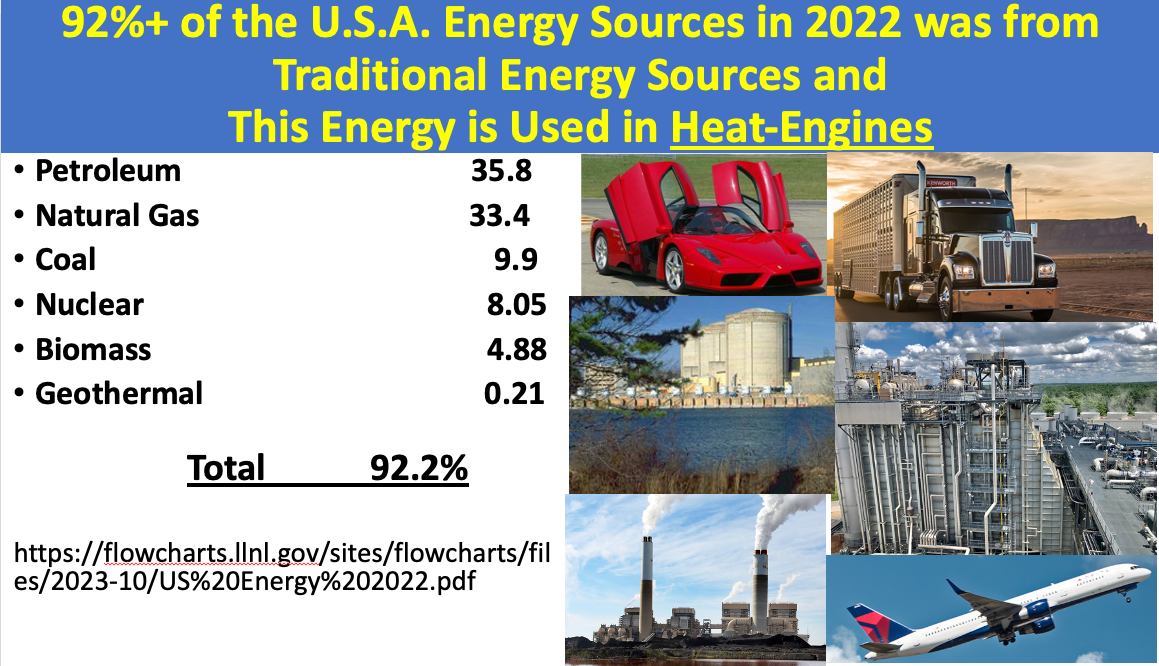
Let’s start with the largest Internal Combustion Engine ever built. The Wartsilla Marine Engine is credited to be the largest reciprocating Diesel engine in the world. These have been tested at up to 114,000 Hp.
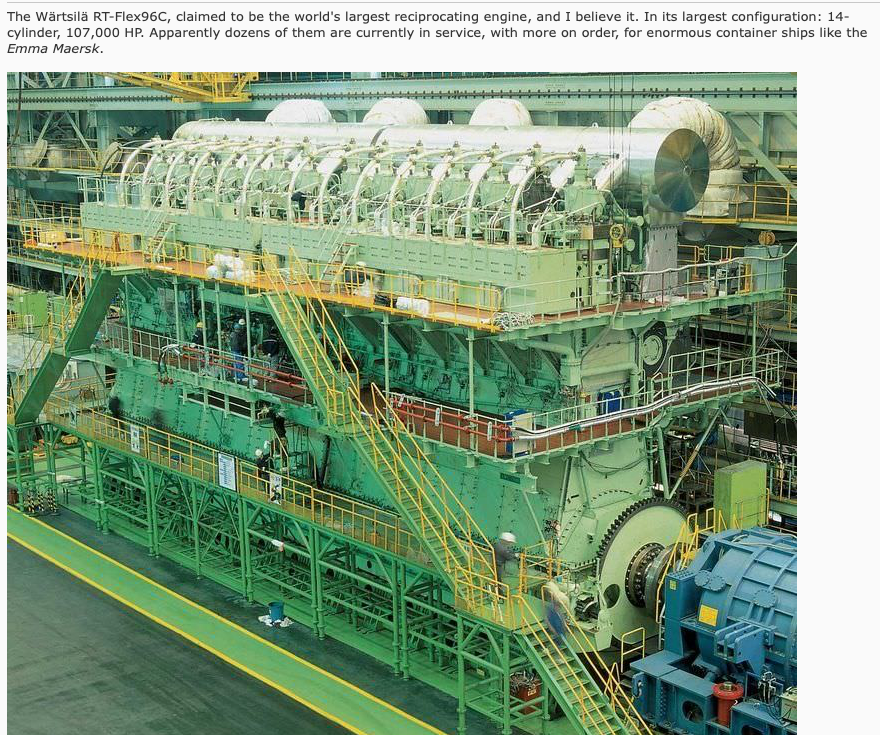
State of the art design Marine Propulsion Prime Movers Have Been Adapted for Use as Stationary Power Generation for a Long Time.
Electric Power generation technology progressed from ship and aircraft propulsion systems over the years. Many central station power plant systems have their roots in marine and aircraft propulsion. Consider these milestones for land, sea and aircraft:(14)
- Robert Fulton Steamboat Clermont-1807
- Otto invents the 4-Cycle Gas engine-1867
- Charles Parsons, invents Steam Turbine-1884
- Charles Parsons Steam Turbine drive on Turbinia-1894, Fastest Ship in the world
- Rudolf Diesel invents Compression Ignition Diesel engine-1895
- First large Diesel engines for Maritime use are in German Submarines during WWI
- Dr. Hans von Ohain (Germany) and Sir Frank Whittle (UK) are both recognized as being the co-inventors of the jet engine, later adapted to electric power generation-1933
- U.S. Nuclear submarine Nautilus launched 1954 powered by a PWR
- Nuclear powered Merchant Ship NS Savannah, launched 1959
- Largest Diesel Engine ever built-Wartsilla RTA96-C 107,000 HP-2006
Internal Combustion Engines for Electricity Generation
Large natural gas and Diesel powered generators are commonly used for Dispatchable backup power for areas served by large capacity of wind and solar generation. When the wind stops and sun is not shining, the Grid must be stabilized with adequate generation that is needed quickly. Internal combustion engines serve this need very well. The picture below is from a facility near Marquette, Michigan. This picture below is a 17 MW (24,000 Hp) gas engine. Multiple engines can be installed for total power capacity of over 225 MW as in the Denton, TX plant.
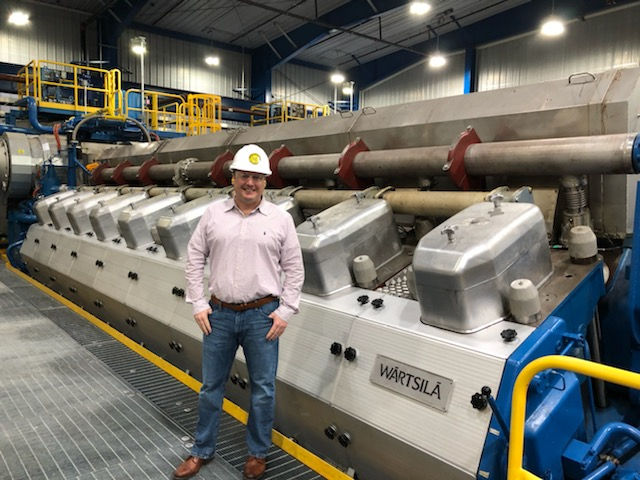
The advantages of the gas engines are: They have black start capability, fast load response, VAR (Volt Ampere Reactive) support, most importantly they can run 24/7 under any weather conditions and they are Dispatchable. The adaption from marine propulsion systems makes the features of black start and load responsiveness intrinsic in the design. These are referred to as “RICE”, an acronym for Reciprocating Internal Combustion Engines.

Aeroderivative Gas Turbines
The aeroderivative gas turbines also serve as tremendously reliable, Dispatchable and powerful prime movers for generators. The name aeroderivative is descriptive as these heat-engines have a long history of development and advancements in materials and design for reliable aircraft propulsion. Therefore, reliability is an intrinsic priority. One of the most common and proven designs is the G-E LM-2500 shown below.
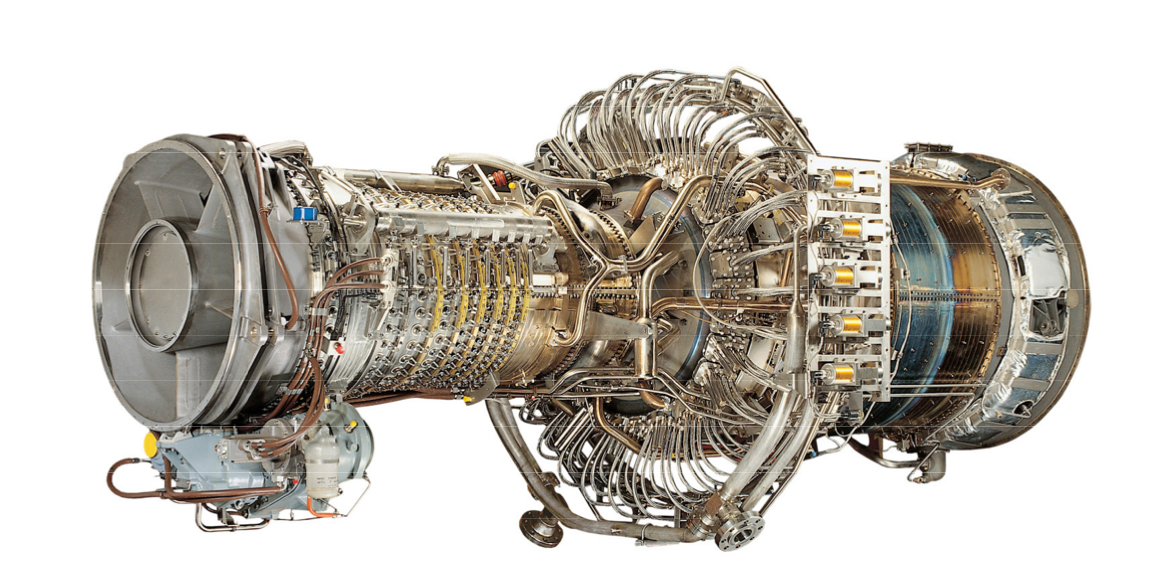
In Part I of this series I described the larger G-E Gas Turbines used with Combined Steam Cycles (GTCC) of the 600-700 MW capacity range. Like the internal combustion reciprocating engines, the gas turbine prime mover has the advantages of fast starts, Dispatchability, VARs support, 24/7 operation, rapid load response and quick shutdown. Truly flexible generation.
Heat-Engines in our Everyday Lives
The most common Internal Combustion Engines (ICE’s) of course are used in transportation. Automobiles, trucks, tractors, farm equipment, construction equipment, aircraft, ships and trains. According to the U.S. Department of Energy, about 37% of the total Primary Energy used in the U.S. during 2023 was for transportation. About 28 Quadrillion BTUs to be exact.

These are the forms of energy that power our lives each day. The ICE is a large part of our lives whether it is in powering our computer, providing illumination, powering industrial production, construction, farming and providing jobs. Also, very importantly for our freedom of travel…..providing the fuel for transportation of our families and friends.
Fertilizer, Farming, Food Production and Food Distribution
Perhaps farming and food distribution should be at the top of the list as it is one of the most basic human needs. Food production begins with fertilizer production which is off topic for this article, but fertilizer production represents a significant portion of total primary energy consumption. It is said by Vaclav Smil and other experts that synthetic fertilizer production is important to feed about 50% of the world’s population. Then, once fertilizer is produced; planting/harvesting/processing/Distribution of food progresses from farm to table. Energy is important every step along the way.(9)
The enormous productivity benefit of a Diesel tractor is obvious. The importance of energy in producing fertilizer, food processing, refrigeration and trucking distribution is not so obvious. However, much of food production farm to table, involves heat-engines and fossil fuels. In fact, the cost component of energy; farm to table is about 50% energy.

The IEA has analyzed the cost component of energy for common foods and documented that about 50% of food cost is from energy.(10)
Conclusions
Conventional forms of energy are important and it takes a lot of natural gas, petroleum, coal and nuclear to power and sustain our high quality of life. Those that believe wind and solar can replace conventional forms of energy during the next twenty years are delusionally misguided and indoctrinated with misinformation. Professor Vaclav Smil has documented this quite well, (He has written dozens of books on the subject and is, in fact one of the sharpest world energy experts)
Four components of our lives cannot be replaced by renewable power. Those four pillars of society are Fertilizer, Steel, Concrete and Plastics.(11, 15)

The “Heat-Engines” that Civil Society Depends on will remain important for a long time and so will fossil fuels. This three part series was intended to provide an overview of these magnificent machines.
Yours truly,
Dick Storm, August 10, 2024
References and Information for further reading and research
- Interesting Engineering: https://interestingengineering.com/lists/15-of-the-largest-engines-in-the-world
- History of Large Gas Engines, Newcomen Society: https://fredstarr.com/wp-content/uploads/14.-Large-Gas-Engines-Lawton.pdf
- Denton Energy Center, 225 MW Wartsilla Natural Gas Engine Power Plant:
https://www.cityofdenton.com/335/Denton-Energy-Center-DEC - Wartsilla Marine Engines and Generators:
https://www.wartsila.com/marine/products/engines-and-generating-sets - Power Magazine, Article on Marquette Energy Center, Michigan: https://www.powermag.com/new-gas-fired-plants-come-online-in-michigan/
- Wartsilla article on Marquette Power Plant:
https://www.wartsila.com/energy/learn-more/references/utilities/marquette-energy-center-usa - G-E Aeroderivative LM2500 Gas Turbines: https://www.gevernova.com/content/dam/gepower-new/global/en_US/downloads/gas-new-site/resources/reference/ger-4250-ge-lm2500-g4-aero-gas-turbine-marine-industrial-applications.pdf
- Largest Diesel Engine in the World, Wartsilla 2006: https://en.wikipedia.org/wiki/Wärtsilä-Sulzer_RTA96-C
- Energy used in Agriculture, Vaclav Smil article: https://www.vaclavsmil.com/wp-content/uploads/docs/smil-article-worldagriculture.pdf
- IEA Report on How the Cost of Energy is Exacerbating the Cost of Food, 2022: https://www.iea.org/commentaries/how-the-energy-crisis-is-exacerbating-the-food-crisis
- Time Magazine, with Vaclav Smil on the four Materials our Society Needs from Fossil Fuels, Ammonia, Steel, Plastics and Cement: https://time.com/6175734/reliance-on-fossil-fuels/
- Part I of this series: https://dickstormprobizblog.org/2024/07/30/the-magnificent-and-indispensable-heat-engine-on-which-civil-society-depends-part-1-heat-engines-1-3-million-horsepower/
- Part II of this series: https://dickstormprobizblog.org/2024/08/07/the-magnificent-and-indispensable-heat-engine-on-which-civil-society-depends-part-ii-focus-on-fossil-fuels-for-ocean-shipping/
- A Short History of Power Generation, 1850-1955, Part I: https://dickstormprobizblog.org/2022/01/14/a-short-history-of-energy-electricity-and-how-our-high-quality-of-living-came-to-be-high-human-development-index-part-1-1850-1955/
- Four Pillars of Civilization, Ammonia, Cement, Steel and Plastics: https://dickstormprobizblog.org/2022/07/25/pillars-of-modern-civilization-all-dependent-on-energy/
 Dick Storm's Thoughts on Energy, Education, Economic Prosperity & Environmental Blog
Members of The Energy Realists of Australia are using the concept of the Tipping Point to explain the urgency of the situation as hydrocarbon capacity runs down to the point where nights with little or no wind will trigger blackouts.
https://newcatallaxy.blog/2023/07/11/approaching-the-tipping-point/
The green energy transition is not happening and the reason can be summed up in two words WIND DROUGHTS.
These were not anticipated because the meteorologists didn’t issue wind drought warnings and the energy planners didn’t check the reliability of the wind supply. They were happy to rely on average wind velocities which miss both the high and low levels, each of which are unsuitable for generating power.
It’s as simple as ABC.
A Input to the grid must continuously match the demand.
B The continuity of RE is broken on nights with little or no wind.
C There is no feasible or affordable large-scale storage to bridge the gaps.
Hence there will be no transition from conventional power to wind and solar power with existing storage technology.
The subsidies and mandates for unreliable energy are driving out coal and a TIPPING POINT is approaching where the capacity of coal power generation will not be sufficient to meet demand on windless nights.
https://newcatallaxy.blog/2023/07/11/approaching-the-tipping-point/
The same thing is happening in all the grids in the world where net zero policies are in place. Britain, Germany and South Australia have passed that point and they keep the lights on precariously with imports and deindustrialization to reduce demand.
Wind droughts are the root of the problem. This is a brief survey of this failure of the meteorologists to issue wind drought warnings and the way independent investigators in Australia documented them.
https://quadrant.org.au/opinion/doomed-planet/2024/06/things-that-go-slump-in-the-night/
Similarly the meteorologists and energy policy planners in Europe missed the Dunkelflautes that must have been known to mariners and millers for centuries!
https://www.flickerpower.com/images/The_endless_wind_drought_crippling_renewables___The_Spectator_Australia.pdf
The next big thing in Australian energy policy will be an exit strategy to get back to affordable and reliable power and clean up the mess of wind and solar assets that will be stranded when they subsidy’s and mandates for unreliable energy terminate.
LikeLike
The list of briefing notes compiled by The Energy Realists of Australia and circulated to state and federal lawmakers from 2020 to 2022.
https://www.flickerpower.com/index.php/search/categories/general/list-of-briefing-notes
LikeLiked by 1 person
My mistake, those comments were written for the later piece on the need to keep burning coal to get over the crisis in the power supply. It’s past my bedtime in Sydney:)
The case for coal is overwhelming in Australia because we have no nuclear power, limited legacy hydro and gas is too expensive to burn outside peak periods.
I will transfer the comments to the right thread:
LikeLike