Category Archives: economic prosperity and energy

830,000 Btu’s per Day/Person

Lawrence Livermore Laboratory Energy Flows of the U.S.A. 2020

Congress and our President are in the process of forcing Net Zero Carbon, Green Energy on all of us. In my view what this will do is increase prices of energy, make our energy less reliable, make America less competitive and in general, harm our quality of life. In thinking about this and attempting to explain why I feel this way, it occurred to me that if all of the citizens knew where our energy comes from and how much we depend on it each day, perhaps more of us would pressure our Congressmen/Congreswomen to resist this foolishness. So, here is my stab at explaining where our energy comes from and why the “Green New Deal” is so harmful.

I have been involved in the energy business for many years and the one chart that explains energy flows best, is the DOE Sankey diagram above. This shows the sources of all of our energy and how it is used throughout the economy. I have been watching this for about 20 years and interestingly, the total U.S. energy use has held steady at about 100 Quadrillion Btu’s per year. In fact, I will show a graph below of the U.S. Energy use by year from 1950-2019.

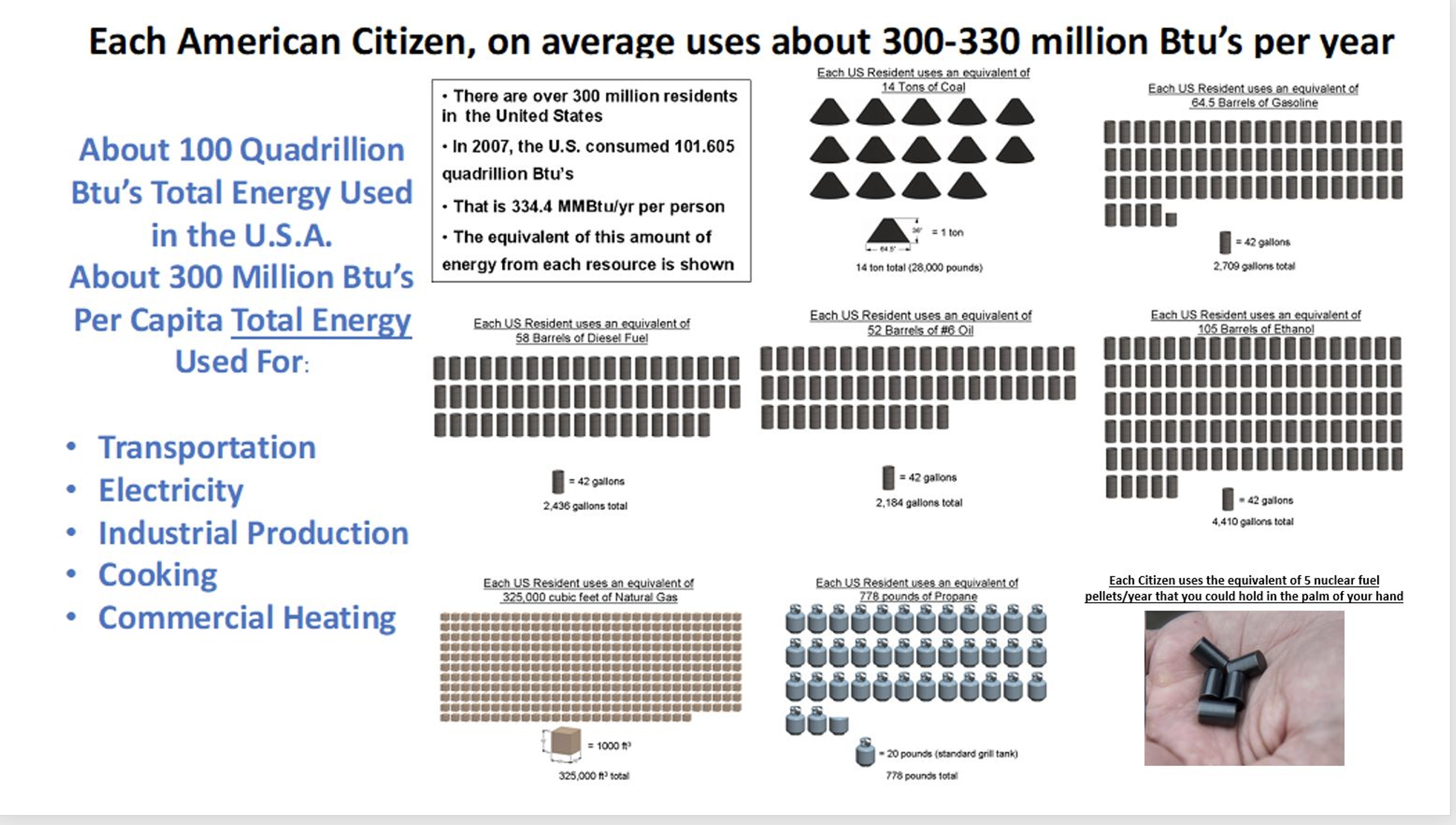
Where does the 830,000 to a million Btu’s per day come from? If we divide 100 Quadrillion Btu’s by the population of 330 million, then the per capita energy use is about 303 million Btu’s/person/year. Divide the 303 million Btu’s per person/year by 365 days and it comes out to about 830,000 Btu’s/day/person.

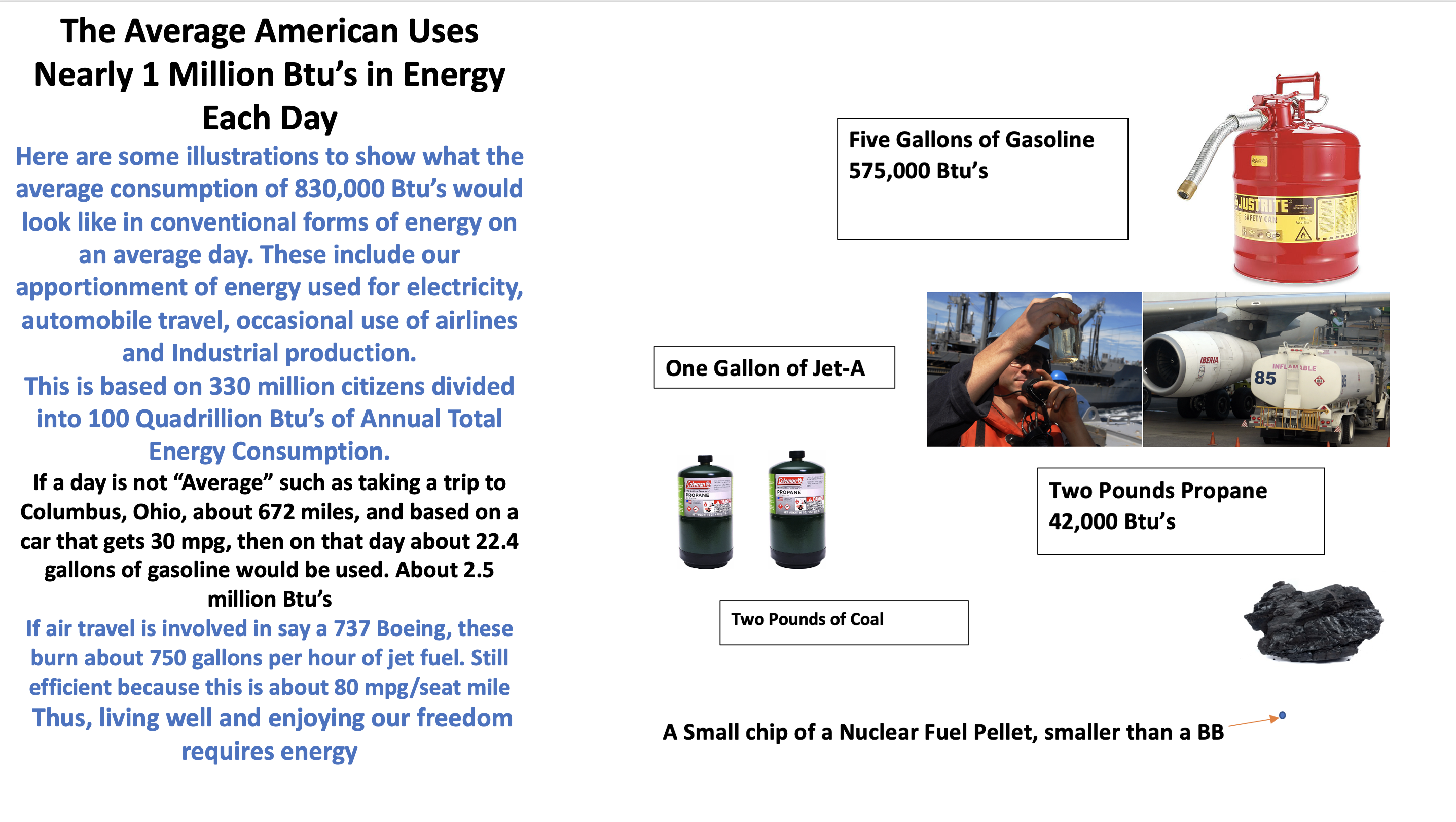
This is average and of course, a person living in a small condo that does little travel, will use less energy than a person who lives in a 2500 square foot home, owns a small fishing boat and travels the world. Lets say the latter example would use more than a million Btu’s per day. This energy could be in gasoline, natural gas, propane for the grill, electricity for HVAC of the home and for cooking. Included in the allottmant of per capita energy use is our share of industrial production, commercial buildings, shipments of goods and government use for the military. Below is an illustration of the forms of energy we might use each day.

So what does this have to do with the “Green New Deal” and the Clean Energy Plan Congress is about to pass? Well, if we are accustomed to living productive lives using conventional energy sources such as outlined above, then how can we sustain our high quality of lives by substituting wind turbines and solar panels for the 96.2 Quadrillion Btu’s provided by conventional forms of energy? Note that on the first figure above, the Sankey diagram I have inserted the total wind and solar in 2019 provided 3.8% of our energy. Petroleum, natural gas, nuclear, coal, biomass, geothermal and old hydropower dams provided the other 96.2%

Let’s get to electricity. The total energy used in 2019 was 100 Quadrillion Btu’s and 37% of this was used to generate electricity. So if we look into the future of EV’s and eliminating the internal combustion engine, then the energy used for transportation will need to come from electricity. Lots more electricity. How does the “Net Zero 2050” proponents think they will get to zero carbon emissions? By windmills and solar. Lots of windmills and solar. Here is an illustration from the Princeton University Net Zero Path.

My opinion is that if this path is taken, it is totally impractical and harmful to America, our way of life and our national security.

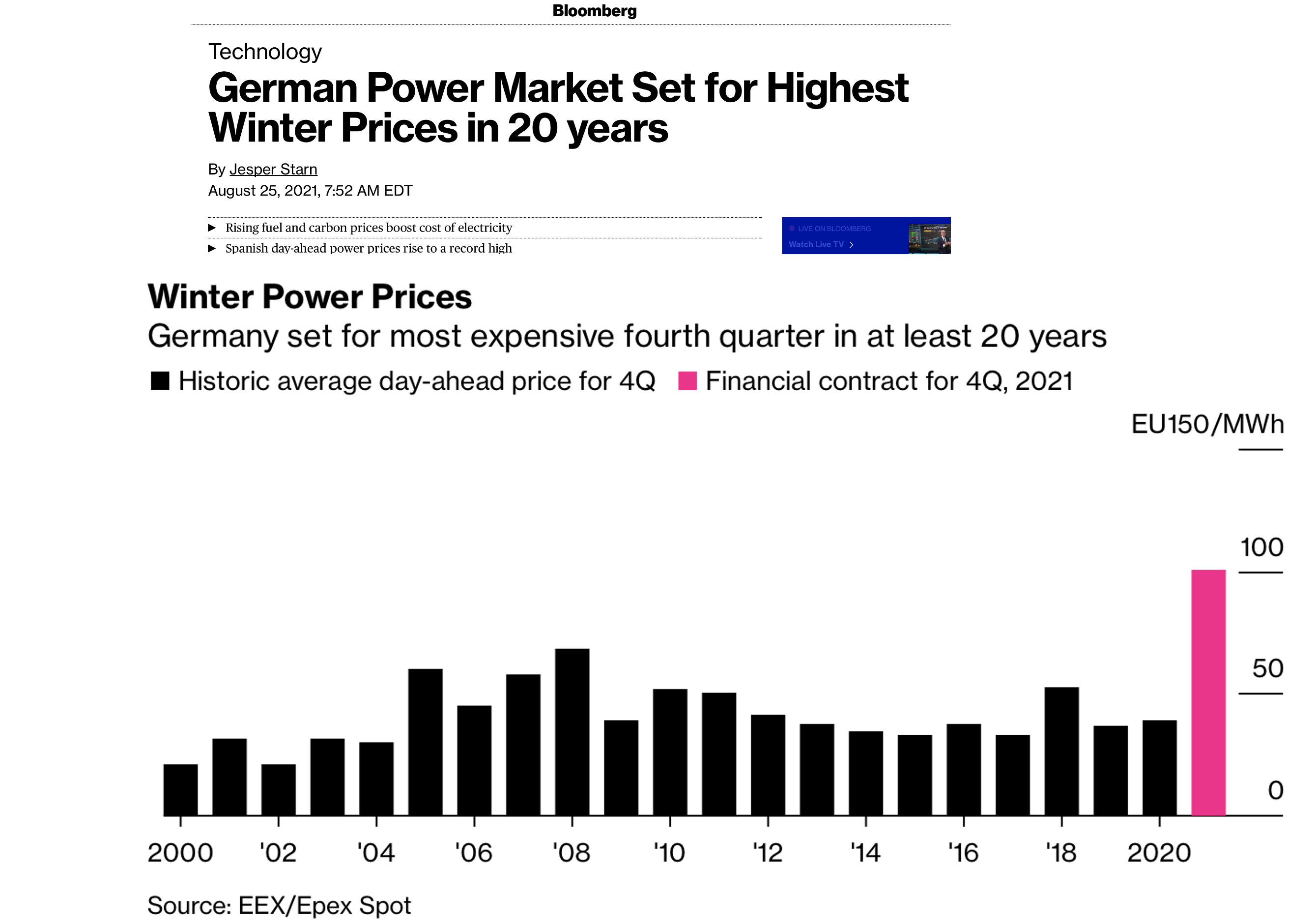
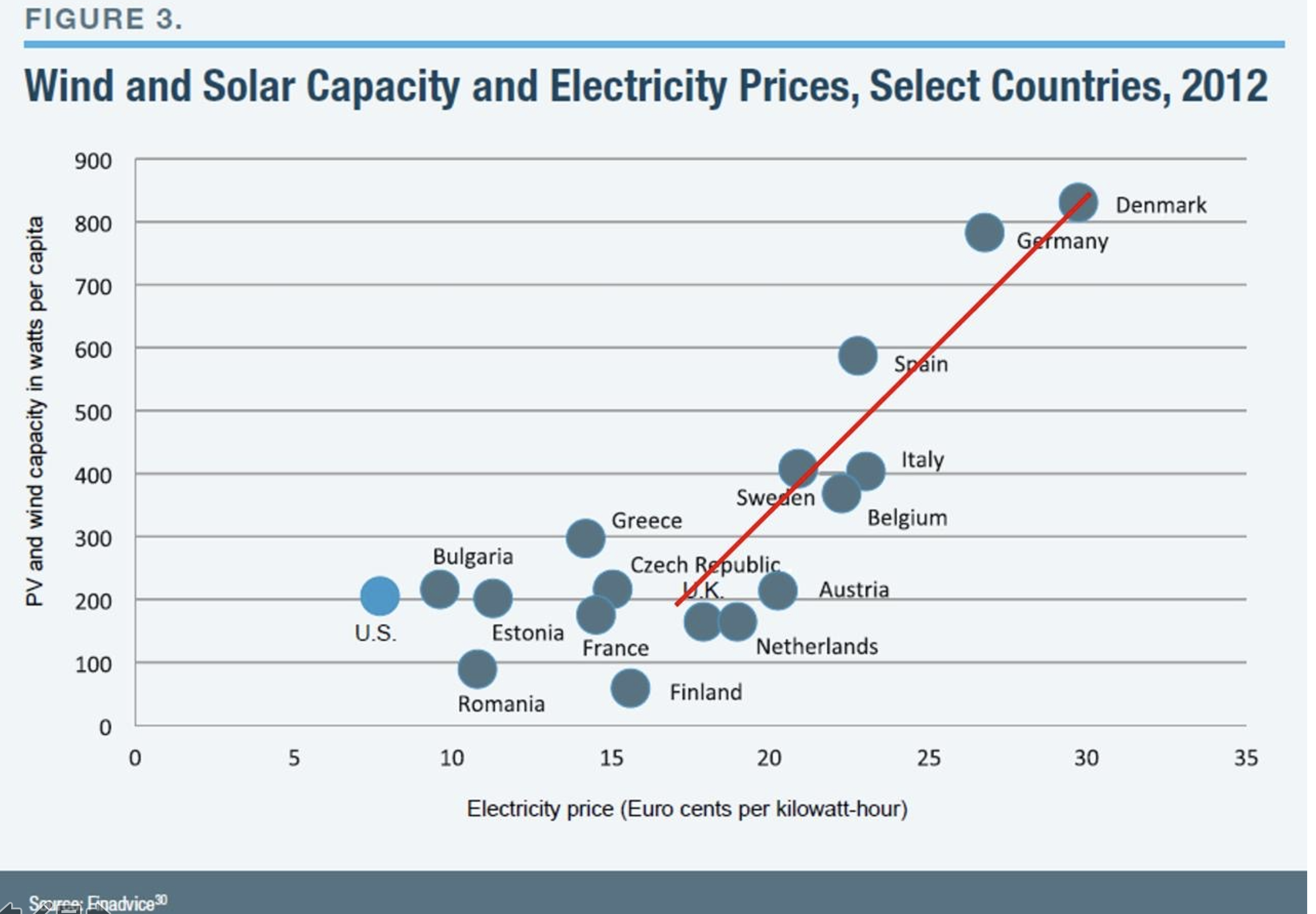
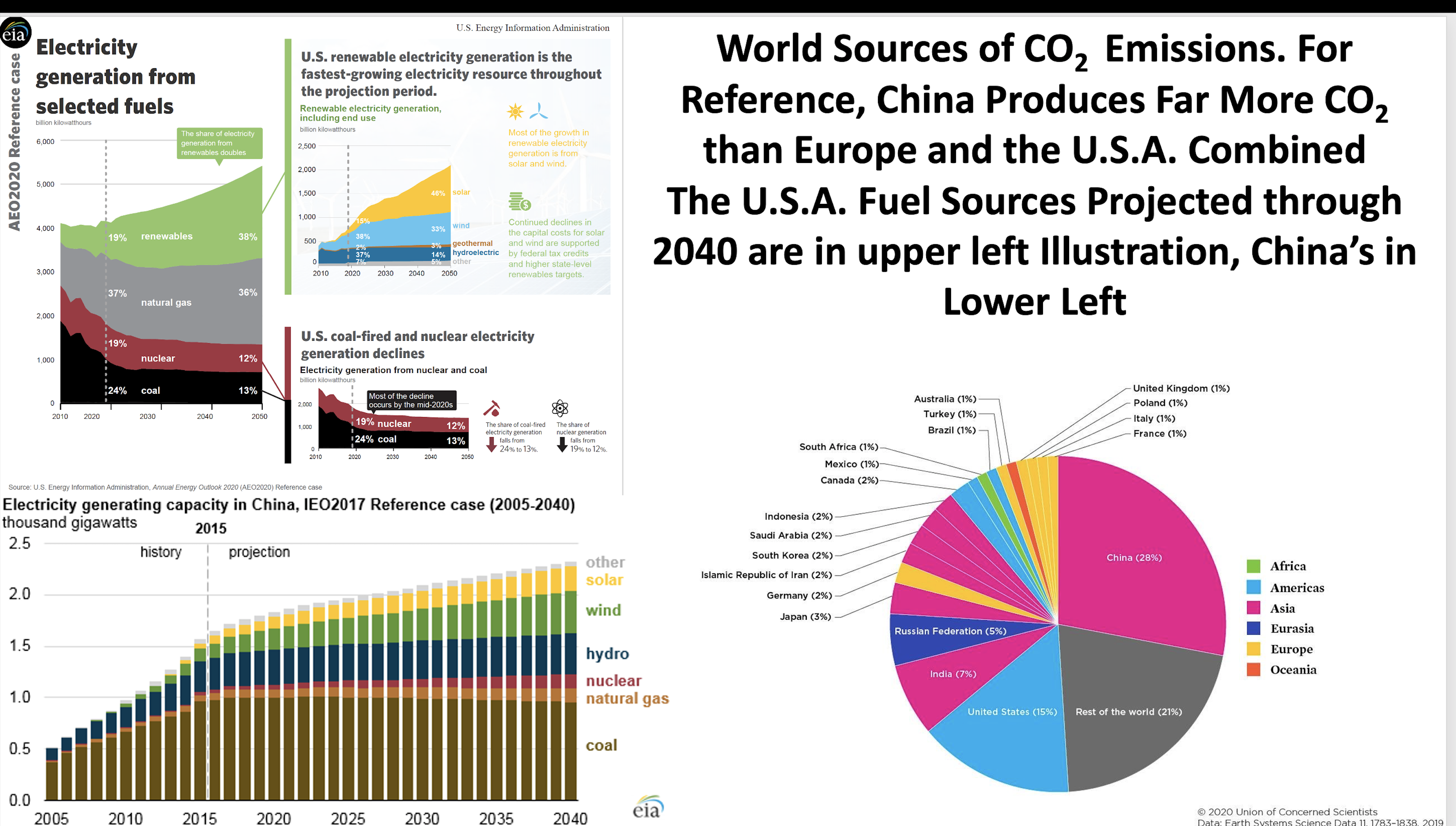
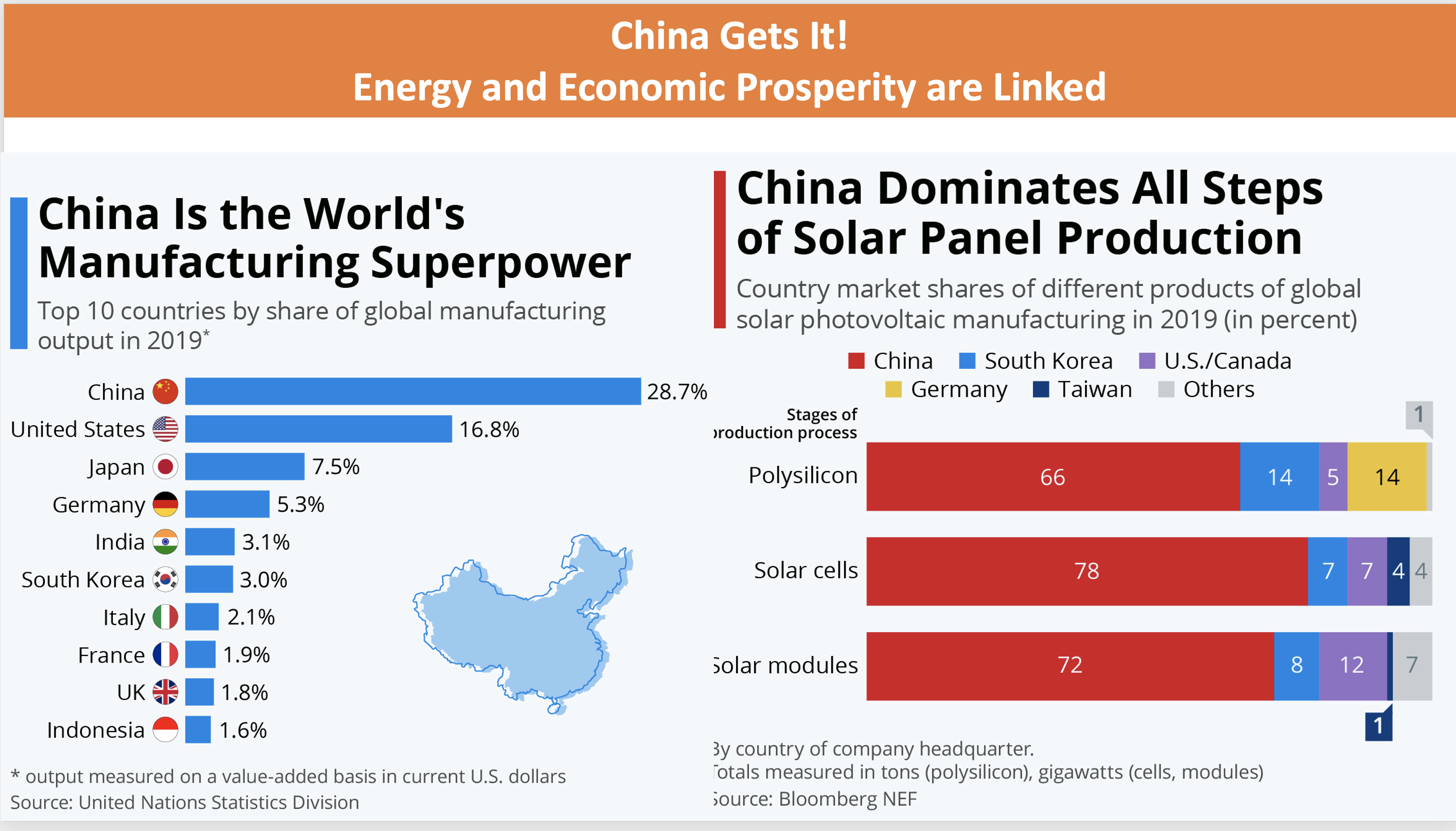
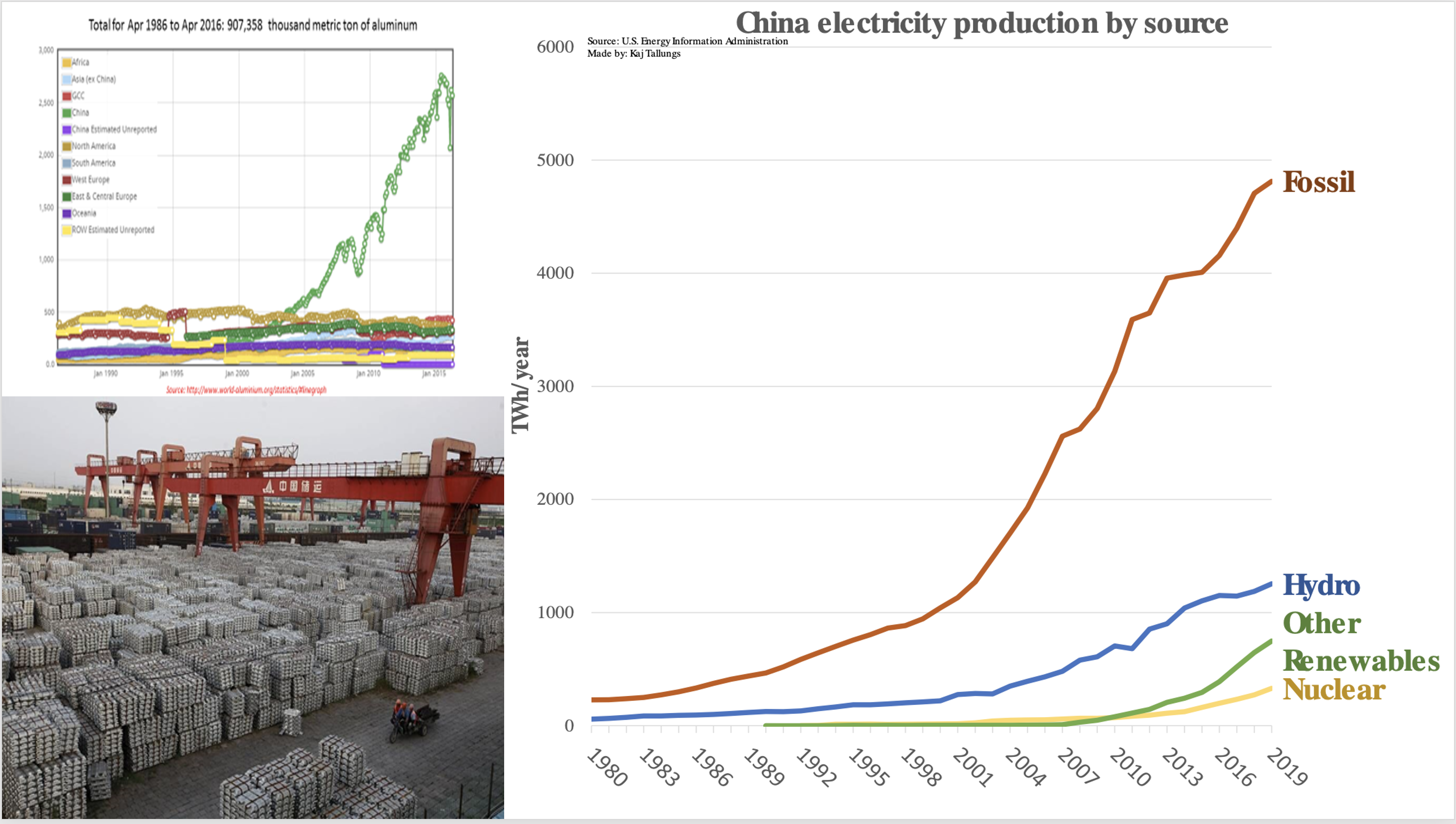
After many years of tax subsidies, wind and solar produced 3.8% of our energy in 2019. Texas, Hawaii and California have their own applications of too much renewable power which resulted in Blackouts in CA and TX and the highest electricity costs in the nation for Hawaii. How can we expect zero carbon based fuels by 2050 and still maintain a strong economy and enjoy our way of life. Perhaps more important to our grandchildren, keep English as our primary language, not Mandarin? The next three charts show the relationship of carbon emissions and manufacturing by a few selected countries.

I will close with the fact that according to a report I saw in S&P Global, China has the four largest banks in the world. The relationship of energy use and economic prosperity cannot be denied. China built more power generation in twenty years than America did since Thomas Edison’s first Pearl Street Station was commissioned.

Vaclav Smil’s quote of “Energy is the Universal Currency” comes to mind.

China loves America’s Net Zero 2050 and the “Green New Deal” Maybe they even wrote them?

Dick Storm, September 16, 2021

93.5% of America’s energy is used in Heat-engines to drive our economy and power our comfortable lives: 80% is from fossil fuels

This huge amount of energy is not easily replaced by alternative fuels! My response to an ASME webinar on forcing a “Green Grid” on America.

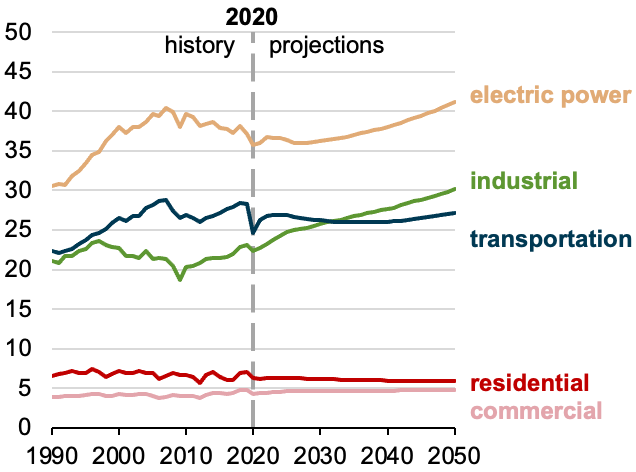
From EIA Annual Energy Outlook Jan. 2021

All Fuels Are Important, but Thermal Power Generation Is Still Number 1

Last month I participated in a continuing education webinar presented by the ASME Mechanical Engineering Magazine. I was upset by the lack of practicality and missing common sense of the presentation. Thus, I wrote a letter to the ASME Magazine’s Editor. The text is copied below.

Throughout my career—and also through the ASME’s long history (ASME’s, American Society of Mechanical Engineers, Boiler and Pressure Vessel Code, B&PV Code saved millions of lives and advanced our country!)—thermal power generation has been the greatest source of dispatchable electricity generation. In my view, policymakers have run a very good and smooth evolution of power generation diversity off the rails. The Biden Administration (probably with advisors like Dr. Jenkins) and Democrat Congress policies constitute an anti-American war on carbon. These policies, if continued, will in fact be extremely harmful to the country’s economy, national security, and eventually, when considering bans on oil and gas production and pipelines in the U.S., our freedoms. Further, if continued as Jenkins, Biden, Kerry, Et Al wish, will contribute to the decline of western civilization. (by strengthening China, Russia, Iran and their allies)

There is not space here to debate climate change, whether manmade or natural. Suffice it to say, I believe climate and weather changes are, for the most part, driven by natural forces of solar activity, ocean currents, volcanoes, tilt of the earth, and other uncontrollable dynamics. The pressure to rejoin the Paris Agreement is driven by other countries that wish to see America decline in power and influence in the world. China will gain the most by America’s decline. Princeton’s Dr. William Happer provides an excellent summary with a segment beginning at minute 24 where the effects of CO2 are discussed. https://bit.ly/3zsXcS6

Reasonable cost, and abundant, energy and electricity are crucial for our economy and the functioning of our society. Over the years, it has been well-documented that all advanced economies grow in proportion to energy use. America’s economy grew in direct proportion to its energy use over the 130-plus years since Edison’s Pearl Street Station commenced operation. 

China’s economy grew from being a poor and developing country in the year 2000 to now being the world’s largest manufacturer and world’s second-largest economy. China produces more than 50% of the world’s steel and aluminum, as well as being the largest producer of manufactured products. China plans to become larger than the U.S. and is likely to pass America as the world’s #1 economy in a few years. Biden’s policies will accelerate the growth of China’s economy and the decline of America’s. To reach the status of the world’s largest manufacturer and largest producer of steel and aluminum, China built more electric power generation in the past 20 years than America did since Westinghouse and GE were founded. Remember George Westinghouse? One of America’s finest engineers.

Energy and economic prosperity go hand in hand. So, let’s look at where our energy comes from. America has used right at 100 quadrillion Btus per year for about the last 10 years or more.  (last year was about 93 Quads due to the pandemic) According to the U.S. Energy Information Administration (EIA), the U.S. used 100.2 quadrillion Btus in 2019. 

More than 90% of the U.S.’s primary energy consumption in 2019 was provided for use by thermal heat engines. This is comprised of about 36.8% petroleum, 32.1% natural gas, 11.3% coal, 8.4% nuclear, and 4.9% biomass. The total renewable energy consumption (excluding biomass) was 6.4%, and a significant portion of that bulk power (40%) was from hydroelectric. This primary energy use includes transportation, commercial, residential, and industrial use. Electricity consumption of our total primary energy was 37.1%.

When politicians and the mainstream media talk about energy- and planet-saving electric vehicles and renewable power generation, I think it would be wise to consider that, if we like our status in the world, and our current comforts and conveniences, then we will need at least 100 quadrillion Btus of energy per year for the foreseeable future. At present, about 93.5% of our total energy is used in heat engines and only about 6.4% is supplied by non-biomass renewables. That’s right. Check the EIA website to see for yourself.

To say changing from 93.5% heat engines to renewable power generation and electric vehicles will be disruptive is a gross understatement. In time, renewable power advances and green hydrogen from renewables will eventually come. But for the next 10 years or more, America should stay the course with modernizing our current fleet of natural gas, nuclear, and coal plants. These are what we depend on and the mid-February rolling blackout experiences in Texas should be a wake-up call to policymakers.

Another example is Hawaii, which plans to shut down its lowest cost power plant—Barbers Point coal plant. As the state moves toward its version of the new “Green Deal,” Hawaii has the highest cost electricity in the nation. Not a problem for an economy based on tourism and government facilities, but $0.25 kilowatts will not permit competitive primary metals production or competitive manufacturing in the contiguous 48 states.

In my adopted state of South Carolina, about one-third of the total electricity is used by industry. South Carolina has a thriving industrial sector, and it depends on reasonable-cost and reliable electricity. Sacrificing reasonable-cost conventional power generating plants to replace with renewables will drive much manufacturing overseas (again). 

As I read the plans for South Carolina’s coal plants, all of which I have worked at and know very well, I see that several more coal units are planned to be shut down in the next 10 years. These are to be replaced with solar or other renewables. Currently, more than 55% of South Carolina’s electricity is generated from nuclear power. Therefore, replacing coal with renewables may not be a problem, if the South Carolina nuclear units keep running indefinitely. However, several of these nuclear units are into their second licenses and will begin shutting down in the 2030s. As I see it, this sets ourselves up to follow California, Hawaii, and Texas into higher-cost power production and less-reliable power supplies. All fuels are important!

Let’s review the last 15 years of fuel changes in the U.S. In 2004, electric power generation was about 92.4% thermal generation. In 2019, the percentage of thermal generation was still the highest at 83.6%. Natural gas made the largest gain at the expense of coal. Wind grew from 0.4% to 7.1% over the 15-year period. Now, if policymakers are concerned about electric reliability and competing in the world with manufactured products, they should rethink the trends toward more intermittent non-dispatchable renewables.

Americans have lived through disruptions before. I lived in a small town in North Carolina, which the county seal showed textiles and aluminum production as being the most important for its economy. Then, after the North American Free Trade Agreement (NAFTA) went into effect, the textile mills closed down, killing about 7,000 jobs in a county with 60,000 people. A few years later, Alcoa Corp. shut down the aluminum smelting plant that had been in operation for more than 100 years, causing another 750 or so jobs to be lost. Aluminum smelting is very energy intensive, it takes about 5 kWh to produce one pound of aluminum. It doesn’t take a world class Economist to understand how China has become the world’s largest producer of steel and aluminum. China uses about 57% of the world’s coal to power their industry. True, China uses more coal than all of the rest of the world put together.

In Texas, I did much work from 1978 onward at an Alcoa plant in Rockdale, as well as at numerous coal plants. Rockdale was the largest aluminum smelter in North America, and it was shut down in 2008 due to oversupply of aluminum from China. Over 6,000 MW of reliable, reasonable-cost coal power generation has been shut down in Texas since 2008. Had these coal plants not been retired, perhaps the events in mid-February may have played out differently.

Energy and economic prosperity are inter-related. The Green New Deal and more renewable power will harm America’s competitive advantage. If we think February was a bad month for electric reliability, imagine what the Green New Deal and further accelerated disruptive changes to renewables will do to the rest of the U.S. Preserving our good lives requires about 100 quadrillion Btus per year. In my view, obtaining this energy from all available fuels within our borders is important.

I suggest that the ASME publications and energy programs consider the facts of All Fuels and why they are important for our country.

Respectfully submitted,

Richard F. Storm, PE

Sustainability of our high quality of life depends on reasonable cost electricity

Energy, is the only universal currency”

The author of several books on energy, Vaclav Smil is quoted as saying “Energy is the only universal currency: one of its many forms must be transformed to another in order for stars to shine, planets to rotate, plants to grow, and civilizations to evolve.”

Most American citizens simply take abundant, reliable and reasonable cost energy for granted. It is not until a major pipeline is shutdown as the Colonial Pipeline was last year by hackers. Or, there is severe weather such as a hurricane that shuts down refineries and/or topples electricity transmission towers. Only then does the average American notice just how important energy is to our lives. As important as energy is to us, we are allowing politicians who know very little about the production of energy, electricity generation, transmission and distribution of energy to, “Completely transform America’s energy infra-structure with the Green New Deal” I wrote last year on Hawaii’s path toward the “Green New Deal”, Here is the link: https://wordpress.com/post/dickstormprobizblog.wordpress.com/32

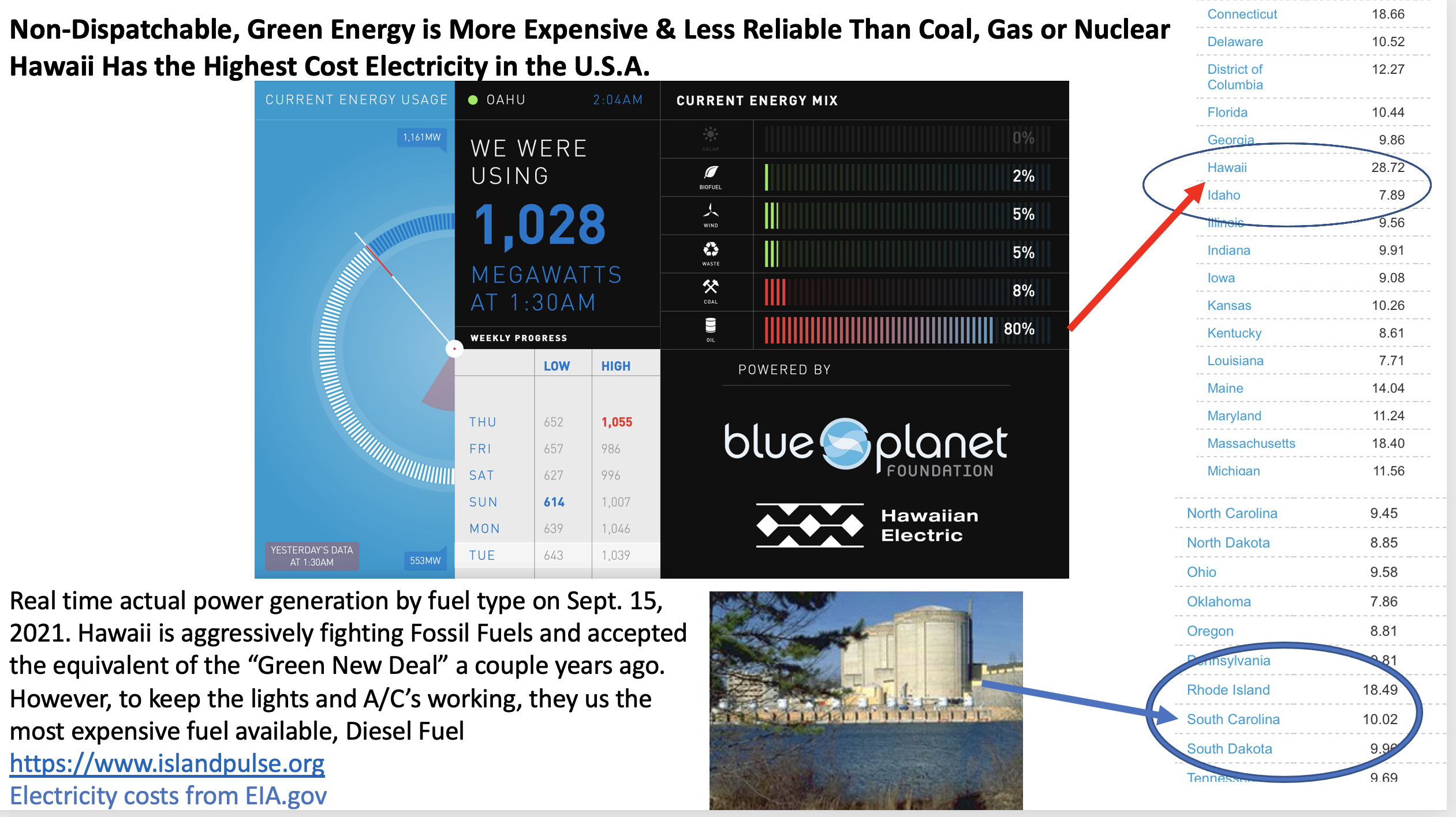
I used Hawaii as an example, because Hawaii is literally an energy island and is not connected to the American Electric Grid. Thus, it provides a perfect laboratory to expose the results of going green, or at least moving in that direction. Because of the isolation from competitive electricity supplies, the change to more green generation is making a much faster impact on electricity pricing. There is not the ability to import low cost coal or natural gas power from other states as say, California can. Because of the intermittant nature of renewable power (Non-Dispatchable), much of Hawaii’s electricity is generated from oil fuel. In fact, you can get a real time update on the generation source here: https://www.islandpulse.org

Oahu has a very reliable and clean coal plant, Barber’s Point. The real time screen shot above shows 14% of Oahu’s power was being provided at this moment. Unfortunately, because of unreasonable Political reasons, the coal plant is scheduled for premature shutdown. Just because the elected officials have their own war on carbon. Their intentions may be pure but in reality to keep the power supply reliable, much of the electricity generation is from oil fuel. (no natural gas pipelines in Hawaii either, thus, oil backup power) Most of the cost of electricity (about 75% for coal and 90% fuel cost component for natural gas or oil) production from a Thermal Power Plant is for fuel. Therefore, using Diesel Fuel which second only to hydrogen, is the most expensive fuel available. As time goes on, the higher production cost of electric generation must be passed on to the Rate-Payers. Thus, Hawaii has the highest electricity costs in America. Note the chart below provided by the Electric Choice.com web site. The average retail cost of electricity in America is about $0.13/kWh. As shown below, Hawaii’s is $0.327/kWh

Critics can say that electricity is a small cost of our household expenses. That, high electric costs such as Hawaii and California have is not a big deal. Well, in my state of South Carolina, manufacturing (jobs) is still a large part of our economy. We have NUCOR Steel and Century Aluminum manufacturers. The production of vital steel and aluminum that we need is very electricity intensive. So, perhaps Hawaiians can enjoy life and their economy thrive. Tourism and government facilities can absorb the high electric costs, competitive manufacturing cannot. My state cannot. Just for reference, over 50% of our electricity in SC is generated by four well run nuclear power plants. These nuclear plants plus reasonable cost natural gas and coal plants keep our electricity costs below the National average. The generation is “Dispatchable too!” That means, electricity load can be increased or decreased as customer demand fluctuates.

All of us should be aware of China’s dominating world manufacturing. China produces over 50% of the world’s steel, aluminum and concrete. China uses over 57% of the world’s coal production for electric power. Yes, China is the most productive and least cost producer of many products manufactured in the world. China the last time I checked, produces about 28% of the world’s manufactured goods. I submit that electricity prices matter. Reasonable cost electricity is absolutely required for competitive manufacturing.

My presentation to the Delaware County Bar Association in July 2016 has some facts and information on how China crushed ALCOA’s aluminum production. This is at this link:

https://wordpress.com/post/dickstormprobizblog.wordpress.com/24

My personal experiences included working (as a contractor/consultant) for ALCOA all over the world at their Alumina and Aluminum smelting facilities. I made many friends with Alcoans from 1978 till about 2012. Then, huge plants such as the Rockdale Texas Smelting operation, the smelter at Suriname, SA and others were shut down. Why? Becuase aluminum requires about 5 kWh per pound to produce the metal. This is just for the smelting operation. More energy is required for alumina production and transportation. Energy costs matter for economic prosperity. For many of my friends at ALCOA, the Chinese dumping of aluminum on the London Metal Exchange, meant early retirement or job changes.

The “Green New Deal” is anti-American and will weaken America’s competitive capacity. Conversely, the “Green New Deal” will strengthen China’s grip on world manufacturing. Their dominance in solar panel manufacturing is well documented.(4) The Green New Deal if passed will be a (another) huge gift to China.

Donn Dears has an excellent website where he provides information on energy, Net Zero Carbon, Electric Vehicles electricity generation, nuclear power generation, hydrogen and much more. Here is the Power for the U.S.A. Blog address: https://ddears.com/donns-articles/ I strongly recommend reading Donn’s articles. He has a knack for writing short concise posts with ample facts and references.

Conclusion:

The changing of America’s electric power generation to becoming carbon free is not practical and in fact, with today’s technology, impossible. I submit the case study of Hawaii’s experiences to show the fallacy of committing to new renewable power sources to quickly. California and Texas have experienced Blackouts because of too much intermittant renewable power and not enough reliable and Dispatchable generation capacity. (Key phrase, Dispatchable Electric Generation capacity) Why would we enact policies and Regulations that make America weaker and less competitive with China?

Dick Storm, August 20, 2021

References:

  1. Island Pulse website by Blue Planet Foundation for real time electric generation data for Hawaii Electric on the island of Oahu. https://www.islandpulse.org
  2. Electric Choice.com for electric rate comparisons of 50 states.

3. Donn Dears Blog: Power for the U.S.A. An excellent collection of relevant articles on energy and electric power generation. https://ddears.com/donns-articles/

4. Coalition for a Prosperous America, report on Solar Panel Manufacturing and dominance of China: Coalition for a Prosperous America report on Solar Panels from China: https://prosperousamerica.org/cpa-releases-report-on-reclaiming-the-us-solar-supply-chain-from-china/

FREEDOM IS NOT FREE, NEITHER WILL NET ZERO CARBON BE FREE

Reducing Reliability and Increasing Prices of Our Energy Supply

Introduction

Vaclav Klaus was the President of the Czech Republic in 2003. I have a copy of his book, “Blue Planet in Green Shackles” with the sub-title, “What is Endangered: Climate or Freedom”

As I was straightening up my book case, I found this interesting insight from nearly 20 years ago. I started paging through the book and one quote by Klaus caught my attention.  “As someone who lived under communism for most of my life, I feel obliged to say that the biggest threat to freedom, democracy, the market economy and prosperity at the beginning of the 21st century is not communism or its various softer variants. Communism was replaced by the threat of ambitious environmentalism.”

Klaus’ book reminded me of my friend Tom’s experience as a Charlotte, NC,  City Ambassador during the 2008 Democrat Party Presidential Convention. Tom, like me was also employed in the energy industry for many decades. So, when energy issues were discussed, his antenna went up.  He heard influential leaders of the Democrat Party strategizing on how to wage the war on coal. Their reasoning was, If they could craft policies to increase coal generated electricity prices, then solar and wind power will become competitive.  Obviously, President Obama won that election and the war on carbon accelerated during his eight years.

These two examples of green policy intentions on two continents are the inspiration for this article. My last post was a reminder that in America we depend on (including the Btu equivalent of renewable generated electricity) about 100 Quadrillion Btu’s each year to fuel our economy. Over 85% of that energy is used in heat engines. So called, because steam turbines, reciprocating gasoline or Diesel internal combustion engines, jet engines and stationary gas turbine generators are all Heat-Engines. Heat-Engines convert the chemical (or nuclear) energy of fuel to heat that is then applied as shaft horsepower, motive force or jet thrust for producing electricity, transportation or industrial production. 
Reasonable cost and reliable energy are important for us to continue our high standard of living.

Below is the Lawrence Livermore Laboratory Sankey Diagram which shows the energy flows from 2019. This was a more normal year of economic activity. The total energy used was right at 100.2 Quadrillion Btu’s. If you study the energy flows, you can verify the conclusion that most of our energy is used in heat engines. Heat engines such as; steam turbines which are used to generate electricity from coal, natural gas, nuclear, geothermal, biomass and petroleum. Gas turbines that are used for stationary power generation, ship propulsion, turbo-prop aircraft propulsion. Diesel engines for trucks, buses, farm tractors, railroad locomotives and backup electric power generation, jet aircraft engines, gasoline for automobiles and trucks.

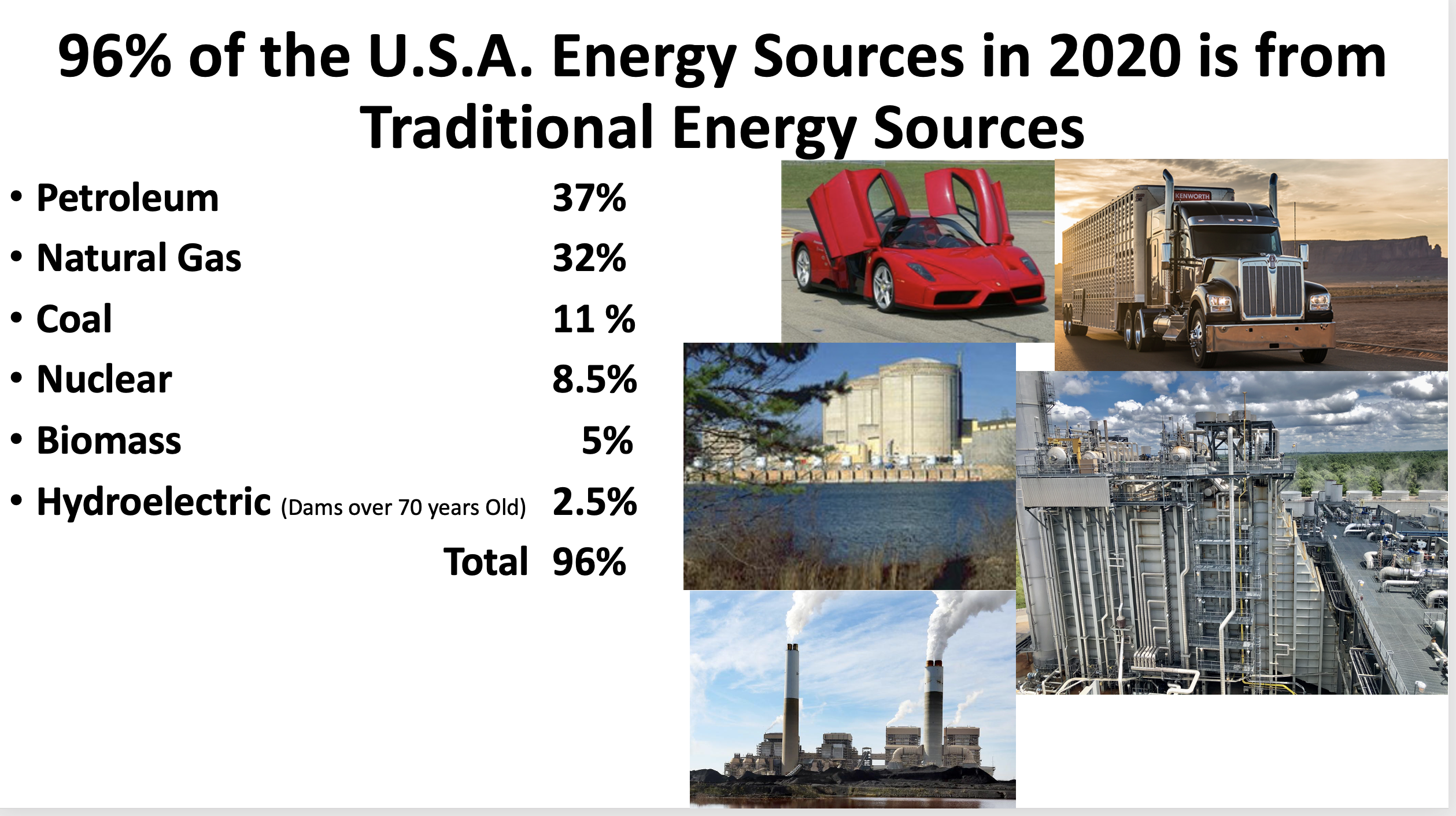
You get the point I am trying to make. To power our high quality of living, we use about 100 Quadrillion Btu’s equivalent of energy. American citizens take energy for granted and many, especially the current Congress and President assume that the existing forms of energy can be substituted in the next 15 years with Renewable forms of energy such as windmills, solar panels and Hydrogen. This is the path our elected officials have us on. So, let me ask you to check the chart below and then visualize replacing the nuclear (8.5%), natural gas (32%), coal (11.4%) and petroleum (37%) with Renewables.  The total of these four sources of energy is 88.66 Quadrillion Btu’s or right at 89% of our total energy used each year. Note solar and wind was 1.04 and 2.74 Quadrillion Btu’s, totaling 3.78 Quadrillion Btu’s. Right at 3.8%.

Hydrogen is a medium that can be used for storage and is therefore zero on the chart below. Hydrogen is planned to be a large part of America’s future fuels, but it should be pointed out, hydrogen requires more energy to produce it by electrolysis than it will produce in a fuel cell or by combustion in an internal combustion engine.

Current Energy Costs for Various Fuels

I have never liked the word “Cheap” and try not to use it. However, when referring to fuel to produce power or motive force, cheaper energy is better. Example, electricity  produced by a gas turbine requires Capital cost to purchase the equipment, construction cost to build the power plant, employees to operate and maintain the plant and spare parts to keep the turbine and all of its auxiliary equipment in top condition. Would you be surprised if I said a gas turbine, combined cycle power plant of say, 600 MW may cost about $ 720 million dollars? The going cost today for a GTCC plant is about $1,200/kW installed capacity. Now, think about the cost of electricity produced by the GTCC plant. It would likely be about $0.02 per kWh if the natural gas fuel was $3.00/million Btu (British Thermal Units). Over 90% of the production cost of a modern high efficiency GTCC plant is for fuel. The raw natural gas fuel is the single most expensive component of electricity production cost. Not the amortization of capital cost, or labor or spare parts. It is fuel cost that governs the production cost of electricity. So, if the natural gas price doubles, so does the production cost of electricity.

Thanks to Hydraulic Fracturing, the War on Coal has not caused a dramatic increase in the cost of electricity because natural gas prices have been very low since about 2012 or so. 

Here is a chart of natural gas prices 2006-2012 from EIA data of Henry Hub spot prices, as recorded by the EIA. The war on coal has been going on since the Bill Clinton Administration but accelerated during Obama’s Presidency. The lower cost coal plants equipped with flue gas cleaning Baghouses, Electrostatic Precipitators, Selective Catalytic Reactors and  Sulfur Scrubbers were the lowest cost generators. Then came Hydraulic Fracturing and cheap natural gas. The low production cost of electricity production by natural gas made competition by coal nearly impossible. Remember, fuel is 90% + of the electricity production cost for GTCC plants. Thus, cheap gas equals very reasonable cost electricity. America has had a good run of reasonable cost electricity up to now.

NATURAL GAS PRICES AT THE HENRY HUB 2006-2012

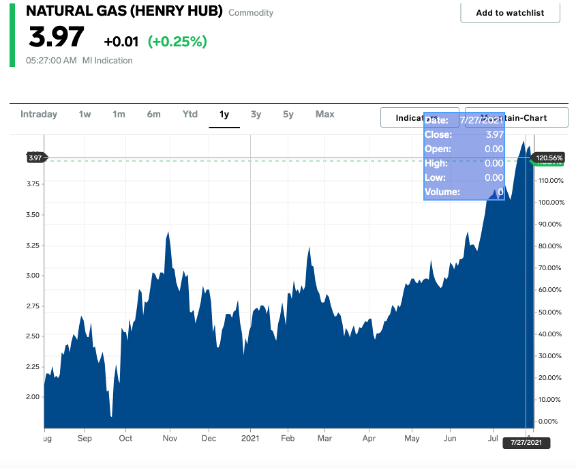
The current natural gas prices have increased from $2.00/million last year, to nearly double the price of 2012. Therefore, if this trend continues electricity prices will have to increase or electricity from lower cost producers, such as coal and nuclear will be needed to keep power costs down.

Here below is the natural gas price as reported by Business Insider Commodities.

The figure below illustrates production cost for the fuel component only when comparing a clean coal plant with a gas turbine combined cycle plant:

COMPARATIVE ELECTRICITY PRODUCTION COSTS BY NATURAL GAS AND COAL FUELS AT THE PLANT BUSBAR

When fuel cost per million Btu’s increases, so does production cost.  Hydrogen cost if you can find it (California prices)  is about  $142.23/million Btu’s as compared to the comparatively less expensive natural gas at $4.00/million Btu.

Typical Fuel Costs Today

The above is my attempt to explain the fundamental costs of Thermal Power Generation of electricity. Because coal plants have many other costs of flue gas cleaning reagents, more O&M personnel and more maintenance requirements of a solid fuel power plant, the fuel cost component for a typical coal plant is about 75% of production cost. Fuel is still the major cost component for electricity generation for gas, coal and oil fueled thermal power plants. 

Gasoline, Regular Octane at               $3.00/gallon   116,000 Btu’s/gal.       $25.86/million Btu’s

Diesel Fuel                                          $3.00/gallon   135,000 Btu’s/gallon  $22.22/million Btu’s

Jet Fuel Jet A   (IATA airline cost)       $1.93/gallon   119,000 Btu’s/gal.      $16.22/million Btu’s

Natural Gas at Henry Hub (July 27, 2021)                                                      $ 3.97/million Btu’s

Coal delivered at SC Power plant estimated                                                  $ 2.00/million Btu’s

The above shows traditional energy costs for “Heat-Engines”. There is a push by the Democrat’s in government to change to “Green Renewable Power”.  Autos, airplanes and trucks  cannot be run on windmills or solar. But, the technology to power these heat engines with Hydrogen is technically possible. The amount of power output is conversion of hydrogen into either electricity through the use of fuel cells or by combustion in an internal combustion engine. The cost to operate will be commensurate with the energy contained in a given unit of hydrogen, usually expressed as Btu’s. The equivalent cost of hydrogen is about $16.51 to replace a gallon of gasoline. Perhaps some day the cost of hydrogen will come down to compare with gasoline prices for a given energy output? 

CONCLUSION:

Net Zero Carbon will come at a very high cost and the high cost will harm our current Freedoms.

Dick Storm

August 5, 2021

References:

  1. Natural Gas Prices from Business Insider commodities: https://markets.businessinsider.com/commodities/natural-gas-price
  2. Storm Technologies Seminar information on economics of power generation.
  3. “Blue Planet in Green Shackles” by Vaclav Klaus Competitive Enterprise Institute, 2007
  4. IATA Jet Fuel Prices: https://www.iata.org/en/publications/economics/fuel-monitor/
  5. Chevron Aviation Jet Fuel specs: https://www.chevron.com/-/media/chevron/operations/documents/aviation-tech-review.pdf
  6. Coal Costs by EIA Coal Markets: https://www.eia.gov/coal/markets/
  7. California Hydrogen Fuel Council: https://cafcp.org/sites/default/files/Path-to-Hydrogen-Competitiveness_Full-Study-1.pdf
  8. Lawrence Livermore National Laboratory Sankey Diagram of Energy Flows: https://str.llnl.gov/content/pages/2021-02/pdf/02.02.2.pdf 

The Importance of Fossil Fuels and Why It Will Be Impossible to Eliminate them in My Grandchildren’s Lifetimes Without Harming Their Quality of Living and America’s Leadership in The World

Introduction

America, the rest of the Developed World and the Developing Countries of the World all depend on Fossil Fuels to power Industry, Quality of Life, Transportation and strong Economy’s. In fact more than 85% of the energy used today is used in “Heat-Engines”. Think about your life today and what you depend on. A car for transportation, air conditioning for summer comfort, Industrial production to provide jobs, economic strength and to continue to fuel our strong Economy, fuel for jet aircraft to shrink the world, Diesel fuel for trucks to deliver our food, Diesel fuel for shipping to transport products around the world. The largest slice of the energy production pie is provided by petroleum. Love them or hate them, the energy density of fossil fuels make them important to power our lives.

In America we use about 20 million barrels of oil each day. America has about 275 million cars and light trucks on the roads. This is peak vacation time in America, summer travel is brisk of people getting away to our favorite beach, mountain retreat or foreign destination. When we travel, we use energy. A lot of it. 

Some prominent Americans, the Main Stream Media, the President and elected officials in high office are promoting “Net Zero Carbon by 2050”.

In my opinion, this is wrong for America and impossible to achieve. I will attempt to simplify my reasoning of why fossil fuels are important and the fact that we cannot eliminate them in the next 30 years unless there are major new break-throughs in technology.

Where We Get Our Energy

Each year, America uses about 100 Quadrillion Btu’s of energy. The U.S. Department of Energy has kept track of our actual energy sources and consumption for decades. Each year a report is produced to show the previous years energy production and use. Since about the year 2006 America has used between 95 and 103 Quadrillion Btu’s each year. Here below are two charts which show the sources and uses for energy in the U.S.A. during 2020. Note that due to the Pandemic, energy use declined from 2019 to only about 98 Quadrillion Btu’s. This was due to reduced travel and economic production during 2020, because of Covid-19. Chart 1 below shows the sources of our energy and the consumption. Note that the optimistic Renewables in 2050 is about 17 Quadrillion Btu’s equivalent. The EIA converts energy from hydroelectric, solar and wind to equivalent energy in Btu’s. Each Btu is equivalent at 100% efficiency of conversion to 778 Foot Pounds of work. Thus, the BTU’s produced and used represent all forms of energy on the charts below.

Sources in 2050 of our energy. Forecast based on the EIA analyses.

  • 38 Quadrillion Btu’s Petroleum
  • 37 Quadrillion Btu’s Natural Gas
  • 17 Quadrillionn Btu’s Renewable Energy
  • 7   Quadrillion Btu’s Nuclear energy
  • 3   Quadrillion Btu’s Hydro-electric
  • 3   Quadrillion Btu’s Biofuels

Total 105 Quadrillion Btu’s projected to be utilized in 2050 (5)

In my opinion, that number is low because our population is growing and I suspect that in order to provide the same quality of life in 2050 as we enjoy now, with a population expected to grow to 390(6) million in 2050, will require more than 105 Quadrillion Btu’s if we continue our high quality of lives.

Let’s discuss Electric Vehicles. Today there are about 276 million cars and light trucks on the road (7). Most are fueled by gasoline or diesel fuel which is provided by over 100,000 conveniently located service stations for refueling. If these are switched to being powered by electric, then the electric power demand will be much larger than 37% of our total energy production. 

The electricity production chart below shows current and future trends for electricity production. If the auto manufacturers stop producing cars powered by internal combustion engines, then to preserve our current freedom to travel, the same total energy will be required for a given prosperous population. Thus, driving similar miles per year will require that electricity be produced in proportion to the fleet of EV’s. Study the chart below. In 2050 the projections are for 42% of our electricity to be generated from Renewables. The other 58% then is projected to be generated from traditional sources, natural gas, nuclear and coal. We should keep in mind that the population is expected to increase by about 18% by 2050.

Conclusion:

If we continue our high quality of living, then Fossil Fuels will be required through 2050. Net Zero Carbon Emissions by 2050 will be difficult or impossible to achieve, in my opinion.

Richard F. Storm

July 31, 2021

References:

  1. Dick Storm’s ProBizBlog: https://dickstormprobizblog.wordpress.com/2020/08/28/the-importance-of-energy-part-2-our-energy-sources/
  2. https://dickstormprobizblog.wordpress.com/category/energy-electricity-economic-prosperity-and-environmental-protection/
  3. Donn Dears “Power for the USA” Blog:  https://ddears.com/2021/04/20/america-we-have-a-problem-the-green-nightmare-part-1-the-nuclear-problem/
  4. Mark Mills, Manhatten Institute, “The Green New Deal Can’t Break the Laws of Physics” : https://www.manhattan-institute.org/green-new-deal-laws-of-physics
  5. U.S. Department of Energy, EIA (Energy Information Administration) Annual Energy Outlook, 2021: https://www.eia.gov/outlooks/aeo/
  6. U.S. Census Data of population projections into the future: https://www.census.gov/data/tables/2017/demo/popproj/2017-summary-tables.html
  7. Number of cars and light trucks registered in the U.S.A. by Statista: https://www.statista.com/statistics/183505/number-of-vehicles-in-the-united-states-since-1990/
  8. The German Experience with Renewables by Michael Schellenberger July 2021: https://michaelshellenberger.substack.com/p/german-emissions-from-electricity-674?token=eyJ1c2VyX2lkIjozNTA0MDMyMSwicG9zdF9pZCI6MzkzMjEwODMsIl8iOiJleWpPVSIsImlhdCI6MTYyNzcyNjM5NywiZXhwIjoxNjI3NzI5OTk3LCJpc3MiOiJwdWItMjc5NDAwIiwic3ViIjoicG9zdC1yZWFjdGlvbiJ9.e-R9JLkkOf0AoO-vTujt5twuRqVqIdPKOz-X9f0Fvko

Energy, Human development index and economic prosperity

Two Examples: America in the 20th Century and China in the 21st

I prepared for a presentation to USCB-OLLI on the history of Energy and Electricity. Along the way of preparing it hit me. Few professors of either history or engineering discuss the relationship of energy and Economic prosperity or for Developing Countries, the relationship of energy and an improving Human Development Index. My friends that are employed in the energy business know this. But, it also occurs to me that we are a small minority, perhaps only a few million out of 330 million American citizens. Most citizens do not really understand until a hurricane kills electric power or a pipeline shutdown causes gas lines. Only then does the average American appreciate the importance of energy to our way of life.

Here is my shot at helping to connect the dots of the importance of energy:

At the turn of the 20th century, coal fuel was important and remained our largest primary energy source until about the end of WWII. Then petroleum took off as the largest source of primary energy. Why? Of course, because of the popularity and convenience of automobile travel and of course, air travel too. Key point: Our economy grew exponentially as a result of abundant and reasonable cost energy. The chart of GDP per person was prepared by “Our World in Data”. Americans in 2017 had the highest standard of living of any country listed on the chart. A short answer would be Freedom, Capitalism and American policies. In my opinion, the one factor not given proper credit for, is abundant and reasonable cost energy. We reached energy independence by 2020 and America’s electricity costs are amongst the lowest in the world.

Together, reasonable cost energy and electricity fuels a thriving economy, jobs and manufacturing productivity. America’s leadership in the Industrial world is at risk, given the foolish and un-scientifically based policies coming from Washington regarding anti-Carbon and Green Energy.

America was once the most productive manufacturer in the world. From 1900 to about the year 2000, the U.S.A. was the world’s largest manufacturer. Especially for steel and aluminum. Then China was admitted to the World Trade Organization and through foreign investments, including U.S.A. based companies, built their manufacturing base. Now, according to Statista and other references, China is the world’s largest manufacturer.

Energy factored into the importance of America’s economic growth in the 20th Century. Likewise, energy is the pre-requisite for China’s growth in the 21st Century. China built more electric power production power plants in 20 years than America did in the preceding 150 years. Most of these are coal fueled and China now burns about 57% of teh world’s coal. Yes, more coal is consumed by China than all of the rest of the world’s countries combined.

The point is, energy powered not only an improving Human Development Index, but energy is required to power a growing industrial economy. It did so in America in the Century America led the world and energy is powering China’s economy at the beginning of the 21st Century. This is described on the chart below by mcKinsey & Company.

I have written my thoughts, (based on facts) some of the reasons why the Green New Deal is against the best interests of America. Let me stop here for now. The key point I wish to make is, Energy and Economic Prosperity are linked. Reasonable cost, abundant electricity and energy is a pre-requisite for our comfortable life styles as well as National Security. America has a treasure of energy within our borders. It is beyond foolish to not use it.

Ron Clutz has written in Science Matters, an excellent post on the relationship of energy and poverty and how the War on Carbon, better known as “Climate Policies” will harm the poor of the world. It is here: https://rclutz.com/2021/08/07/world-of-hurt-from-climate-policies-part-4/

Some will ask, “What about Climate Change”. Well the best 30 minute presentation I have seen to dispel manmade Climate Change is Professor William Happer’s talk at Hillsdale College.

To Watch the Video Proving there is No Climate Crisis, go to: 

How to think about Climate Change 

A talk at the National Leadership Symposium of Hillsdale College 

Phoenix, AZ, February 19, 2021 

By William Happer 

A key segment begins at minute 24 where the effects of CO2 are discussed. https://bit.ly/3zsXcS6

So, I ask, why are the Democrat Party politicians in Washington working hard to weaken America?

Dick Storm, June 22, 2021

All Fuels are important! A review of the Reality of Competitive Electricity Generation and the supply of needed Transportation fuels

The President has re-engaged the Obama Administration “War on Carbon” and signed executive orders to kill pipelines, restrict drilling and production of oil and gas on Federal lands and to rejoin the Paris Climate Agreement. If not rescinded, this will cripple American economic growth and prosperity. For decades I have promoted policies of “ALL FUELS are IMPORTANT” so that America can remain a world leader, become energy independent and be competitive in manufacturing. Long story short, the Four E’s have been important to me for many years. The four E’s are: Energy, Environmental Protection, Education and Economic Prosperity.

America depends on 88% conventional fuels to power our high quality of life, our manufacturing and is important for National Security. The 88% is not a wild exaggeration, I have posts in other articles on this Blog that support it as being a fact. Yes, one in ten units of energy are from conventional fuels. Attempting to Kill conventional fuels is worse than dumb policy.

Yet, the Leftist Democrat politicians, the main stream news, entertainment personalities, TV and movies all lead the American public to believe that most of our electricity is generated or could be, from renewable power and soon. This is wrong.

I thought it might be useful to show where our electric power comes from when we need it today. A case in point is the PJM Interconnection which provides electricity generation control (like the FAA provides Air Traffic Controls, PJM provides electrical Dispatch controls for most of the northeastern U.S.A. from New Jersey going west to Chicago. Today is a cold day in Philadelphia and there is not a lot of wind and at 0500 AM zero solar. So, where is the power being generated? Here is a real time chart which was available on the PJM.com website. This shows generation by fuel. Note that about a third each is nuclear, coal and natural gas. Out of 104,430 MW’s being generated only 3,342 MWs are from Renewables. This is 3.2% of the 104,430 MW’s being used (needed) this morning.

Feb. 10, 2021 Generation mix by fuels from pjs.com website

Here is a screen shot from a wsj video on the rise of Renewable Power Generation. Usually, the wsj is a factual news organization. I must admit, it is true that 90% of the NEW Generation in 2020 was Renewables, but still this is only a small percentage of the total (about 3.7 % of 1,000GW of total generation capacity). As the above data from PJM shows, 3.2% by renewables, the EIA data for the entire year 2020 was about 3.8% total energy from renewables.

Here is a picture of the Alaska Pipeline. I show this because it is useful to illustrate the amount of energy America depends on each day. About 20 million barrels per day is what America uses in oil. That is used mostly for vehicle transportation, Jet Fuel and industrial output. The Alyeska pipeline passed about 2.2 million barrles per day on it’s most productive year, 1988. So, picture ten pipelines like this to represent the U.S.A.’s oil use. The Keystone Pipleine is rated at 830,000 barrels per day or less than half of the flow in one 48″ diameter Alaska pipeline.

Just as a reminder, America uses about 100.9 Quadrillion Btu’s of total energy each year. This is utilized as shown below on the chart:

Each of us use about 300-330 million Btu’s per year on average. Whether it is coal, natural gas, nuclear, jet fuel, gasoline, Diesel, hydroelectric, Biomass, wind or solar. We depend on this much energy for our life styles, transportation, comfort, cooking, heating, convenience, manufacturing, commerce, mining, manufacturing and National Defense. Think about the importance of energy in your life.

When the President issues Executive Orders to work toward stopping coal plants, killing pipelines, stopping Hydraulic Fracturing for natural gas production, shutting down oil production and stopping use of all Fossil Fuels, it is simply not possible in the short term. Maybe not possible in decades to do without Fossil Fuels. My friend Donn Dears wrote on his Blog recently about the use of coal and fossil fuels for the production of steel and concrete. Together steel and concrete, according to Mr. Dears represented about 12% of all carbon dioxide emissions.

The Democrats and Green Extremists are, whether they understand it or not, working against the best interests of America. They are harming our hard fought struggle to become energy independent. (I understand in November 2020 America was a net exporter of oil for the first time in decades) If we shut down U.S.A. production of energy fuels, then it is making us vulnerable to supply disruptions. I am old enough to remember the Arab Oil Embargo’s of 1973 and 1980. We do not want to return to dependence of volatile supplies of vital fuels or minerals. Dependence on vital minerals such as Lithium, Rare Earth minerals and other ores is a topic for another day.

Another important point. If the Democrats want to save the planet, the best people to produce energy is Americans. We have standards, regulations and practices that have worked well. I submit, look at our stellar record of safety for nuclear and coal plants. The long life of the Alaska pipeline. If sources in America are off limits then the fossil fuels will be imported from other countries that do not have safeguards as effective and proven as ours. How does that improve the environment?

Back to electricity. These were the six top producers of America’s electricity in 2019: Not a bad balance. (data from the EIA)

  1. Natural Gas Fueled Plants         38.4% of USA total
  2. Pulverized Coal Power Plants    23.4% of U.S.A. Total                                              
  3. Nuclear Power Plants                       19.6% of USA total
  4. Hydroelectric generation               7% of USA total
  5. Wind Turbines                                       7.1% of USA total
  6. Solar Power                                             1.7% of USA total

Of course protection of the environment is important. Also important is National Defense, homeland Domestic manufacturing (to keep jobs here), Economic Prosperity, keeping our high quality of life and a fair world trade balance. The four E’s which I think are all very important and should be balanced for truly sustainable living well: Energy, Environmental Protection, Economic Prosperity and Education.

The fourth “E” Education on Energy Matters has not been very well mastered by the President and Democrat politicians.

Thus, my conclusion that

ALL FUELS are IMPORTANT!

Dick Storm

Are You Worried About the Future of America?

The November 2020 Presidential Election to put it politely did not end with the best interests of America as a priority. President Biden disingenuously said at the inauguration, that he wants to unite the country. Then he went to the Whitehouse to sign Executive Orders to Cancel the foundation of our economic growth during President Trump’s four years. He is in the highest office of the world and he has plans to use the power of that office to do as much harm as possible to America. I don’t know why the Democrat Party, Liberals & the Mainstream Media can be so hateful of America. But they are.

Their Goals seem to be to Dismantle America’s #1 Position in the world as a Beacon of freedom and to harm or kill the largest Economy on the planet. Biden’s first step to weaken the U.S.A. is to reduce Domestic Energy Production. Reasonable cost energy is a huge component of world manufacturing competitiveness. Abundant production of reasonable cost energy also creates and sustains “Jobs” too! To put it into in a four letter word Mr. Biden may understand.

I will be perfectly honest, I am concerned for the future of America. Here are some of the reasons why I am concerned.

Even before Biden took office, a Federal Court in the Washington D.C. Swamp struck down the Affordable Clean Energy Rule” This was on President Donald Trump’s last full day in office, the federal court struck down his final effort to undo Obama’s legacy of the Liberals misguided war on carbon. This hands President-elect Joe Biden a clean slate to craft regulations for anti-American carbon rules. The US Court of Appeals for the District of Columbia Circuit struck down the 2019 Affordable Clean Energy (ACE) rule. This was the Trump administration’s effort to lower power sector emissions and at the same time, keep our energy costs competitive with the world. This court action by itself is very harmful. Then, in Biden’s first day in office, he started the process of killing the Keystone Pipeline. A great start to dismantle our economy and is sure to bring a smile to the faces of V. Putin and Xi Jinping. Why? Washington, DC is a Swamp of misguided politicians, but many of these people have children and grandchildren just as I do. So, why are they so Hell Bent on ruining America? The anti-American Cancel Culture is now in power.  God help us.

Here is my take on the relationship of energy and economic prosperity. Let’s start with a little history of the 100 years of progress following energy pioneers Edison, Westinghouse and Tesla. America entered and helped win two world Wars and in WWll America was declared by FDR to be the “Arsenal of Democracy” because of our talented citizen engineers to invent and manufacture. Following WWll, economic expansion of America was the Gold Standard for the world to take notice and copy. (China certainly took notice and copied our model of using energy and manufacturing to build an economy). We were very open and sharing with our technology for producing nearly every modern marvel from efficient aluminum and steel production to airplanes, vehicles and computer chips. The recorded economic and energy history show these American creative inventions, manufacturing and expansion have a paralleleconomic growth track that follows the use of abundant and reasonable cost energy. Energy and Economic Prosperity go together. America’s God given Treasure of coal plus Admiral Rickover and President Eisenhower’s gift to mankind of nuclear energy kept our economy powered and growing for decades. The graph below is from data by the EIA and the American Coal Council. Note the chart ends in 2010 when our GDP was about 13 Trillion dollars. Now the U.S. economy has grown 50% greater than it was in 2010.

Through this 40 year growth period of the American Economy, coal provided about 50% of America’s electricity production and nuclear from the 1980’s on, provided about 20% of America’s electricity.  (Coal + Nuclear= about 70%)

Then about 2012 Hydraulic Fracturing and Directional Drilling revolutionized American natural gas and oil production. America progressed to becoming the #1 Producer of natural gas and oil. The downside of the abundant natural gas was, that it became more economical to use as a power generation fuel than inexpensive coal. Part of this was raw fuel cost differential and part of it was American inventiveness with highly efficient, advanced aeroderivative gas turbine power plants. The total plant efficiency of the best and most advanced gas turbine combines cycle plants is now over 60% under ideal test conditions. Dispatchable power generation with overall efficiencies of over 50% were attainable and getting better every year. The newest and best Ultra-Supercritical, clean coal plants can achieve about 42% thermal efficiency. Most of the existing coal fleet has a heat-rate of about 10,000 Btu./kWh or about 34% thermal efficiency. Fuel cost for a gas turbine combined cycle plant is about 90% of the production cost of electricity. A coal plant production cost is burdened with environmental flue gas cleanup equipment and reagents plus a much larger operations and maintenance staff. Thus, natural gas plants have the economic advantage over coal. The cheaper the fuel cost, the more reasonable the power production cost. Natural gas and coal are almost equal in cost/million Btu’s at about $2.00/million Btu. Thus, with less staff, higher efficiency and no flue gas cleanup costs, natural gas produced electricity is produced at significantly less cost than coal generated power for the same raw fuel heating value cost in $/million Btu. If natural gas prices escalate, so will electricity production cost. Perhaps an advantage for coal but not good for America’s competitiveness. The Biden policies of harming natural gas production through increased regulations and restricting pipelines is (or will be) if he continues, harmful to our country by causing natural gas prices to rise over time, which will increase electricity costs. The nuclear plants for the time being, continue to generate about 19% of America’s electric power.

We have come a long way and our air is the cleanest it has ever been. Check the EPA 50 year progress graph below:

All through this 50 year growth period of the American Economy, growing population and increased road miles of driving, coal provided about 50% of America’s electricity production and nuclear from the 1980’s on, provided about 20% of America’s electricity. 

We have come a long way and our air is the cleanest it has ever been. Check the EPA 50 year progress graph above:

The abundance and reasonable cost of electricity does matter to the U.S.A.! Reasonable cost electricity is required to be competitive. I am sure the Liberals will take care of the power costs for lower income families by some form of welfare or subsidies. But, what about Industry? In my adopted state of SC about 1/3 of electricity is used for Industrial production. Especially steel and aluminum. If we are to keep some of these vital industries, we will need to keep electricity costs reasonable. I object to the politicians view (and some Electric Utility Exec’s too) that electricity costs can be increased with minimal harm to individual pocket books. Maybe so for individual home owners but, tell ALCOA or NUCOR that the electricity rates will double and see how that impacts their product competitiveness and new plant siting.

I see this as quite a legacy of success in clean power generation and economic prosperity. The power for our economy is fuels. The best simple illustration of where our fuels come from and how they are used is shown on the EIA/Lawrence Livermore National Laboratory, Sankey Diagram of energy flows. Here below are the energy flows for the year 2019:

I would point out (from the Sankey Diagram above) that America depended on about 37% Petroleum, 32% natural gas, 11.4% coal and 8.46 % nuclear. These fuels, I and most others involved in power generation, consider to be conventional and they total just about 89% of America’s energy. During the last couple years America achieved energy independence and I understand, November 2020 for the first time in decades, America did not need to import any oil or natural gas.
President Biden’s stated intentions are to escalate the war on carbon. It is a war on America’s energy and with that, an assault on our economic prosperity. (spell that JOBS) The Sankey Diagram above showed about 89% of our energy is from conventional fuels. With all of the tax credits and subsidies of renewables, solar and wind are on the chart at 1.04% and 2.74% (Note, I took the liberty of rounding the numbers in Quadrillion Btu’s to percent because the total U.S.A. energy use is 100.2 Quadrillion Btu’s/year, thus pretty close to 100 for the % stated)
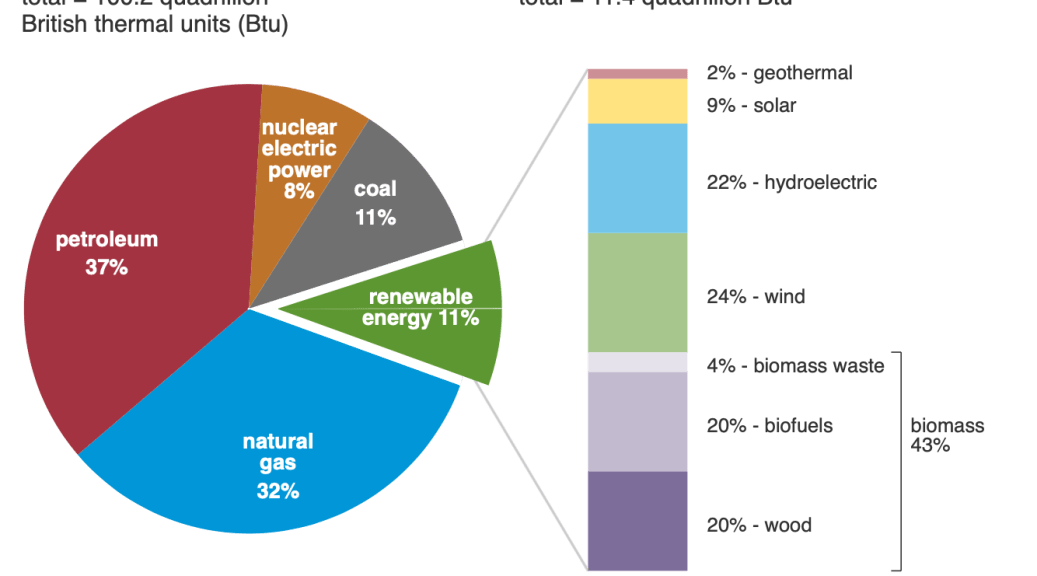
The pie chart below from the EIA, shows 11% renewables. Of the 11% renewable energy, most of the power was produced by old hydroelectric dams, wood. Biomass and biofuels.

In America we have some of the cleanest air on the planet and we are at this point, the World’s largest Economy. Congratulations America! Well done. Thanks to the hard work and ingenuity of American engineers, business, technicians and tradesmen.


Does World Manufacturing Competitiveness matter? It does from my viewpoint. China has built more coal power generation in the last 20 years than it took America to build over the preceding 100 years. China took a page out of American history to power their industries with reasonable cost fuels and by the way, China uses about 7.4 times as much coal as America and more than the rest of the world all put together.

Notice how America has plateaued at about 100 Quadrillion Btu’s total energy each year since about the year 2000. Check the rise of China’s energy use to more than twice America’s and still growing. China produces over 50% of the world’s aluminum and steel. China is the world’s largest manufacturer. Yes, China has learned the relationship of reasonable cost energy and manufacturing might. Unlike President Trump, American Liberals in Congress and President Biden seem to be interested in supporting Russia’s gas and China’s manufacturing. More interested in Russia and China’s success than supporting America’s taxpaying, citizen workers, businesses and Industry.

Thank you, President Trump for four very good years in promoting energy policies and reducing Federal Regulations. Your policies were conducive to economic prosperity, keeping our country strong and employing millions of our citizens in good paying jobs. It is with sadness that I view the news of Biden-Harris as they begin policies that are certain to weaken America. We will miss Mr. Trump’s policies.

Dick Storm

The Importance of Energy to Power High Quality of Life, Part 1

The citizens of North America, Europe, Japan and Australia are all accustomed to having abundant, reliable and reasonable cost energy and electricity. Not until a hurricane or extreme weather comes when power lines are downed, do Americans appreciate the importance of energy and electricity to power our way of life. My goal in this Blog is to show the relationship of energy to the Human Development Index and the inter-relationships of energy and our quality of life.

First let’s take a look at NASA’s composite photo of the “Earth at Night”. Remember the dark areas of the Planet as you then scroll through the next few graphs of economic activity and energy.

NASA, A Composite Photo by Satellite of the World at Night

Next, plots of energy and GDP for selected countries of the world. North Korea is not included in the data plot, but the satellite photo showing lights below the 38th Parallel clearly show the distinction of a centrally controlled Socialistic government and Economic Freedom of South Korea.

Total Energy in Total, Millions of Btu’s, consumed per Capita and Relationship with Human Development Index as a Measure of Quality of Life

Satellite view of the 38th Parallel separating North and South Korea

The next graph is from ExxonMobil’s Outlook for Energy and uses data from the U.N., World Bank and other respected references. Note the vertical axis showing energy use in kWh per person/year. Over 50% of the world’s population uses less than 2,000 kWh/year. Americans on average use about 13,000 kWh/year. The electricity is used for residential heating, cooling & cooking. Keeping it into perspective, nearly 1 Billion people of the world do not have access to any electricity. Note the chart which follows, below. This data from the UN, World Bank and the chart was prepared by “Our World in Data”.

There are almost 1 Billion people of the world that do not have access to electricity. If you go back to the NASA composite photo of the earth at night above, you can see by illumination the difference between the Developing countries and the Developed Countries.

So, how do citizens use energy to create better lives? The figure below shows the uses of Total Energy used in the U.S.A. Americans utilize on average about 100 Quadrillion Btu’s (BTU= British Thermal Unit). The 100.2 Quadrillion divided by 330 million citizens comes out to about 330 million Btu’s/person/year. This is total energy use and includes energy used for electricity generation, transportation, industrial production, heating, cooling, cooking.

The highest use of energy in the U.S.A. is for electricity production at 37% of our total. Next is transportation at 28.2%. When all uses of energy are totaled in Btu equivalents, then divided by the population, the average comes out to about 330 million Btu’s per person per year. This includes all uses of energy.

To illustrate what 330 million Btu’s is equivalent to our friends at Storm Technologies created the graphic below:

The energy equivalent of 330 million Brittish Thermal Units could be about 48 barrels of Diesel fuel, 64.5 barrels of gasoline, 14 tons of coal or 778 pounds of propane. This is what Americans use on average. Those of us that travel more or have larger homes use more than the average. An apartment dweller in a large city with no car will use less. Also figured into the average energy use is Industrial production. Primary metals such as aluminum, copper and steel use huge amounts of electricity to produce.

The Industrial production provides jobs and improved economic freedom. The next chapter will cover energy independence and how reasonable cost energy impacts world trade and competition.

Dick Storm

Hawaii: A Gimpse Into the future of the “green new deal”

Hawaii is a model of the impact of applying carbon free electricity generation policies before storage technology catches up. “Green Policies” do not necessarily result in “Green Power” as I will close with the actual power generation in real time.  As an engineer specializing in efficient and clean coal power generation for five decades, whenever a coal plant shutdown is in the news, it catches my attention. So, when I read about the plans to shut down the 180 MW, AES Barbers Point Coal Plant near Honolulu, it caught my eye.

Oahu’s Cheapest Source Of Power Is About To Go Away

The title of the article in the Honolulu newspaper sums it up nicely: “Our Cheapest Power Is About to Go Away……. In 2016, HECO paid AES Hawaii an average of 5 cents per kilowatt hour. During the same period, wind was about 20 cents per kilowatt hour, solar about 21 to 23 cents.”

Hawaii is a perfect laboratory to show the effect of implementing extreme green policies on electric generation. Why? Because as islands, they are not connected to the US Grid. Therefore, the policies as implemented will create a fairly swift impact on electricity prices. According to the EIA, the highest retail electricity price in the U.S.A.:  Hawaii at $0.3099/kWh. https://www.eia.gov/electricity/monthly/epm_table_grapher.php?t=epmt_5_6_a

Digging a little deeper the plans for the future are for 52% Renewables by 2021 and 100% Renewables by 2045. https://www.hawaiianelectric.com/clean-energy-hawaii/integrated-grid-planning/power-supply-improvement-plan

As the Democrats in congress push for the new Green Deal, Hawaii offers an example of the adverse impact on electricity prices. Later, when Barbers Point is shut down, reliability could also become an issue. 

If you are interested in the fuel mix for generation on the island of Oahu, here is a link for the real time power generation. https://www.islandpulse.org  As this is written (0700 3/24/2020), I checked and 86% of the power was Fossil Fuels and of the 14% Renewables, they include 9% from the thermal waste to energy facility, 5% wind and because it was early morning, 0% solar.

I have always advocated a “Balanced Portfolio of Generation”. A plan to include LNG, Coal, Renewables, Oil and Waste to Energy would have been wiser, in my opinion.

Dick Storm