Category Archives: economic prosperity and energy

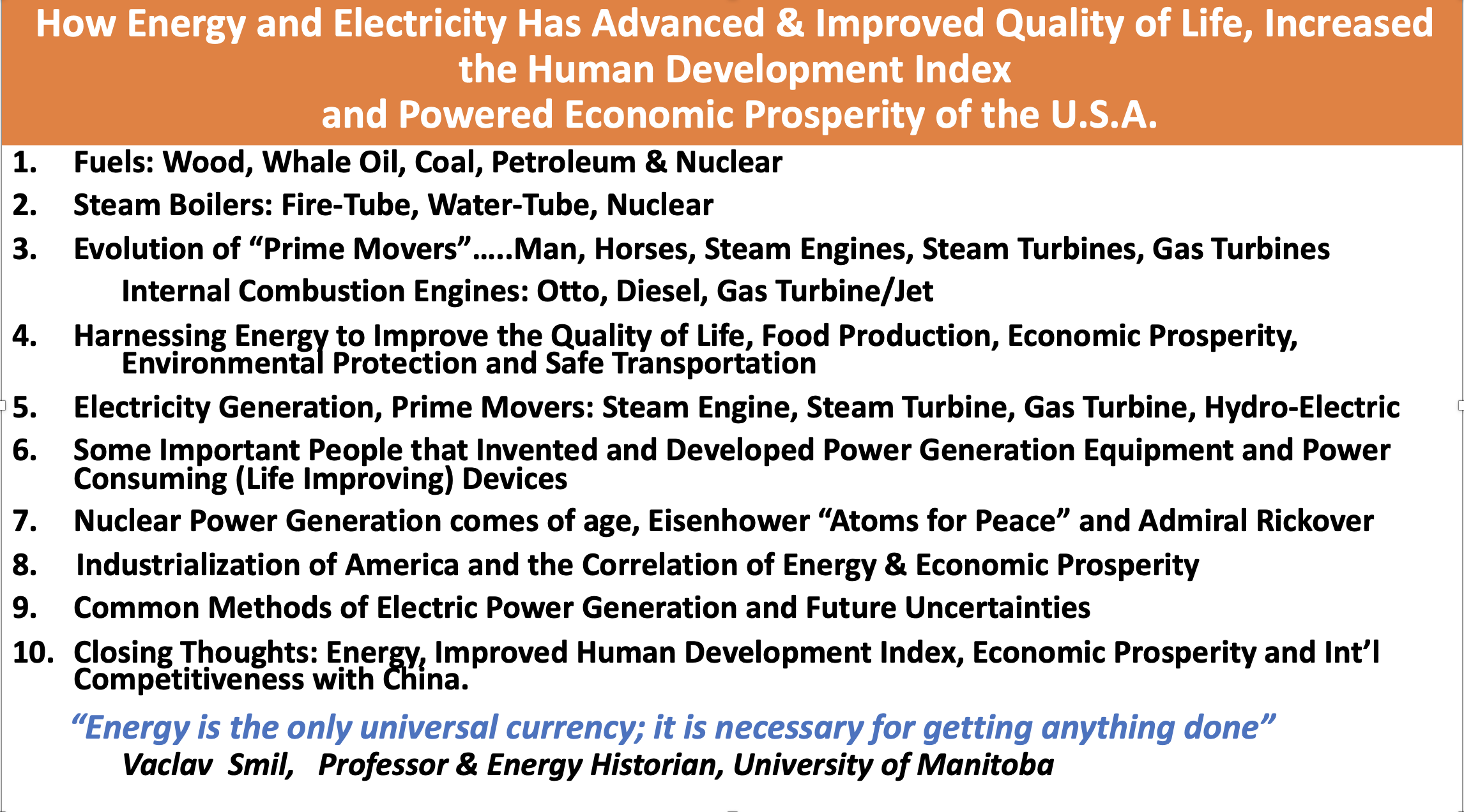
A Short History of Energy & Electricity and How Our High Quality of Living Came to Be (High Human Development Index) Part 1, 1850-1955

Energy and electricity have fascinated me ever since I was a teenager. The purpose of this post is to share the progress of energy and electricity from the Industrial Revolution to today. I had the honor of presenting a course at USCB-OLLI (Osher Lifelong Learning Institute) and much of the information presented in that course is presented here.

After presenting the course on energy and electricity generation in February (2021), it occurred to me that it may be interesting for some OLLI members to review of how energy and electricity came to be so important in the lives of all of us. Especially the aspects of Industrial growth, manufacturing and economic prosperity. As I was preparing for the course, the relationship of energy and economic growth became very clear to me. I always thought the relationship of Energy and economic growth was important. Nearly all of the College Professors of Engineering and History simply cover the History of Electricity production or the History of Energy. Few that I have known connect the inter-relationship of Energy and the growth of the “Human Development Index”. If we couple progress in energy production with economic progress, I think it is worth sharing because the application of energy to food production, transportation and industrial output grew geometrically from 1900 to today. Many factors contributed to the sharp rise of America’s HDI (Human Development Index) and manufacturing capacity after the year 1900, but in my view, the importance of abundant and reasonable cost energy has not been taught in Public Education or appreciated by the News Media. So, here is my shot at connecting the dots of the advances in energy and economic prosperity. 

I have always loved thermal power plants and spent five decades working in the electric power generation business. Mostly as a “Boiler Engineer”. Over my career I have accumulated a library of old books and technical literature on power generation and most of the illustrations used are from my library. 

Let’s start with the importance of “Steam”. We do not hear many references to steam today, but Steam remains important in power generation today and is likely to remain important in the future as well. 

So, let’s start with the first steam engines and take a quick trip through the ages of energy and power generation to see how humans have harnessed energy to do our hard tasks and improve our lives.

James Watt is usually given credit for the first commercially applied steam engine of the Industrial Revolution. But, to be fair, there were at least three before him. Hero’s turbine in the first Century and Thomas Savory in 1698 applied steam as a motive force. Then, Newcomen in 1712.

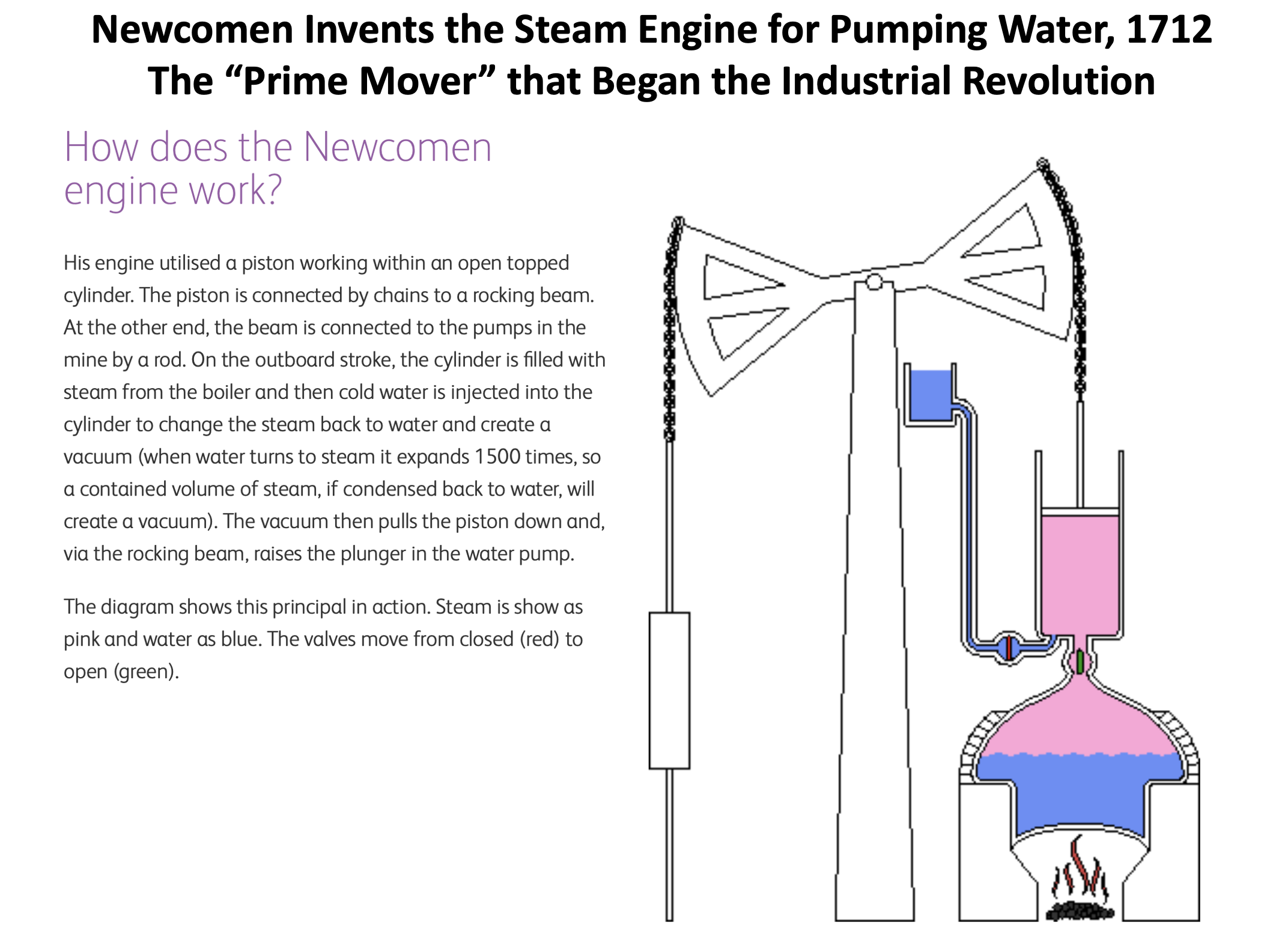
The Industrial Revolution began with the invention of the steam engine. The first version was invented by Newcomen about 1712. This engine uses water to condense the steam vapor beneath the piston which then provides differential pressure between atmospheric pressure and the partial vacuum created upon the collapse of the vapor. A pound of water will expand about 1500-1700 times when changed to vapor. In Newcomen’s engine, it was the collapse of the steam space that created atmospheric pressure to force the piston down and thus operate the pump.

About 64 years later, James Watt invented his version of the steam engine that could generate more force than atmospheric pressure by using high pressure steam.

James Watt’s engine created the potential for greater engine output and became the basis for the Industrial Revolution.

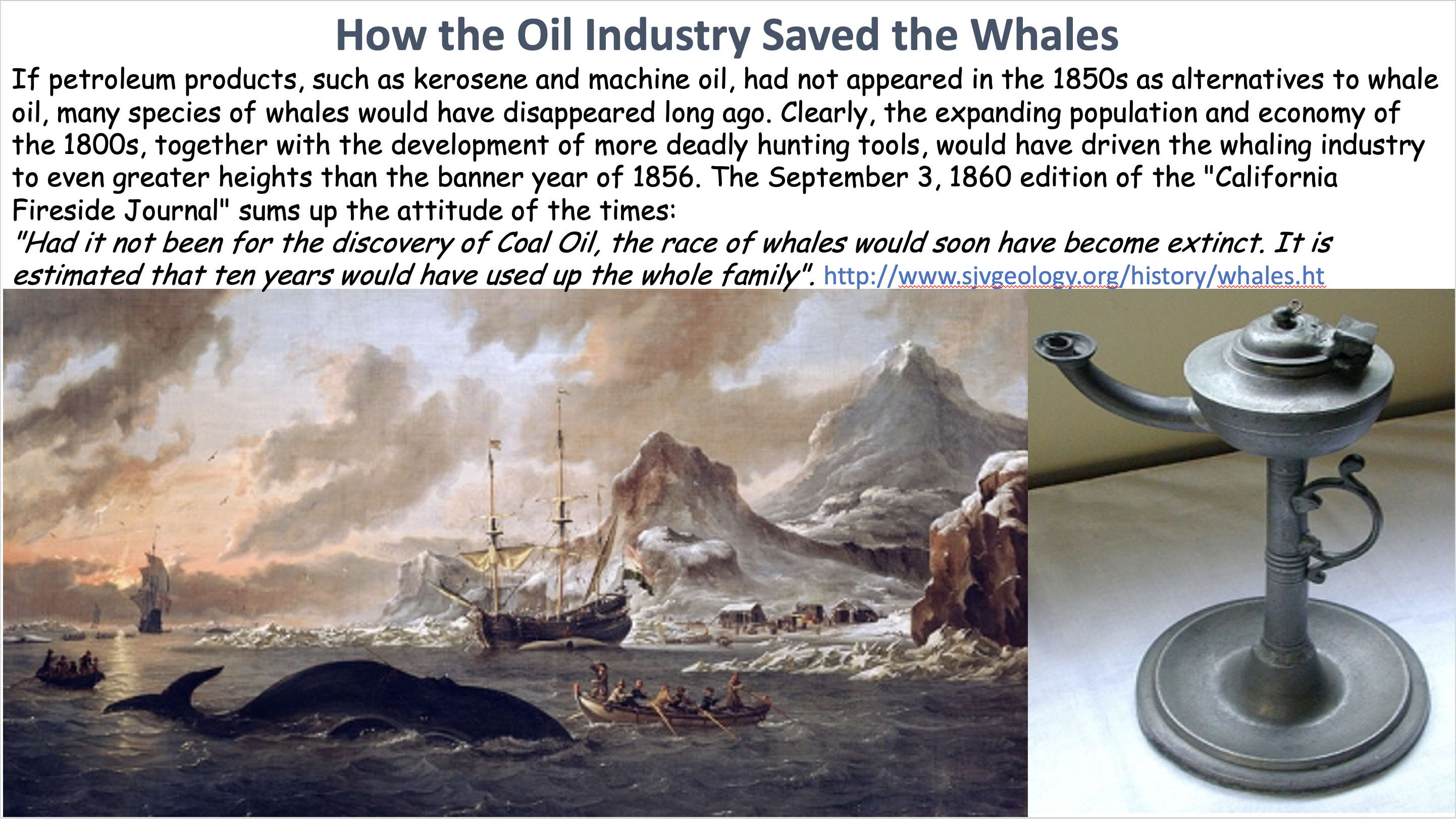
The first electric generation in the U.S.A. was about 1880 by Thomas Edison using a reciprocating steam engine drive. Before getting into electricity generation, it is timely to remember that illumination before the light bulb was provided by whale oil and then kerosene. Thus, it can truly be stated that the oil industry saved the whales.

As we cover the history of energy, I think it is notable to consider the environmental aspects of energy produced in 1850 for illumination. Before Edwin Drake struck oil and started the American oil industry, whale oil  or candles were used for night-time illumination. It could be said that Drake, Rockefeller and others involved in the production of oil & kerosene helped to save the whales. Next, the advancements of energy were used to provide transportation. Steam boats and Railroads first used wood and then coal fuel to produce steam power for motive force.

Transportation propulsion systems have been the leader for commercial electric power generation since Edison’s day. First, reciprocating steam engines used as prime movers for steamboats and then locomotives were adapted to stationary generators. Then, steam turbine drives for ships were adapted to stationary power generation. Later, aircraft jet engines were adapted for use as stationary generators and finally, nuclear propulsion systems developed by the US Navy were applied to commercial power generation.

Wood was the primary fuel of the 19th Century and it was used for heating, cooking and transportation via railroad locomotives and steam boat propulsion. The steam engines used for railroads, boat and ship propulsion were later adapted for stationary use in power plants to generate electricity. Interestingly, marine propulsion systems were the basis of technology later adapted to use for power generation. Steam engines, steam turbines, the latest advances in coal boiler developments and even nuclear power generation designs all had their roots in marine propulsion.

Memories and photos of Coal Fueled Steam locomotives of the 19th Century do not help the case for use of coal in today’s power generation plants. The enormous potential power of steam was harnessed for transportation as well as to power the Industrial Revolution. Environmental controls of exhaust gases and particulates came much later. 

This is a short course, so there is clearly a compression of a lot of history. It is my hope to take a quick review of the significant inventions of the last 150 years and to show the relationship of energy to the growth of America and our very high quality of living. Until there is a disruption of our energy supply, such as a pipeline shutdown or a hurricane, we tend to take for granted, our place at the top of the “Human Development Index Pyramid”.  Energy is at the heart of our high quality of living.

It is true that through the use of our God given energy resources, our lives have progressed to a higher Human Development Index. More on that later when the HDI of other countries is compared to ours.

American civilization grew from an agriculturally based society to an Industrial production-based country in just a few decades. About 1915 and continuing to today, much of the work that our ancestors were subjected to is now accomplished with energy. Heat-Engines lay at the heart of the rapid progress of the last 100 years for food production, transportation, industrial production and Economic progress. 

Until the Internal Combustion Engine was Applied to Improving Agriculture and Transportation, Horsepower was the Norm

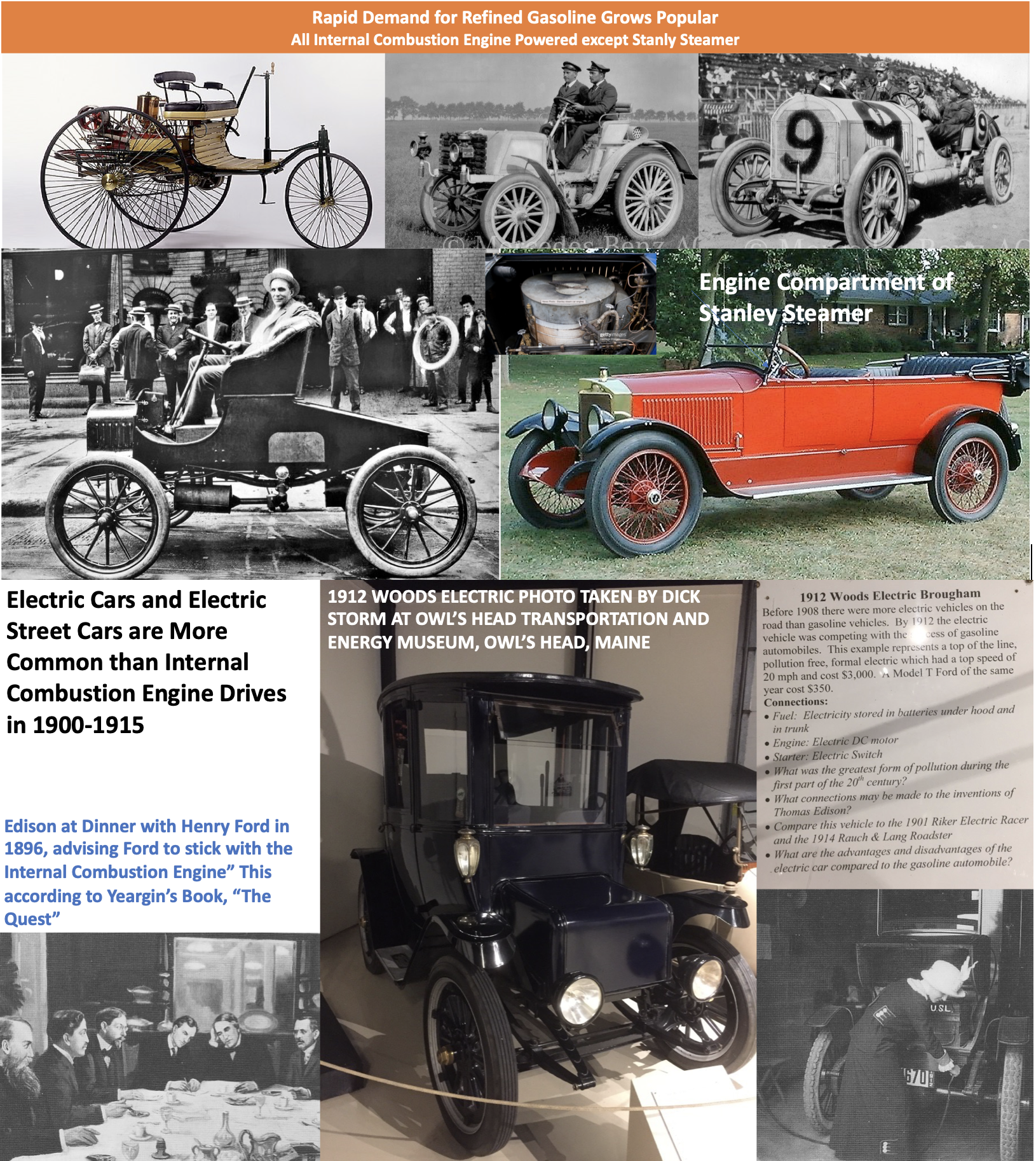
Benz gets credit for the first automobile produced with an Internal Combustion Engine

Looking back to the days of my grandfather (born 1895), about 40% of the American population lived in rural areas on farms and it took 40% of the population to produce food for the other 60%.

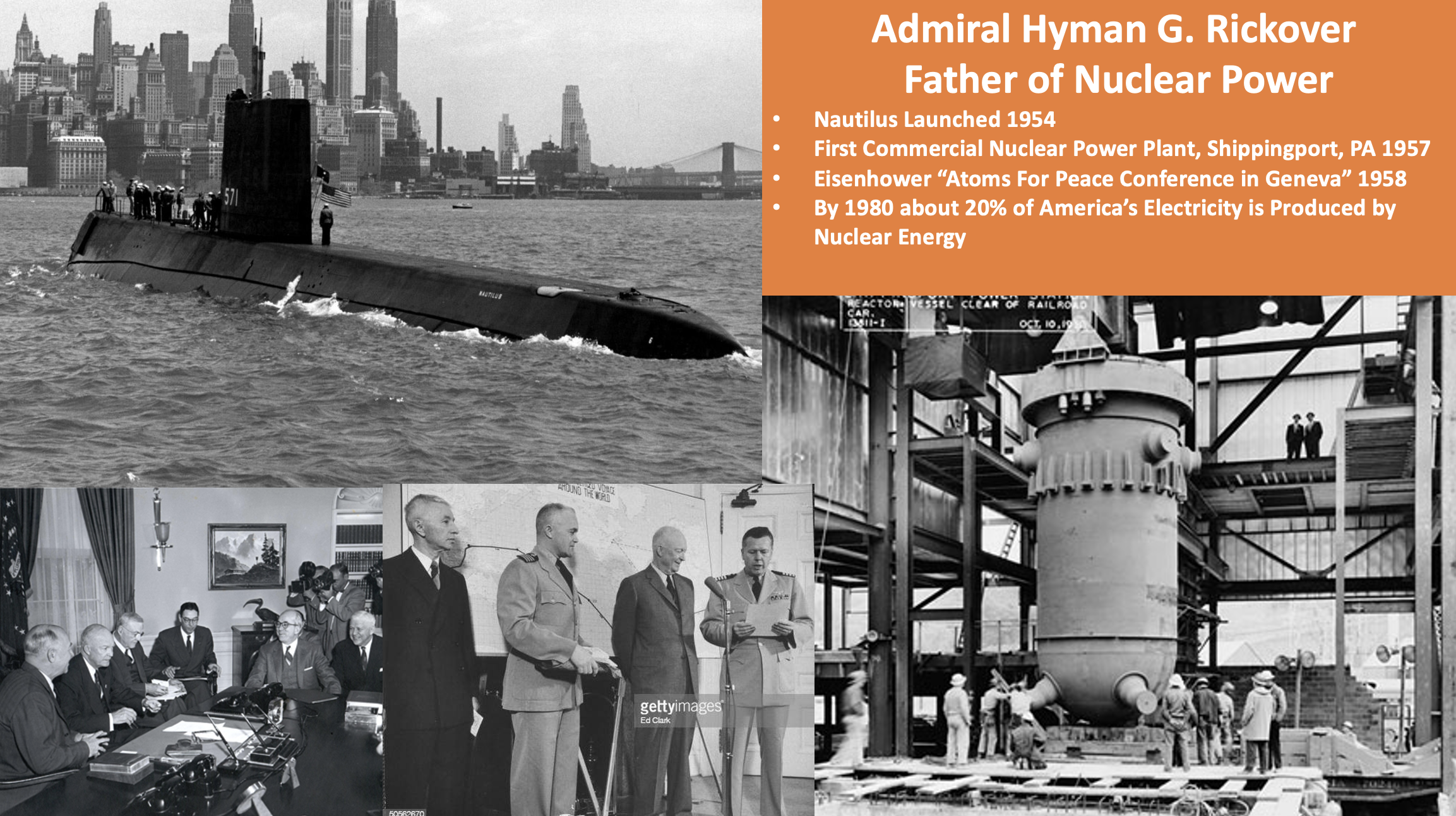
1900 was a year to keep in mind for both the astounding progress of energy and electricity generation. Also, in that year, the Father of Nuclear Power Generation was born. Hyman Rickover was born in Makow, Poland. It was during his lifetime that he personally developed nuclear power for ship propulsion systems. First for submarines and later for aircraft carriers and then commercial nuclear power generation plants. Rickover’s life was productive and amazing. Truly, this one individual changed the world of power generation over his life-time.

A classic speech given by Rickover in 1957 starts with how man has used energy to improve quality of life. Rickover gave historical milestones in energy going back to the Egyptians. This was part of President Eisenhower’s “Atoms for Peace” initiative. The genesis of peaceful uses for nuclear power.

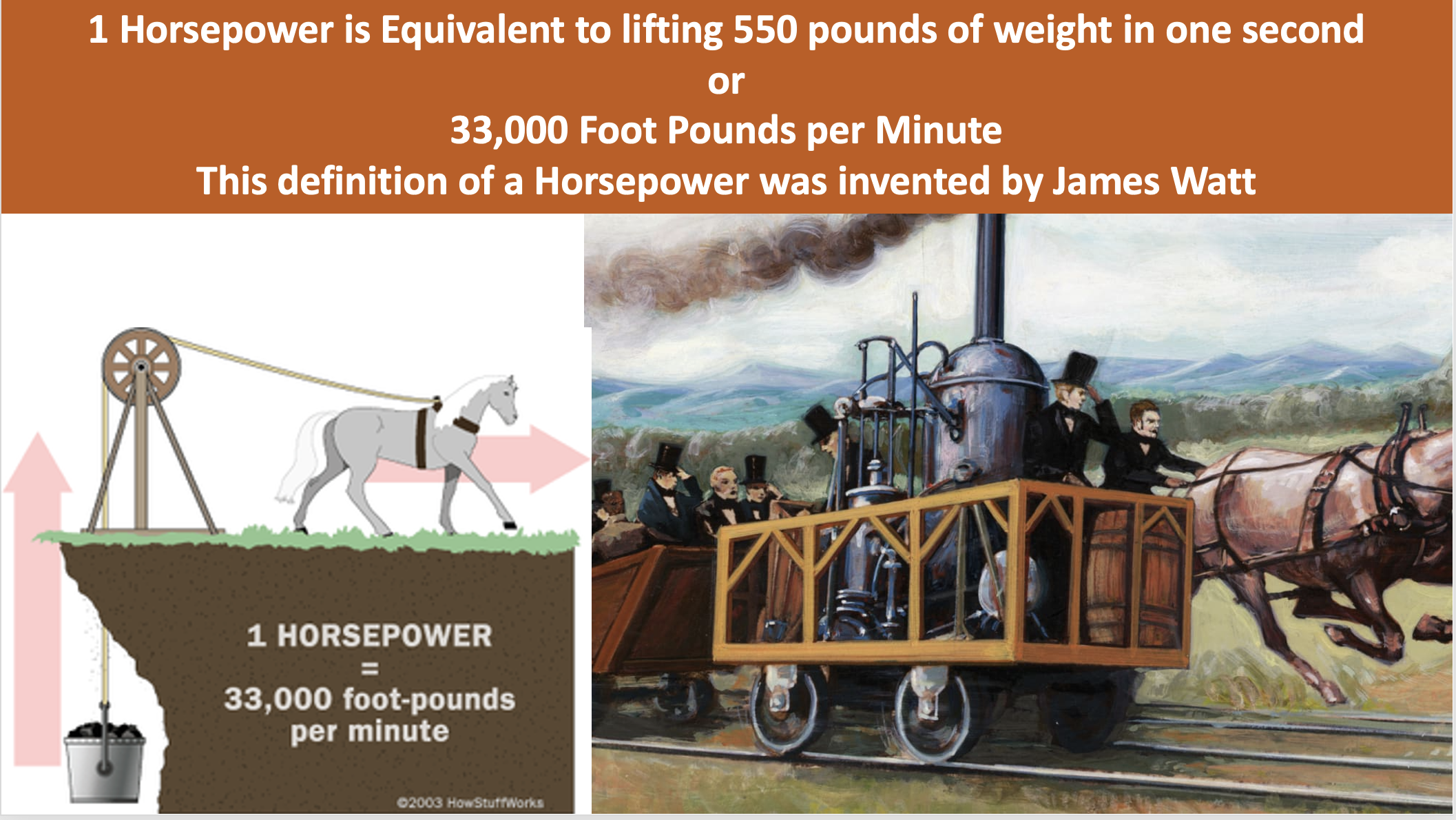
Muscle power was being replaced by steam, gasoline and Diesel engines. James Watt created a definition of “Horsepower” by performing various tests. The numbers he settled on to describe a “Horsepower” (still used today) are 550-foot pounds of work in a second or 33,000-foot pounds per minute. This is the definition of one horsepower.

The illustration shows a cartoon of a horse pulling a large bucket of coal vertically upward, representing 1 HP.

The Railroads traversed America in the later part of the 19th Century and provided a platform to further advance the development of boilers and steam engines. It was not long to reach the point that coal fueled locomotives could greatly outrun a team of horses and do so for long duration.

Economic Prosperity parallels the advancements in use of machines powered by steam or internal combustion engines are used to replace muscle power.

Karl Benz is credited with building the first gasoline powered automobile about 1886. Later, Henry Ford invents and develops the assembly line to mass produce automobiles and the demand for petroleum soars. Rockefeller had been producing kerosene for illumination up to about 1900.  Rockefeller was concerned that Edison’s electric light bulb invention would reduce the demand for kerosene and it did. However, with the steady increase of mass-produced gasoline powered automobiles, the demand from Rockefeller’s Refinery’s was steadily increasing.

The right panel (below) shows the sharp increase in GDP at about 1900. America’s GDP and individual family earnings led the world. In my opinion, much of this sharp increase in economic prosperity is due to the reasonable cost, abundant and domestically available energy which was replacing muscle power.

As seen above, the American Economy soared after 1900. By 1903, America’s GDP per person was the greatest of all of the Industrialized Countries of the world. The U.S.A. GDP/person $8,941 with the United Kingdom second at $7,482. Nearly double that of France and Austria. This coincides with the introduction of electricity distribution, the start of gasoline powered tractors, trucks, the beginning of U.S. Steel, Aluminum and automobiles. Energy use was multiplying the production of primary metals and manufactured products. Much previously produced with muscle and some hydropower.

Mechanization of Farming Made Food Producton Much More Productive with Far Less Labor The Fordson Tractor was introduced about 1915

At the same time that Westinghouse, Edison, Tesla and Allis-Chalmers were building power plants in the U.S.A., Parsons, Brush, Thompson, Siemens and others were taking similar steps in Europe.

Edison invented the Incandescent Light Bulb in 1880. However, carbon arc, electric lights were used for street lighting about 1870. (Carbon Arc Lighting was invented by Humphry Davy in early 1800’s using hundreds of batteries to produce the voltage needed for an arc)

Werner Von Siemens invented the Dynamo in 1866. Another European, Nikola Tesla became interested in Alternating Current and invented the Poly Phase Motor. Tesla then found work at an Edison Power Plant in Paris. Tesla was able to work out a transfer to Menlo Park to work directly with Edison. 

Siemens Factory in Germany for producing electric motors, Carbon-Arc Lamps on the streets of Berlin. Inset photo of Charles Parsons Steam Turbine

Edison was convinced that A/C power was not as good as D/C power. Tesla correctly favored A/C because of the ability to transform to higher voltages for long distance transmission and also because the Poly Phase A/C system worked well with his Poly Phase Motor.

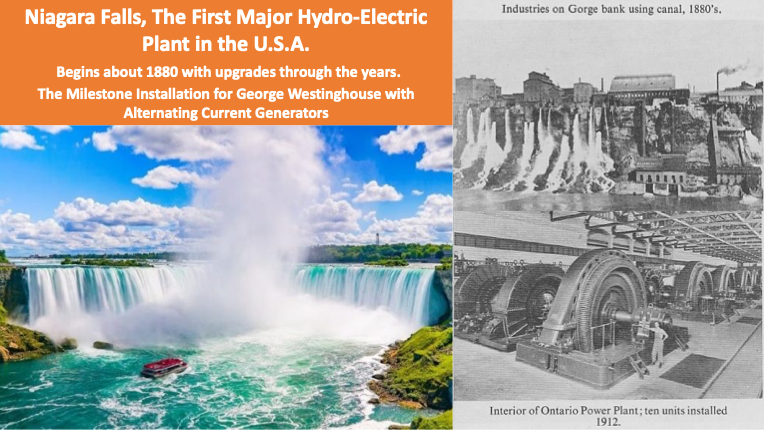
Tesla leaves Edison’s employment and struggles in business by himself for a while. Then, Tesla and George Westinghouse team up together. By 1890, Westinghouse had invented the Transformer and this plus Tesla’s inventions of Poly Phase Motors and A/C current create a harmonious and productive team effort of Tesla and Westinghouse. One milestone project that Westinghouse topped Edison on was providing the generators for the first hydro-electric plant at Niagara Falls. The advantages of Alternating Current made longer distance power transmission possible. With Direct Current that Edison favored, the wires could only transmit power about a mile. 

There is much written on the “Current Wars” between Edison and Westinghouse. The American Juris Prudence System does not look so great in retrospect and especially the harsh handling of the engineering excellence that was applied by Tesla and Westinghouse. J.P. Morgan gets involved as a major investor in Edison General Electric which then becomes, “General Electric” and Tesla’s Patents on the Poly Phase Motor and Alternating Current become the basis for the American Electric Grid. From what I have read, it was the deep pockets of J.P. Morgan that held Westinghouse back. 

The disputes between Westinghouse and Edison were not very harmonious to put it mildly.

Edison, Tesla and Westinghouse. Three important people regarding theapplication of electricity for practical purposes

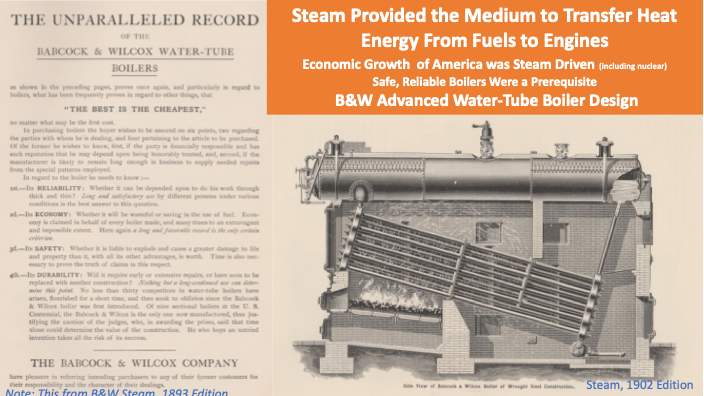
Steam Power requires a steam generator or boiler. As is the case today, Thermal Power Generation provides most of teh world’s electricity. Steam boilers are important and Babcock & Wilcox invents the inherently safe, water-tube boiler in 1867.  I will give a few examples of boiler safety later.

Fire-Tube Boiler (Left) B&W Water-Tube Boiler (Right)

The difference between a “Water-Tube” and a “Fire-Tube” Boiler is the manner in which the heat is transferred from the products of combustion to the water to create high pressure steam. A Fire-Tube Boiler has a large diameter shell (like a Locomotive Boiler) with the hot gases passing through tubes that pass through the large diameter shell. Steam engines are the prime movers for generators of either A/C or D/C and to have steam, so a reliable high-pressure boiler. Is needed to provide the steam supply. There are two types of boilers, Fire-Tube and Water-Tube. The fire tube boiler is a typical design which is similar to steam locomotives of the 19thand 20th Centuries. The  products of combustion leave the fire box and the hot gases of about 2,000-2,500 degrees F. enter tubes which pass through a large pressure vessel. Heat flows from the hot gases through the fire tubes and into the water contained in the large cylindrical pressure vessel. The larger the steaming capacity the larger the boiler cylinder needs to be.

This evolution of boilers is taking place in 1850 to 1900 and steam engines for ships, locomotives and stationary power generation systems are getting larger and larger. Thus, the boiler pressure vessels had to grow in diameter as well. 

The science of Welding and Metallurgy was in its infancy and steel plates were rolled into cylinders to form boiler shells but instead of welding the seams as is done today, they were caulked and riveted. The many riveted joints were an inherent weakness of large pressure vessels.

Fire-Tube Boiler Construction, before welding was developed and applied to pressure vessel fabrication

The inherent safety risk of Fire-Tube Boilers was that the shell diameter for a large capacity boiler must be very large. In the 19th Century and in fact, until about 1930, boilers were constructed using rivets to attach the shell plates together. Welding was not applied to boiler pressure parts till about 1930. Thus, the rivets combined with relatively primitive advances in steel manufacturing and metallurgy, created a high risk for failure of the pressure parts. Between 1895 and about 1910 there was about one major boiler explosion per day. Often each individual boiler explosion would kill dozens of people. Here are a few examples of terrible boiler explosions.

The American Society of Mechanical Engineers (ASME) is Founded in about 1880 and one of the main reasons is to work as an organization to improve the safety of the public. The first edition of the ASME Boiler and Pressure Vessel Code is published about 1915. 

Niagara Falls became the first major Hydro-Electric Plant in the USA and I believe, the largest in the world at the turn of the Century. A beautiful and environmentally friendly way to harness the energy of falling water. 

Niagara Falls was an important milestone for power generation. But the enormous demand that began with the 20th Century was satisfied by heat-engines. Reciprocating Steam engines and steam turbines.

Reciprocating Steam Engine Drive for a D/C Generator about 1890 at the Williamson Free School of Mechanical Trades

Meanwhile, in England, Charles Parsons is experimenting with steam turbine designs. As with steam engines, the first major applications of steam turbines are for ships. One of the notable steam turbine applications was to the Royal Navy Ship the Turbinia.

The British turbine powered “Turbinia” was built about 1894. This ship was demonstrated by Parsons to the Royal Navy as being twice as fast as reciprocating steam engine powered ships of the time. Marine applications tend to lead stationary power plants into the nuclear age with the first of a kind used for ships and the Navy, both in Europe and the U.S.A.

In America, about 1900 the transition from steam engines to steam turbines began. In this figure below there is one huge steam engine with a large flywheel in the foreground. In the back can be seen three smaller, but larger capacity steam turbines. From 1900-1915 numerous manufacturers of steam turbine drives came to be. Among them: Westinghouse, General-Electric, Allis-Chalmers, Charles Parsons, Brown-Boveri and Siemens.

In London and other large cities, Central Stations were built to generate electricity for the surrounding area. With DC current, it was only practical to extend wires for about a mile square. Later, AC was used which can be transformed to higher voltage and transmitted over longer distances. The slide of the London Power Station shows the typical arrangement of equipment in this time. Note the belt drives to the Dynamos located on a level above the steam engines and the water-tube boilers.

Energy use is not just for electricity. Even today, about 63% of our primary energy is used for transportation, industrial production and heating. About 37% of America’s energy is used to generate electricity. Automobiles become common and at the turn of the Century, the Internal Combustion Engine was welcomed as a great improvement for the environment. Cars and trucks powered by gasoline engines were a lot cleaner than horses. Petroleum became the largest portion of our energy use following WWII and continues to this day to be the major source of primary energy. Increased Industrial production, improved comforts and conveniences, improved quality of life and the resulting economic activity after 1900.  All of these increased demand for most forms of primary energy and electricity.

Both marine uses and stationary power generation prime movers make progress from reciprocating steam engines to turbines and to advanced boiler designs for safety, improved efficiency and reliability.

The illustration below shows a diagram of how using coal as a source of heat energy is converted to steam which is then converted by a steam turbine to shaft “Horsepower”. Keeping in mind the definition of a horsepower is 33,000-foot pounds of work in one minute. In this example, using coal that has 11,500 Btu’s per pound, the potential work equivalent is 11,500 multiplied times 778-foot pounds per Btu. At 100% efficiency, this one pound of coal would produce about 9-million-foot pounds of potential work. The enormity of this heat energy provides insight into the tremendous energy provided by steam and also, the stored energy within the pressure containment of a steam boiler. This brings us to the advancements in safe design and construction of steam boilers over the next few decades.

From Storm Technologies, Inc. Library of Educational Slides on Power Generation

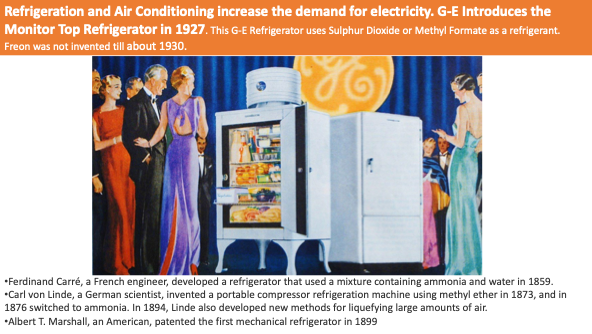
The demand for electricity grew sharply after the inventions of motors, air conditioning and home appliances. Refrigerators became commonly used in homes beginning about 1927. 

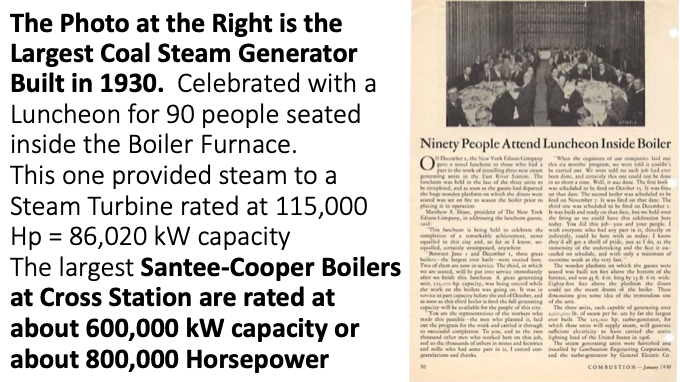
Coal fuel was the predominate fuel during this period for electricity generation. Steam turbine drives as prime movers had grown in size and reliability. The steam boilers larger and larger. Welding of boiler pressure parts was advanced after about 1930 and steam boilers became larger and more safe. Overall, the coal plants became quite large. Here is an article that appeared in “Combustion Magazine” during the 1930’s.

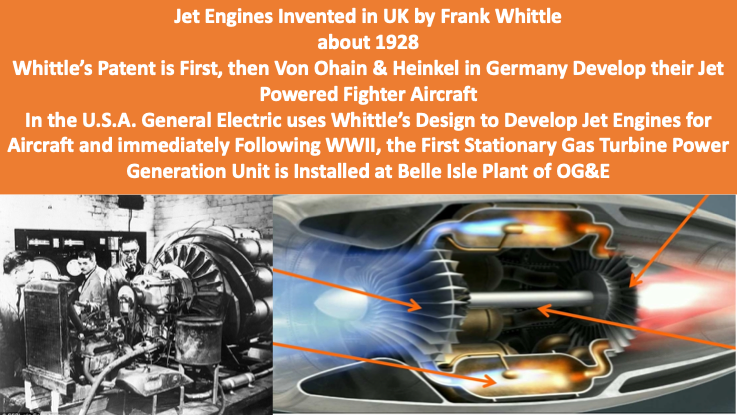
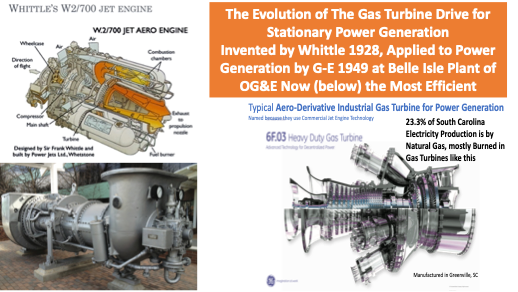
At about this same time, pre WWII, Frank Whittle invented the Jet Engine. This basic design was later used after WWII as the besis for stationary Gas Turbine Drives for generators.

Frank Whittle of the UK is generally given credit for design of the jet engine. It is thought that Von Ohain in Germany had access to Whittle’s Patent before his work. 

Only twenty-two years old when he first conceived the idea of a continuous cycle combustion engine in 1933, von Ohain patented a jet propulsion engine design in 1934 that was similar in concept to that of Sir Whittle but different in internal arrangement.

Von Ohain joined Ernst Heinkel in 1936 and continued with the development of his jet propulsion concepts.

He successfully bench tested of one of his engines in September 1937 and a small aircraft was designed and constructed by Ernst Heinkel to serve as a test bed for a new type of propulsion system known as the Heinkel He178. The Heinkel He178 flew for the first time on August 27, 1939. 

G-E progressed using Whittle’s design to develop both aircraft and stationary gas turbines for power generation.

American Bombers being assembled at Ford Motor Company Plant during WWII, Packard Automobile Plant becomes a Manufacturing Plant for Aircraft Engines

Following WWII, America’s Industrial might continued with the rebuilding of Europe and Japan with the Marshall Plan. Energy use increaded as did manufacturing capacity. Along with the energy and manufacturing capacity increases came increased Economic growth.

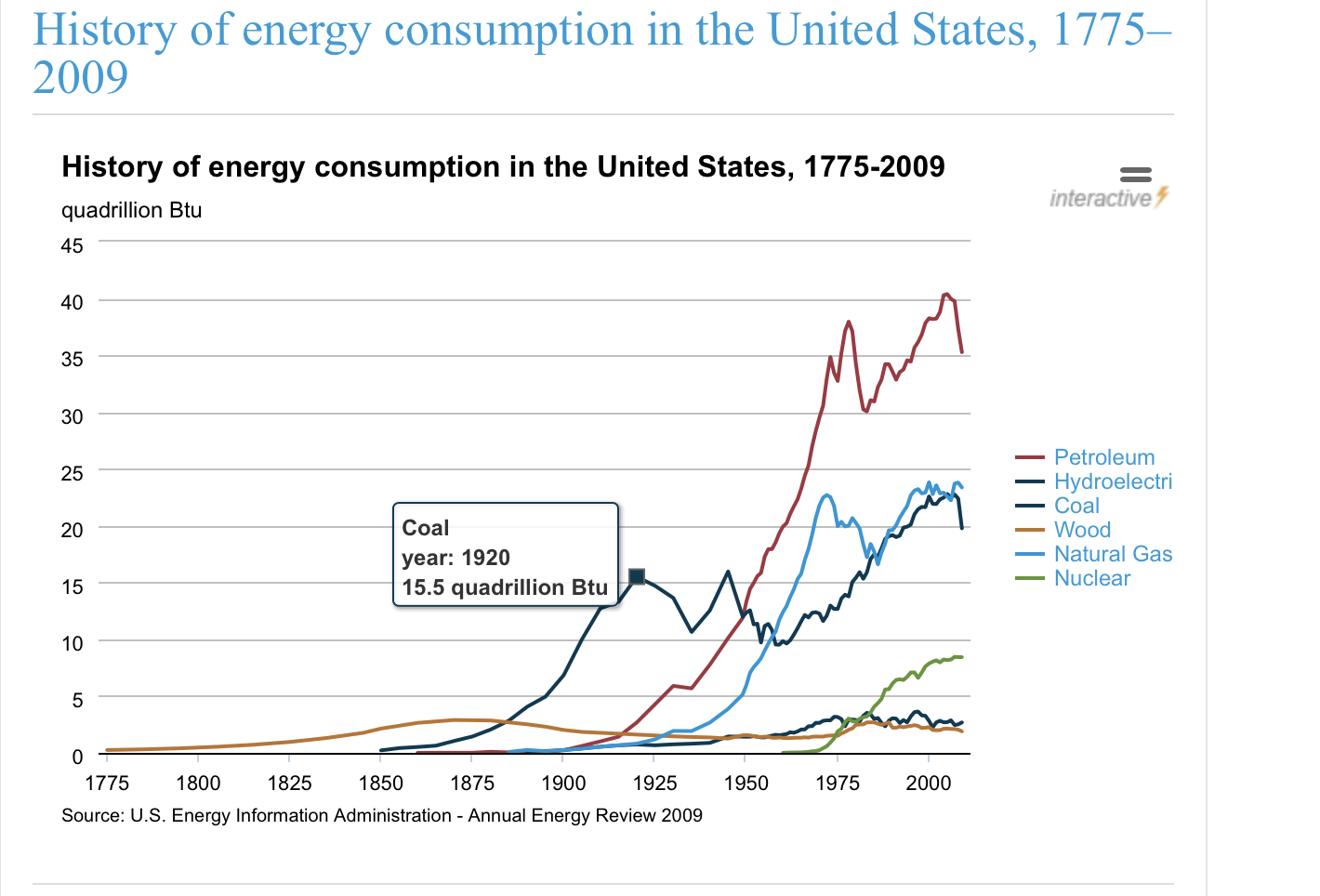
U.S. Dept. of Energy, Energy Information Administration Chart of Total Energy Use of U.S. 1775-2009

The growth of energy consumption is shown above. This growth in energy can be compared to the GDP of Economic growth in the chart below which is copied from “Our World in Data” website.

The chart below was prepared by ExxonMobil for their Energy Outlook publication. The data is from the World Bank and the United Nations. The point is, the Human Development Index is related to energy avalaibility and use. More energy use can be parlayed into a better quality of life. The foregoing text and illustrations show how the U.S.A. progressed from an Agrairian Economy in the 19th Century to become the most productive Industrial Economy of the world by the mid 20th Century. Of course, Economic Freedom had much to do with America’s rise, but so did the availability of abundant and reasonable cost energy. This will conclude Part 1 of this post. Part 2 will show the relationship of energy and economic prosperity from 1950 to the present day.

Conclusions and Summary:

  1. America progressed from wood and whale oil fuels to the more abundant and increased energy density of coal and oil in about 50 years, 1850-1900.
  2. Our economy progressed and quality of life improved as more muscle labor (human and animal muscle) saving machines were invented, produced and utilized.
  3. Steam engines and steam turbines were the prime mover of choice for ships, railroads and agriculture until the various versions of internal combustion engines were invented and manufactured. The gasoline Otto Cycle and the Diesel Cycle engines were invented and began production in the late 19th Century.
  4. The first major oil discovery in Texas is Spindletop, 1901. This begins the long and productive history of oil production in the state of Texas.
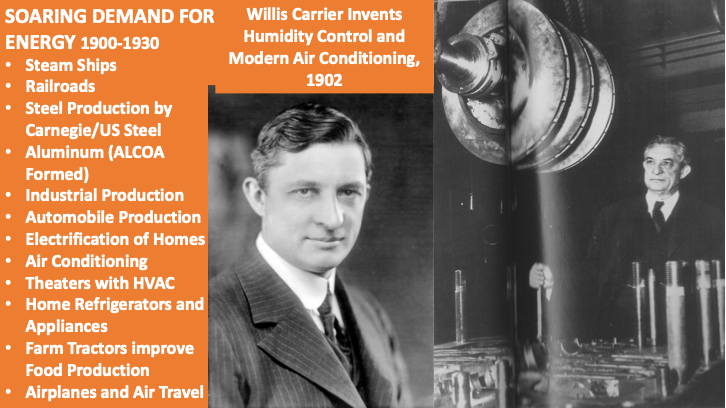
  5. Willis Carrier invents modern air conditioning and humidity control 1902.
  6. Henry Ford revolutionized automoble transportation starting about 1903.
  7. Agricultural production is vastly more productive by the replacement of horse muscle power with mechanized tractors powered by gasoline or Diesel internal combustion
  8. Carnegie and United States Steel become the largest steel manufacturers in the world after 1901
  9. Charles Martin Hall invents and perfects the Aluminum Smelting process in 1888. The Pittsburgh Reduction Company produces aluminum used in the Wright Brothers “Flyer” 1903. Later the name is changed to the Aluminum Company of America and the acronym, ALCOA
  10. Production of both Steel and Aluminum are both very energy intensive. Thus, abundant, reasonable cost energy is required for the steel and aluminum industries to grow as they did.
  11. About 1928 General-Electric produces home refrigerators for preservation of food.
  12. Texas begins development of the Permian Basin oil fields, 1928
  13. During WWII America becomes the “Arsenal of Democracy” and along with our Allies save Western Civilization. The Allies “Arsenal” was fueled mostly by American produced energy, mostly coal and oil.
  14. Captain Hyman G. Rickover has a vision for nuclear propulsion system for submarines and nearly singlehandedly, designs and then leads a team to build the first nuclear powered submarine, the Nautilus which puts to sea 1955.
  15. President Eisenhower launches “Atoms for Peace” Initiative for Peaceful uses of atomic energy. Begins at Atoms for Peace Conference in Geneva, 1955

This is Part 1. Part 2 to follow in the near future. The purpose of this post is to show the importance of reliable, reasonable cost and abundant energy. Energy to power our high quality of living. Our energy has been reliable, low cost and abundant for decades. My observation is that people have become accustomed to reasonable cost and reliable energy for so long that we take it for granted. The environmental extremists on the other hand, have attacked all conventional forms of energy including Fossil Fuels and nuclear which together comprise about 90% of the energy that we depend on.

The foregoing list of 15 accomplishments is intended to show the relationship of energy to high quality of life and economic prosperity. If energy availability is reduced, then our quality of life and economic prosperity are harmed. Up to this point in history, we have always increased energy production to meet the demand of our growing population.

Dick Storm, January 13, 2022

ENERGY AND ECONOMIC PROSPERITY

A few weeks ago, I commented on a post on LinkedIn by Donna Castro. My question was, “I wonder what the correlation is between Economic Prosperity and Energy Use”. So, to answer my own question I did a little research and here is the result of that search.

The “Visual Capitalist”(1) published the graphic above Dec. 21, 2021. I have been interested in the relationship of energy use to fuel Economic Prosperity for many years and liked this graphic.

The total world GDP is projected to be 94 Trillion Dollars. Only 18 countries have greater than a 1% share of the total world economy. The U.S.A. and China comprise about 42%. The ten largest economies are:

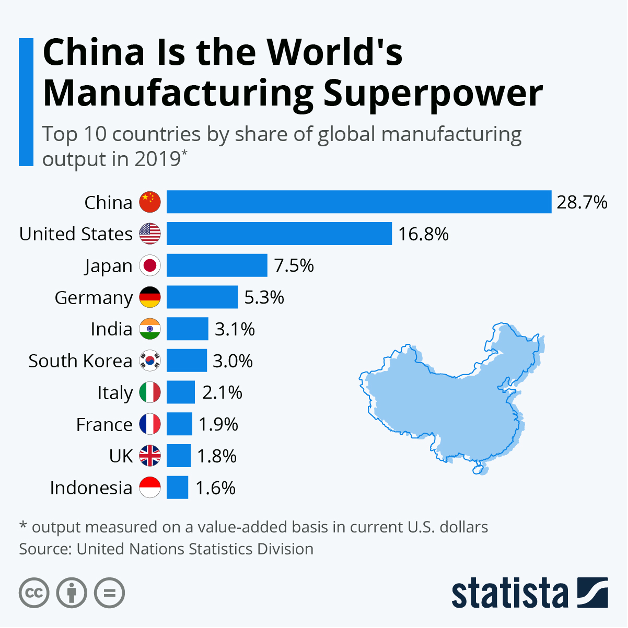
So, back to my curiosity of relating energy use to economic output, I thought it would be useful to show the top ten countries ranked by total energy use. Statista and other organizations list these. I used the chart from Statista. Not surprisingly, the data from all sources show the largest economies use the greatest quantity of primary energy. China is the world’s largest manufacturer and they produce over 50% of the world’s steel and aluminum. Primary metals production is very energy intensive, thus, it is expected that China will use the greatest amount of primary energy and they do.

Chart by Statista.com

The Net-Zero Carbon Emissions Policies of America brings to mind the threat to our economic prosperity and our comfortable life styles. I have written my thoughts on Net-Zero Carbon, the War on Coal, War on Carbon and my opinion of Net-Zero Carbon, in other posts on my Blog.

A new book by Donn Dears is available which has lots of background and details with fresh information of why the Net-Zero Carbon policies of the Biden Administration are harmful to the U.S.A. I recommend his book for anyone who is interested in the relationship of Economic Prosperity and Reasonable and well thought out Energy Policy. Net-Zero Carbon and the current “Green” initiatives in Congress are not reasonable and not well thought out by people who understand energy and electricity generation.

The Net-Zero Carbon Emissions Policies of America brings to mind the threat to our economic prosperity and our comfortable life styles. How can we reshore more manufacturing and become energy independent again by following anti-American energy policies as laid out in the path to Net-Zero Carbon? I have written my thoughts on Net-Zero Carbon, the War on Carbon and my opinion of this policy on this Blog and other publications. However, Mr. Dears has done a very nice job of condensing many issues of Net-Zero Carbon into about 100 pages.

Donn Dears.org

Note the Sub-Title: Which correctly states, “The Climate Policy Destroying America”

The theme and title of this post is “Energy and Economic Prosperity” the current U.S. Climate Policy is weakening America and Mr. Dears is correct with his choice of sub-title.

I recommend his book and the information available on his web page for reference on Energy Policies that affect our Economy and our life styles:  https://ddears.com

I have been concerned about the war on coal and now the war on carbon for many years. Not only is Net-Zero carbon harmful to the U.S.A. but it is also slowing down Human Development of countries in the Developing World. Going back to the first illustration above, note that the U.S.A. and China comprise 42% of the World’s GDP and that only 18 countries exceed 1% of the total 94 Trillion Dollars of World GDP. 

Energy and Human Development Index

The Illustration below is available on the ExxonMobil(3) website and is based on U.N. data.  Note that 50% of the world’s countries and 20% of the world population do not have fuel for cooking. I personally have experienced walking down the streets of cities in numerous Developing countries. I have witnessed heavy pollution which stings the eyes. Such pollution is not found in the U.S. Many Asian countries still use cow dung for indoor cooking.

My point: The Net-Zero Carbon Path that the U.N. has adopted does not serve the Developing countries very well either.

Let me show another of my favorite illustrations of Energy Poverty in the world. This is the NASA Composite Photo, “The Earth at Night”. These night time photos show the differences of energy and electricity abundance or shortages by the illumination that is visible from space. First let’s look at Africa and Europe: 

NASA, Earth at Night Composite Photo

NASA, Satellight Photo at night showing Europe and the continent of Africa. Also apparent in the Human Development Chart above showing Yemen and Nigeria as two Developing countries that have a low HMI (Human Development Index) with a corresponding low energy consumption.

Compare this to the United States at night below:

Conclusions:

  1. The U.S. President & Congress’ quest to enact Net-Zero Carbon into law will weaken America’s capability to sustain our economy and our life styles.
  2. Energy and Economic Prosperity are inextricably linked and restricting energy production and development weakens our country. Don’t forget the Fossil fuels needed for our Nations Defense. F-22’s and F-35’s require high quality Jet fuel.
  3. The United Nations Framework Convention on Climate Change (UNFCCC) and the Intergovernmental Panel on Climate Change (IPCC) both of which are worldwide, are harmful to Developing Countries as well as OECD countries.
  4. The only winners in the UNFCC and IPCC agreements (if they are fully implemented) is China and Russia.

For more details, I suggest reading Mr. Dears books on the subject. He has written several excellent texts.

Dick Storm, January 3, 2022

References:

  1. Visual Capitalist:  https://www.visualcapitalist.com/visualizing-the-94-trillion-world-economy-in-one-chart/
  2. Statista.com for ranking of energy use by country: https://www.statista.com/statistics/263455/primary-energy-consumption-of-selected-countries/
  3. ExxonMobil Outlook for Energy 2021: https://corporate.exxonmobil.com/-/media/Global/Files/outlook-for-energy/2021/2021-Outlook-for-Energy-fundamentals-infographic.pdf
  4. NASA, “The Earth at Night” composite photo: https://earthobservatory.nasa.gov/ContentFeature/NightLights/images/media/BlackMarble_2016_EuroAfrica_composite.png
  5. https://eoimages.gsfc.nasa.gov/images/imagerecords/79000/79800/dnb_united_states_lrg.jpg
  6. NASA Earth Explorer: https://earthobservatory.nasa.gov/map#6/40.000/-100.000

World Affairs Council, Their Take on the Importance of Coal for Electricity Generation

I joined the Hilton Head Chapter of the “World Affairs Council” and as a member, I get daily Newsletters. Today I received the message below on the world’s addition to coal (36% of Electricity Generation). The article included the SME Link to their web page on the Importance of Coal to the World. Energy, Food Production and Economic Prosperity are all inter-related. America has steadily used about 100 Quadrillion Btu’s each year for about twenty years. Fossil Fuels provide about 80% of the energy we depend on. Our quality of life and Freedom (especially freedom of travel) depends on reliable, reasonable cost energy. You probably already know this, but I suspect most of the Democrat elected officials (except Joe Manchin) and (D) voters do not.  Just saw yesterday in WSJ the impact of high fertilizer costs on farming. (High Natural Gas Prices Cause Rise in Fertilizer and Food Prices, Dec. 16, 2021: https://www.wsj.com/articles/surging-fertilizer-costs-push-farmers-to-shift-planting-plans-raise-prices-11639580768?mod=itp_wsj&mod=djemITP_h )

Dick Storm,

December 17, 2021

The article below is copied from the “World Affairs Council” Newsletter which was published today

Dec. 17, 2021 World Affairs Council

A Global Addiction

At the 26th United Nations Climate Change Conference in Glasgow last month, more than 40 countries pledged to phase out their use of coal. Richer countries expect to end coal burning in the 2030s, the BBC reported. Developing nations have set a 2040s deadline.

China, India and the US didn’t opt into the agreement, however. India agreed to “phase down” rather than “phase out” coal, for example, wrote National Public Radio. Diplomats viewed the shift as a compromise. Environmentalists were deeply disappointed. Coal is one of the biggest sources of greenhouse gas emissions that cause climate change.

The black, combustible sedimentary rock that helped fuel the Industrial Revolution in Europe and the US in the late 18th and early 19th century is proving to be a thorny subject for world leaders, businesses and activists. Nearly everyone agrees that the world must wean itself off coal. But doing so is easier said than done. As the Society for Mining, Metallurgy & Exploration explained on their website, “Coal is the most abundant source of electricity worldwide, currently providing more than 36 percent of global electricity.” Link to Coal is Important to the World: https://www.smenet.org/What-We-Do/Technical-Briefings/Coal-s-Importance-in-the-US-and-Global-Energy-Supp#:~:text=Coal%20is%20the%20most%20abundant,“home%20grown”%20energy%20source

In the long term, the future of coal is bleak. China has stopped funding the construction of coal plants overseas. The US has done the same. But today, after significant reductions in emissions during the worst of the coronavirus pandemic, coal-burning has surged back along with world economic growth, Deutsche Welle reported. Even as the US and Europe decrease their coal burning, Asian countries will likely pick up the slack as they race to develop their economies, added the World Economic Forum.

Low coal supplies helped cause electricity shortages as the pandemic waned in China, which accounts for more than half the world’s coal consumption, CNN wrote. Factories were forced to cut production. Reports of folks stuck in elevators embarrassed leaders in Beijing. It’s not surprising that Chinese officials promptly ordered up more mining.

Such problems are not limited to Asia. North Macedonia is planning to import coal from Kosovo to deal with energy shortages in its antiquated energy grid, according to Reuters. Household electricity prices in North Macedonia, meanwhile, are slated to rise by 10 percent in the new year.

Change is coming, however. In Australia, where Prime Minister Scott Morrison has long defended the country’s powerful coal industry, homeowners are forecast to install rooftop solar panels on nearly half the country’s houses in the next decade, Bloomberg reported. Australia is therefore expected to cut coal consumption faster than earlier estimates suggested. Morrison is now in the odd position of pledging not to shutter coal-fired plants too quickly, the Guardian explained.

He and other leaders are hanging on tightly when many believe it’s time to let go.”

In my opinion the “War on Carbon” is the most successful Hoax ever thrust on World. Perhaps during the coldest months of winter 2022, people will wake up? Memories are short regarding last years Blackouts in Texas and the fact that had over 6,000 MW of coal power generation NOT been retired, the Blackout and resulting deaths did not need to happen. This is my personal opinion, Dick Storm, Dec. 17, 2021

References for additional support

  1. World is depending on coal power during this time of energy shortages: https://oilprice-com.cdn.ampproject.org/c/s/oilprice.com/Energy/Energy-General/Coal-On-Track-To-Break-Records-Despite-Efforts-To-Curb-Production.amp.html

King Coal is Dead. Long Live the King!

Coal has been important to lift people from poverty to good lives for about 150 years. The Developed world made great progress from 1900 to present day thanks to reasonable cost coal power. The Electric Utilities once educated the public on power generation and “Living Better Electrically” Any of us born before 1950 can remember the Edison Electric Institute Mascot, “REDDY KILOWATT”. What a wonderful benefit that was for Humankind. As a high school student I actually knew where electric power came from and the basics of Thermal Power Plants.

Then ironically, about the time of the 1973-74 Arab Oil Embargo, I was working for Carolina Power and Light Company. A responsible and efficient Electric Utility headquartered in Raleigh, NC. I remember as a fact, CP&L cut the Public Relations Budget which included killing programs in schools to teach Home Economic Students the benefits of “Living Better Electrically”. Also, TV and Newspaper articles to explain the importance of electricity. So, what filled the void? The Environemntal Extremists filled the void. Then in the 1990’s Bill Clinton’s Presidency began the “War on Coal”. Later the war on coal morphed into the war on carbon.

Thank you Ron Clutz for writing your article. I will post a couple pictures of life without Fossil Fuels. As John Kerry flies around the world professing to save the Planet, I suppose this is what he and the Biden Administration wish for us to do, return to muscle power. This is preposterous considering we are well into the Digital and Space Age!

An Amish Teenage Girl with Team of Horses Plowing circa 1960

Without new thinking on nuclear power, (anti Carbon) climate policy can’t succeed

This is copied from the Tennessee Star Tribue Newspaper Opinion page, Nov. 11 2021. Full credit is given to the author, Mr. John Windschill. Thanks also is given to my friend Don Spellman for forwarding to me. I thought this is well researched and well written. As for myself, I believe Climate Change is mostly from natural forces, but if a reduced carbon society is desired and our quality of life and freedom is to be continued, then nuclear power must be included along with all other fuels.

The perceived dangers are overestimated. 

By John Windschill

From Dick Storm course at USCB-OLLI on the Future of Energy and Electricity Generation

A summer of destructive flooding, fires and drought across the planet, coupled with a sobering update from the United Nations climate panel, indicates that we are likely not making adequate progress addressing climate change. And our climate change ambivalence is especially obvious when it comes to nuclear power.

Despite nuclear power having potential to greatly reduce the fossil-fuel emissions that are responsible for about 70% of U.S. transportation- and electricity-related carbon emissions, and despite nuclear power being among the safest means of electricity production we have (as reported in Forbes, the Lancet and the Journal of Cleaner Production), many well-run nuclear plants are being retired.

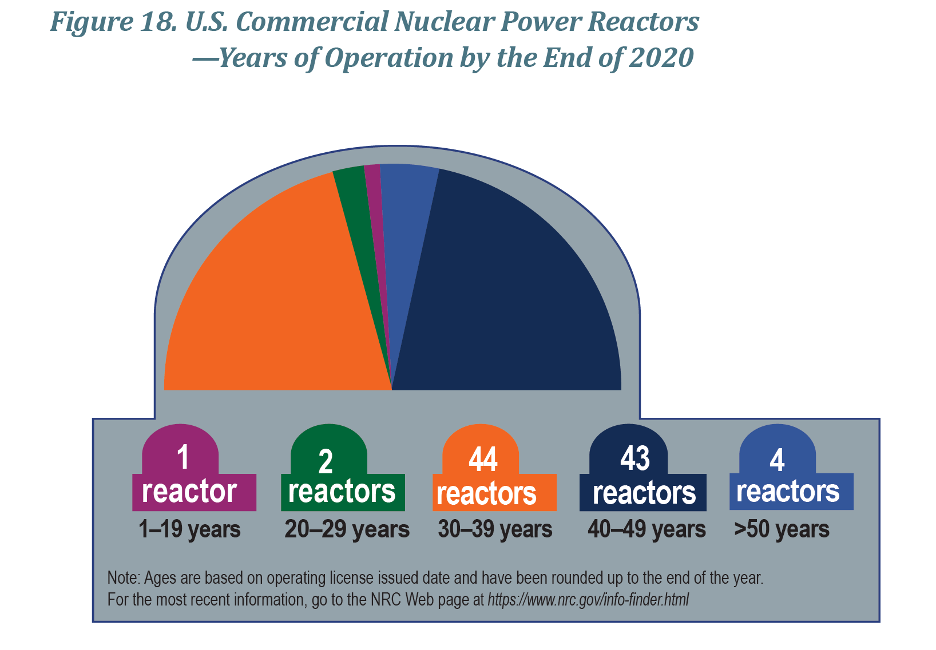
In the last eight years, 11 nuclear reactors were retired in the U.S. This year four more are scheduled for permanent closure. These plants collectively represent 14,700 megawatts of electrical supply — enough electricity for 10 million people.

Consider the experiences of Germany, France and Sweden. Germany’s decision to forgo nuclear power has resulted in its falling far short of its carbon emission goal. France, which receives 72% of its electricity from nuclear, has less than half the carbon emissions of Germany, and electricity prices that are 40% lower. Sweden’s electricity is 40% nuclear, with prices 35% below Germany’s and per capita carbon emissions that are 57% lower.

Critics of nuclear power identify fear of accidents and a belief that a solution for waste disposal does not exist as reasons to oppose nuclear power. Neither of these is valid. People are afraid of nuclear power because it pushes all the wrong emotional buttons. As a result, the very low risk that nuclear power entails is not appreciated.

At the core of the fear of nuclear power is a fear of ionizing radiation (hereafter simply referred to as radiation). Radiation is extremely common in our environment. It is a straightforward substance to monitor and control, and its impact on public health is well understood. Each second natural background radiation interacts with our bodies more than 10,000 times. These natural sources account for about half of the radiation dose the average American receives, with the remaining half coming from medical procedures. The 60 operating nuclear power plants in the U.S. contribute less than 0.01% from routine operations.

The two basic ways a nuclear power plant can increase public radiation doses are accidents and waste disposal. Three accidents have occurred that affected the public. These, in increasing order of severity, were Three Mile Island in 1979 in Pennsylvania, Fukushima in 2011 in Japan, and Chernobyl in 1986 in Ukraine. This history of nuclear power over 42 years proves how safe nuclear power is.

At the Three Mile Island accident there were no health effects. Nuclear Regulatory Commission reports indicate the average radiation dose received by members of the public living near the plant was far below natural background radiation levels.

Fukushima released more radioactive materials than Three Mile Island, but because of effective emergency response efforts, public radiation doses were low. The United Nations Scientific Committee on the Effects of Atomic Radiation and the World Health Organization (WHO) concluded that there would be no observable health effects in the public from the accident.

The Chernobyl accident was basically the most severe nuclear power plant accident that is possible. International Atomic Energy Agency and WHO reports indicate that the only cancer that has been detected from the accident is thyroid cancer, which has led to 15 related fatalities. Among initial responders, 28 tragically died of acute radiation poisoning at the time of the accident.

Based on conservative estimates, it is possible that a few thousand might die within 50 years of cancers not epidemiologically detectable among the background cancer rate. This puts a cap on the worst-case result. A few thousand people die each day in the world due to air pollution from fossil fuels and also from auto accidents. With more than 37,000 fatalities worldwide since the Three Mile Island accident, commercial air travel has about a 10 times larger impact on public health and safety.

For comparison among electrical generating sources, the fatality rate per billion kilowatt-hours generated is: coal, 25; natural gas, 2.8; global nuclear, 0.074 (includes an assumed 4,000 future deaths from Chernobyl); wind, 0.035; hydro, 0.024; solar, 0.019; and U.S. nuclear, 0.0001.

And the lessons learned from the three accidents described above have been effectively applied to make safe nuclear power even safer.

Regarding high-level nuclear waste, James Conca (who has Ph.D. in geochemistry from California Institute of Technology) says, “We know where to put nuclear waste, how to put it there, how much it will cost, and how well it will work.” An oft-repeated phrase is that high-level waste is dangerous for tens of thousands of years, but the fact is that high-level waste loses 99% of its toxicity within 600 years. And while high-level waste is very toxic material, it is less hazardous than gasoline.

The U.S. produces 50 times more lethal doses of gasoline each year than lethal doses of high-level waste; we carry our gasoline with us pretty much everywhere we travel, and it is stored much less carefully than nuclear waste.

The very small volume of high-level waste allows meticulous control to be achieved. Each U.S. resident’s lifetime share of high-level waste would fit in a single can of Coke. Kilowatt for kilowatt, solar power waste has 10,000 times greater volume than nuclear waste, and wind’s total is 500 times larger, each involving large amounts of toxic metals in panels and batteries. Also, nuclear waste is an inert solid within a metal casing (i.e., spent nuclear fuel), not green, oozing goo.

And yet, wind and solar get an environmental hall pass, but nuclear power is labeled as exceedingly dangerous.

The current concept is to secure the solid waste in highly robust steel containers, and to store the containers in an accessible manner that allows routine monitoring and inspection in a deep underground repository free of groundwater that has been geologically stable for millions of years. Yucca Mountain north of Las Vegas was selected for study.

Prof. Bernard Cohen of the University of Pittsburgh calculated that if all the electricity in the U.S. were provided by nuclear power, it would result in 0.3 deaths per year in the U.S. due to waste storage. Should we be concerned with tiny quantities of nuclear waste migrating from a very remote, highly engineered and easily monitored facility sometime in the far distant future, or with the millions of tons of carbon dioxide and harmful particulates we currently pump into the air to breathe and cause our planet to heat up?

Yet in 2011 President Barack Obama defunded the Yucca Mountain project. Again, faulty risk assessment and politics won out over science and sound public policy.

We should be insisting that our government more vigorously pursue this valuable technology that could be a difference maker for addressing climate change. Bill Gates has helped form a new company, TerraPower, whose mission is to bring nuclear power plant design forward to the next level of safety and economic performance. In a recent quote from Forbes, he said “there are only three ways to solve the electric grid problem: one is a miracle in [energy-battery] storage, the second is nuclear fission, and the third is nuclear fusion.”

Wind and solar have a vital role to play, but we should not be putting total reliance on a miracle.

IPCC Data: Rising CO2 is 75% Natural

I have always believed Climate Change was mostly natural, here is a more scientific presentation showing 75% Natural forces are the cause of Climate Change. Thank you Ron Clutz for your analysis..

Ron Clutz's avatarScience Matters

A previous post reprinted later below raised the question Who to Blame for Rising CO?  It provided synopses of three studies challenging the IPCC orthodox explanation that humans are the cause by burning fossil fuels.  This post brings the research up to date with a 2021  publication by Edwin Berry.

The graph above summarizes Dr. Berry’s findings.  The lines represent CO2 added into the atmosphere since the 1750 level of 280 ppm.  Based on IPCC data regarding CO2 natural sources and sinks, the black dots show the CO2 data. The small blue dots show the sum of all human CO2 emissions since they became measurable, irrespective of transfers of that CO2 from the atmosphere to land or to ocean.

Notice the CO2 data is greater than the sum of all human CO2 until 1960. That means nature caused the CO2 level to increase prior to 1960, with no reason to…

View original post 2,989 more words

Glasgow, COP-26 Elitists and Special Interests Promote China First, America Last, Why? Because Energy Savvy Engineers Were Not Successful In Educating The Public and Politicians on the True Facts

Well, that is at least one reason we have such a mess of energy policy now.

Once a “War on Carbon”, Has now Morphed into a “War on Freedom”, “War on our Rights”, “War on Capitalism” and an assault on much of What “We the People” Have Worked Hard For. The clowns in Scotland are spending our tax dollars and restricting our freedoms as best they can. Essentially putting China and the rest of the world first, America last. All on our dime.

Meanwhile, U.S.A. High Gas Prices, Super Market Shortages, Inflation , Oil and Gas Jobs are Killed and Winter Energy Supplies may be limited. The American people did not vote for this

America has been a leader by example in reducing carbon. The U.S.A. has reduced our carbon emissions by over 50% since 2005. How? By releasing the power of free markets and American innovation. At the end of President Trump’s term, America was energy independent. He did that in four years only to have Joe Biden reverse his policies.

The War on Fossil Fuels is not new and the intentions have always been to raise energy costs so that “Green Power” will become competitive. Yes, the intentions of President Biden, John Kerry, Al Gore and the rest of the Green Extremists (Reminder, the War on Coal started in the Clinton-Gore Administration. Obama just continued and accellerated anti American energy policies Clinton-Gore began) The war on carbon is intended to make Exploration, Development, Production and use of oil, gas, coal and even nuclear, more expensive and harder to use. All of this as the world’s people still depend on Fossil Fuels and nuclear together for almost 90% of our total energy. How can our leaders be so ignorant and insensitive? Well, back in the 1990’s when bill Clinton started the “War on Coal”, I did my best to educate the public and the students of public schools and several Colleges on energy and electricity generation. I am proud of my efforts, small as they seem in the grand scheme of things. There is still a need for Energy Engineers to become active in PR for Energy!

I copied the Oct. 2011 Commentary(Below) from POWER Magazine’s web page. Kindly note my last line: I sure wish the readers of POWER and many other engineers took the suggestion to educate the public on energy and electricity generation more seriously. If we had, perhaps we would not have the mess we have in Washington today.

(From Oct. 2011)

Shaping America’s Energy Policy

America’s energy and environmental policies have been dysfunctional for decades. Obsessively moving toward “green” has made America weaker and has damaged our economy. During POWER’ s first 100 years (1882–1982), the magazine chronicled the U.S. growing into the strongest industrialized economy in the world. America designed and built products for the world using raw materials and energy from within our own borders. Now we are in a recession and the U.S. Environmental Protection Agency’s (EPA) “War on Coal” continues. Does anyone get the connection? Ever-worsening regulations are killing jobs by the thousands.

Past Turning Points in U.S. Energy Production

Remember when America took risks and led the world in energy innovation? Let’s review some of the past milestones.

The pace-setting power stations Eddystone and Philo are ultrasupercritical power plants that were designed in the 1950s. Hailed as the most efficient coal power plants in the world when they were launched, these plants were designed for over-40% thermal efficiency.

Then Admiral Hyman G. Rickover and President Dwight D. Eisenhower followed through on the “Atoms for Peace Initiative” to commercialize the success of the Navy nuclear propulsion systems, which were to be applied to electricity generation for peaceful purposes. The Shippingport nuclear power plant began operations in the early 1960s, and larger commercial nuclear plants were on the drawing boards. By the mid-1960s, it was said that nuclear power was such a technological breakthrough that “electricity will be too cheap to meter.” America went on to build more than 100 commercial nuclear plants, most of which are still operational. U.S. nuclear plants remain economical and have earned an enviable safety record.

Then came oil embargos, followed by volatile natural gas prices. The high oil and gas prices resulted in a surge in building new coal plants from 1975 to 1985. The nuclear fleet grew until 1978, when the Three Mile Island accident created a major setback. In recent years, nuclear power morphed into the politically correct, carbon-free fuel. However, the tsunami in Japan in March and the resurgence of anti-nuclear groups around the world seem to have once more stalled future nuclear plant development.

The Need for Energy Policies That Promote Our Economy

U.S. energy policy should promote the use of all fuels. America is the Saudi Arabia of coal. If mining permits, EPA regulations, and common sense energy policies were practiced, then power engineers could replace our aging coal plants with new clean coal plants exceeding 40% thermal efficiency. This would be an efficiency improvement of about 7 percentage points above the existing coal fleet.

It is absurd that environmental activists can shape the U.S. energy policy based on ideology alone, with little concern for keeping electricity prices reasonable and our economy growing. Why don’t environmental activists embrace new, more efficient clean coal plants? America should be replacing our aging fleet with new, more efficient, clean coal plants. Will we ever learn?

My concern is that the same type of political correctness that nearly killed nuclear power after Three Mile Island may harm the future of clean coal plants. If the U.S. rebuilt the aging 300+ GW coal fleet with all new, clean ultrasupercritical coal plants, it would employ well over three million Americans. Jobs and a strong America are related to the utilization of homegrown energy, including the mining of coal and raw materials; construction; and the production of steel, cement, copper wire, generators, boilers, balance-of-plant equipment, and environmental controls. Compare the number of jobs created to build, operate, and maintain new coal plants with the “green jobs” of erecting foreign-built windmills or solar power facilities.

If we want to restore economic prosperity and renew manufacturing in America, then we need reasonably priced electricity to supply power to manufacturing plants. Keeping electricity costs reasonable for residential consumption is nice, but to restore manufacturing jobs in America, reasonably priced wholesale electricity, which is available on a 24/7 basis, is needed. This point seems to be forgotten in the national dialog on America’s energy future.

Educating the American Public About Electric Power Production

I think each of us who understands power production has a responsibility to educate our friends, neighbors, and elected officials. There are millions of citizens who believe reasonably priced, reliable electricity is an entitlement. The right thing for human advancement is to use the God-given natural resources that have made “living better electrically” a way of life in the developed world.

In my opinion, we should build green power where it is practical and economic to do so, such as on the roofs of buildings and parking garages. I support the building of nuclear plants and combined cycle gas plants, where economically justified. Energy engineers understand that when the sun sets and the wind is calm, the U.S. needs reasonably priced, dispatchable power to energize what is left of America’s manufacturing might.

I urge the readers of POWER to do your part in educating the public and our elected officials on the true facts of how we can continue to “live better electrically” and keep America strong. I promise to do my part. Will you?”

— Richard F. “Dick” Storm  (was in 2011 ) CEO/senior consultant of Storm Technologies Inc. in Albemarle, N.C.

Reference:

  1. POWER Magazine, Oct. 2011 Commentary: https://www.powermag.com/shaping-americas-energy-policy/#.YYIdCBf0vsM.linkedin
  2. Ron Clutz, Science Matters, Climate Change is 75% Naturally Caused by IPCC Data: https://rclutz.com/2021/11/06/ipcc-data-rising-co2-is-75-natural/#like-22392

The War on Carbon, How it Came to be:

Climate Change has been going on since well before the Romans. Certainly well before coal was burned for power generation. Yet, the main stream news is fixated on Climate Change being the result of the Developed World’s use of Fossil Fuels over the last 100 years. The MSM has completely blown off the possibility that Climate Change is mostly Natural. I am a proponent for reasonable cost, abundant energy and the resultant improved quality of life. I am also interested in protecting the environment, and I love nature just as much as any environmentalist does. Reasonable cost Energy improves quality of life and is referred to by some as improving the “Human Developmet Index”. It concerns me that the most reasonable cost and proven sources of energy have become somewhat socially unacceptable. Such as coal, oil, gas and nuclear. Ironically, these four forms of energy are the one’s that provide about 90-96% of the Developed World’s energy. Many Financial Institutions are reluctant to loan money to Developers of mines, fossil fueled power stations or refineries. Even though there are still almost a Billion people on the planet that have limited or no access at all to electricity. Energy and Economic prosperity go together.

A slide from a recent course I presented. The data are from the UN, Our World in Data and ExxonMobil’s Outlook for Energy

So, this begs the question: Why would so many in the MSM, Entertainment, Politics, Education and the General Public be against the very things that make our high quality of lives possible? As I was thinking about this, it occurred to me that perhaps it would be helpful to remind folks of how we have arrived at this absurd place in history. Here are my thoughts and research of how the “War on Carbon” came to be. This is purely Politically Driven, not based on science or protection of the planet.

The UN Agenda 21

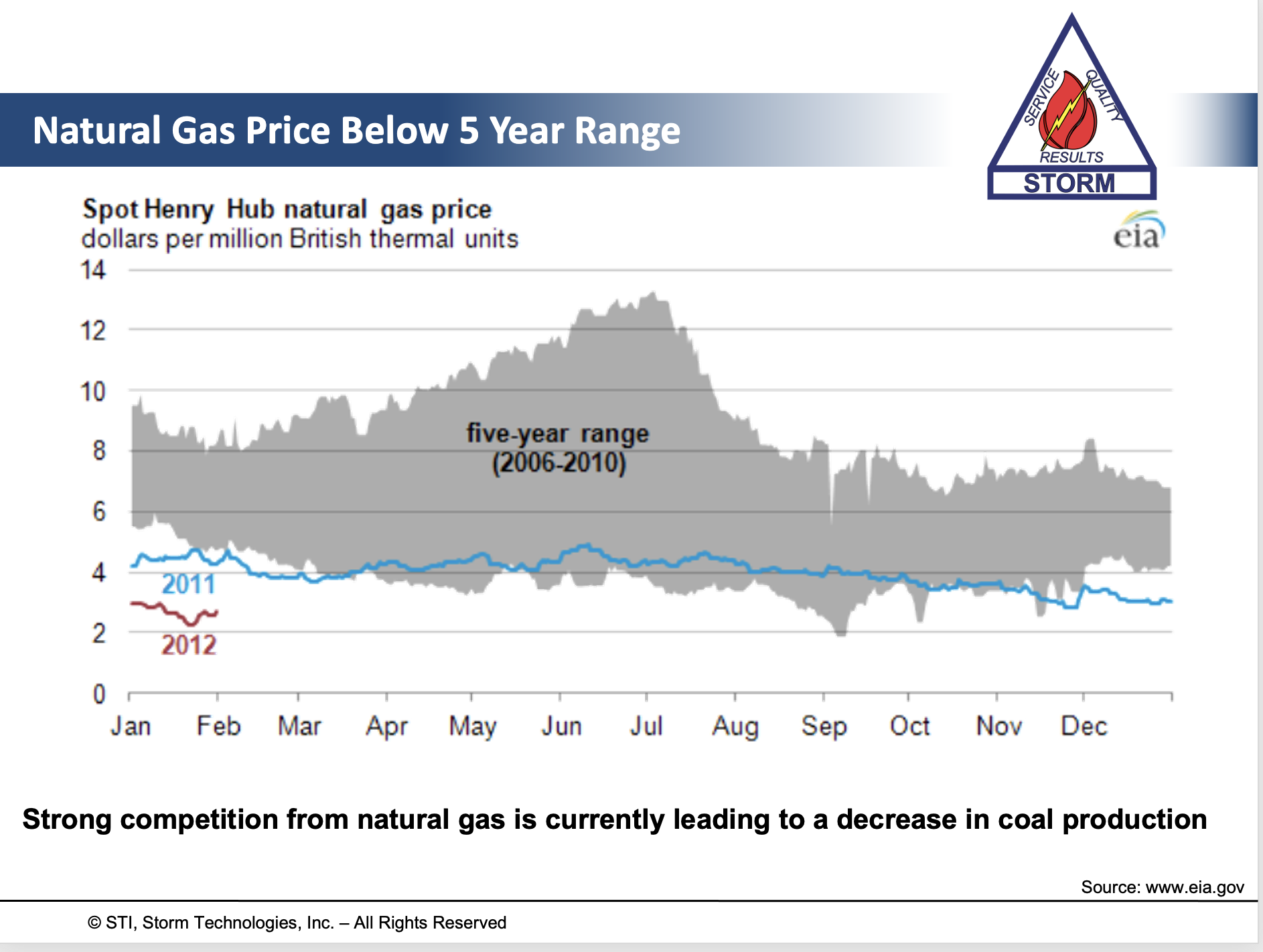
It was 1993 and Bill Clinton was President of the U.S.A. with Al Gore as Vice President. Executive Order #12858 was signed.(1) This is my understanding of the beginning of the “War on Coal”. The U.N. Agenda 21 began in a conference in Rio de Janeiro in 1992. It brought together concerns for our environment, Socialism, Secular Humanism, and the world banking cartels. U.S.A involvement began in 1992, with then good intentions, by President George H.W. Bush. Bush #41 referred to Agenda 21 as encompassing “Sacred Principles”. Then the good intentions deteriorated into viscious, effective and well funded attacks on coal. The cost to Americans was blunted due to the near simulateous successes of the Shale Gas Revolution which greatly increased production of Domestic natural gas and drove natural gas prices downward. In the short term, the low natural gas prices actually hurt coal power more than the extremists and Democrat’s smear campaigns. However, the damage was permanent with no new coal plants being built in the U.S.A. since about 2012. Many older coal plants have been irreversibly decommissioned and hundreds demolished. Many of these plants could have been operating now had they been maintained. I hate to say the Environmental Extremists have won, but it looks like they have. But, who benefits from the Environmental Extremists apparent success? In my view, the only beneficiaries are China, Russia and other adversaries of the U.S.A.

Now, natural gas prices are escalating and even the Left Leaning MSM talk of expected high energy bills in winter and possible energy shortages. Therefore, given this scenario, I thought it was timely to review, from my vantage point, just how this madness came to be.

War on Coal 1993-2012

The Democrat’s have hated coal for many years. The only reason I can rationalize their hate, is because the well funded Environmental Groups usually support Democrat’s. Here below is an excerpt from Wikipedia on the “War on Coal”(6)

“A goal of the Sierra Club is to replace coal with other energy sources.[31] Through its “Beyond Coal” campaign, the Sierra Club has set a goal to close half of all coal plants in the U.S. by 2017. American business magnate and former New York City mayor Michael Bloomberg donated $50 million to the Sierra Club’s anti-coal work in 2011, and announced another $30 million gift to Sierra’s Beyond Coal campaign in 2015.[32]The Beyond Coal campaign says 187 coal plants have been closed since 2010.[33] Other funders of the Sierra Club’s anti-coal campaign include the William and Flora Hewlett Foundation and the John D. and Catherine T. MacArthur Foundation.[34] The CEO of Chesapeake Energy, a natural gas company, donated $26 million to the Beyond Coal campaign between 2007 and 2010.[35]

The Sierra Club is also opposed to nuclear energy.[36][37] “

Then, piling on with the MSM and the environmental organizations comes the allying of the public schools and teaching (indoctrinating) extreme green policies to our teenagers many of which have now grown up to be adults.

In addition to demonizing of carbon in Public Schools the general public is bombarded with “Save the Planet” propaganda by entertainment personalities, and the  MSM.  Here is a short history of the War on Coal by Politico(7)https://www.politico.com/agenda/story/2015/05/inside-war-on-coal-000002/ 

The Democrat’s hated coal and then that hate has morphed into hate of all Fossil Fuels. The (D’s) are supported by Environmental organizations (4,5) that mostly, also hate nuclear. So, the Democrat’s and Environmentally (Like Bush 41, they have good intentions) conscious citizens tend to oppose the one carbon-free form of power that is efficient, reliable, proven and capable of Dispatchable operation at high-capacity factor. The generation (it has been 28 years since Clinton signed EO) of youth that were indoctrinated to hate coal and nuclear are now voters.

This is my summary of “How the War on Carbon” has brought us to Congress working on a Stupid and anti-American Path to Net Zero Carbon. A path that only benefits adversaries of the U.S.A. The best word I can think of to describe these policies is “Stupid”.

A better path would be to continue energy independence using Hydraulic Fracturing and production of all of America’s oil and gas, including pipelines for safe transport of oil and gas. Build many more new nuclear plants to produce more nuclear power generation for both electricity generation and for hydrogen production. Also, build new highly efficient coal plants with the future capability for CCUS (Carbon Capture, Utilization and Storage) Called HELE (High Efficiency Low Emissions)

In closing, my view is that all forms of energy are important including; nuclear, coal, oil and gas. By the way, another reason that supports this is the fact that about 96% of America’s energy is provided by conventional energy as shown below. Disrupting the supply chain of Domestic energy will weaken America.

These views are my own and not those of any organization that I have been part of. I take full responsibility for these opinions and they are based on my personal experiences in the electric power industry over many decades.

Richard F. (Dick) Storm, PE

PS I just came across this post by the GWPF (Global Warming Policy Foundation) A reminder that all the meetings and hype are strictly Political, not about getting Results:

References:

  1. Living with Agenda 21, Surrendering Our Freedoms by Dr. H. Lawrence Zillmer, Copyright 2012
  2. U.N. Agenda 21 Info: https://sustainabledevelopment.un.org/content/documents/Agenda21.pdf
  3. U.N. Sustainable Development Report, 2021: https://sustainabledevelopment.un.org/content/documents/UN-DESA_Back_Common_Future_En.pdf
  4. Capital Research Center, Report on Climate Dollars https://www.climatedollars.org/full-study/a-short-history-of-global-warming-fears/
  5. The NEW Leviathan, Crown Forum, NY 2012 Check Appendix X and summary of $9 Billion in Assets
  6. Wikipedia, “War on Coal” https://en.wikipedia.org/wiki/War_on_coal
  7. Politico, “War on Coal” https://www.politico.com/agenda/story/2015/05/inside-war-on-coal-000002/
  8. War on Coal, Issues in Science and Technology: https://issues.org/real-numbers-president-obamas-war-on-coal/
  9. An Excellent video of some very smart Patriots, The Right Stuff Climate Team (Retired NASA Engineers): https://www.therightclimatestuff.com
  10. Donn Dears well written and practical articleshttps://ddears.com/donns-articles/
  11. Michael Shellenberger on John Shanahan Website. Solar Panels make more waste than nuclear: https://www.allaboutenergy.net/energy/238-energy/today/wind-and-solar/north-america/862-100-percent-renewable-energy-rested-on-a-lie-michael-shellenberger-environmental-progress-mark-jacobson-usa
  12. Armstrong Economics, Great article on CO2 and the politics of the “War on Carbon” aka, “Manmade Climate Change” https://www.armstrongeconomics.com/world-news/climate/3rd-attempt-to-publish-this-google-interferes/
  13. EPA New Source Review  Settlements Summaries: https://www.gem.wiki/EPA_Coal_Plant_Settlements
  14. EPA Settlements on NSR violations by WEPCO 2003: https://www.epa.gov/enforcement/wisconsin-electric-power-company-wepco-clean-air-act-civil-settlement 
  15. Dissertation on the Sierra Club Success of Beyond Coal Campaign 2020: https://www.proquest.com/openview/b734be1b4fa402463fbb2ee03a7993e5/1?pq-origsite=gscholar&cbl=18750&diss=y
  16. Inside the War on Coal Politico, The Agenda 2015: https://www.politico.com/agenda/story/2015/05/inside-war-on-coal-000002/
  17.  NRDC China Office: https://chinadevelopmentbrief.org/ngos/natural-resources-defense-council-nrdc/  
  18.  Government Accountability Office Report on Environmental Protection Agency–Application of Publicity or Propaganda and Anti-Lobbying Provisions EPA Lobbying, 2015: https://www.gao.gov/products/b-326944
  19. NRDC About us and link to IRS 990 Form: https://www.nrdcactionfund.org/about/
  20. Influence Watch, NRDC page: https://www.influencewatch.org/non-profit/natural-resources-defense-council-nrdc/
  21. Washington Examiner: Gina McCarthy CEO of NRDC: https://eelegal.org/washington-examiner-gina-mccarthy-and-nrdc-together-again/
  22. Wrong Kind of Green, NRDC and Source Watch: https://www.wrongkindofgreen.org/the-group-of-ten/natural-resources-defense-council/
  23. Bezos awards $100 million to NRDC : https://www.nrdc.org/media/2020/201116
  24. Bezos plans to give Billions to Environmental Org’s: https://www.cnbc.com/2021/09/20/jeff-bezos-pledges-1-billion-to-conservation-through-bezos-earth-fund.html
  25. Activist Facts,  Environmental Report (Follow the Money): https://www.activistfacts.com/organizations/19-natural-resources-defense-council/
  26. Washington Examiner 2013 EPA and Sue and Settle Lawsuits: https://www.washingtonexaminer.com/epas-back-room-sue-and-settle-deals-require-reform
  27. Activist Facts, Sierra Club, Beyond Coal, Beyond Gas, Nuclear :https://www.activistfacts.com/organizations/194-sierra-club/
  28. Mother Jones 2012, Sierra Club “War on Coal” update to kill 167 coal plants: https://www.motherjones.com/environment/2012/04/map-american-coal-plants/
  29. AEP Newsletter to employees and Retirees on Turk Plant Settlement: https://aepretirees.com/2011/12/22/aep-resolves-all-legal-challenges-against-turk-plant-plant-on-track-to-begin-commercial-operation-in-2012/
  30. PowerEngineering Articles on Turk and Duke Coal plant closures, 2/01/2012: https://www.power-eng.com/renewables/aep-resolves-all-legal-challenges-against-turk-plant/#gref
  31. Source Watch Brags on NRDC being responsible for forcing shutting down of Seven major coal plants in Texas in 2007: https://www.sourcewatch.org/index.php?title=Natural_Resources_Defense_Council#Support_for_coal_gasification
  32. Environmental Defense Fund: https://en.wikipedia.org/wiki/Environmental_Defense_Fund
  33. Influence Watch profile of EDF: https://www.influencewatch.org/non-profit/environmental-defense-action-fund/
  34. WUWT, Article, July 8, 2022, Green Communism, Eradicate the Energy Privilege of Rich Countries:  https://wattsupwiththat.com/2022/07/08/green-communism-eradicate-the-energy-privilege-of-rich-countries/

The Impossibility of “Net Zero Carbon”

I presented a short course to the local University, OLLI, Life-Long Learning Program. I thought it may be helpful to provide a summary of the course on this Blog so that it is available to others. Mindful that many policy makers and voters are not aware of the costs of renewable energy and the difficulties in living without carbon based fuels. This course was intended to provide insight to non-energy engineers on this important topic. Also included at the end are numerous references that are not widely discussed by the Main Stream Media, Entertainment and even in “Woke” Social Media.

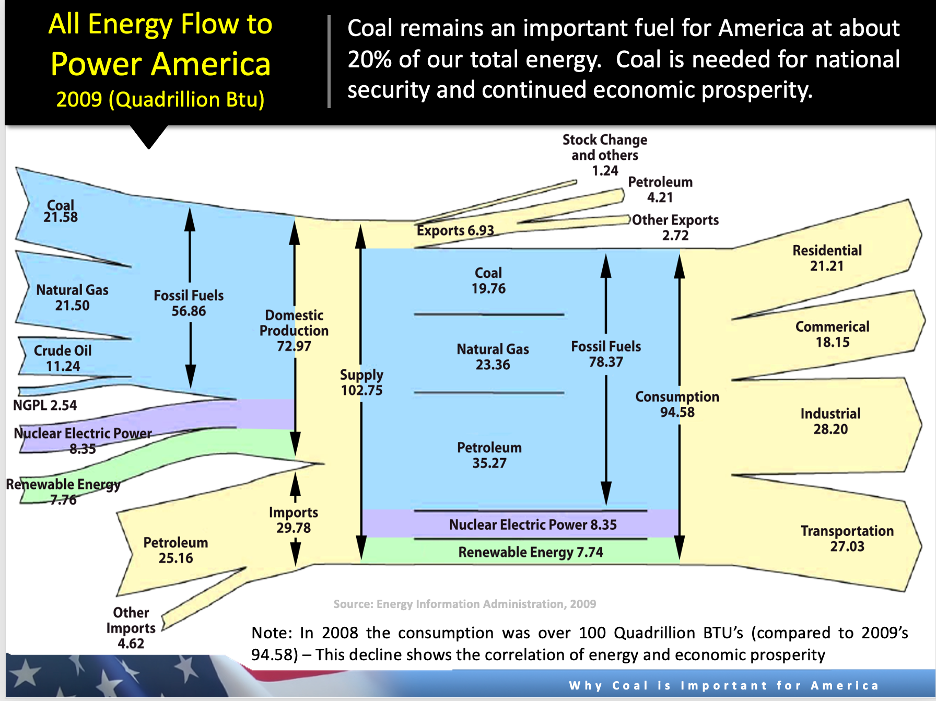
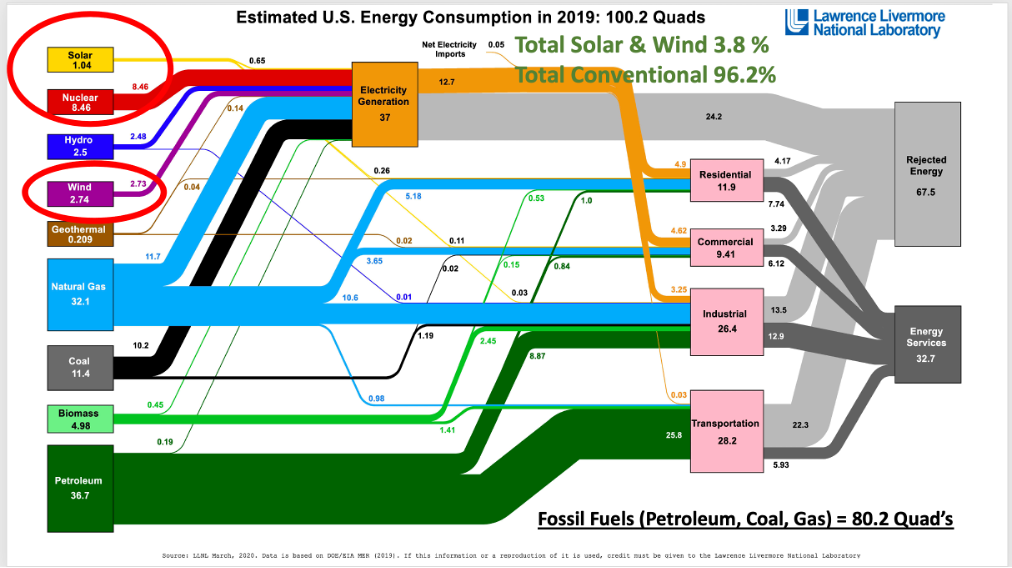
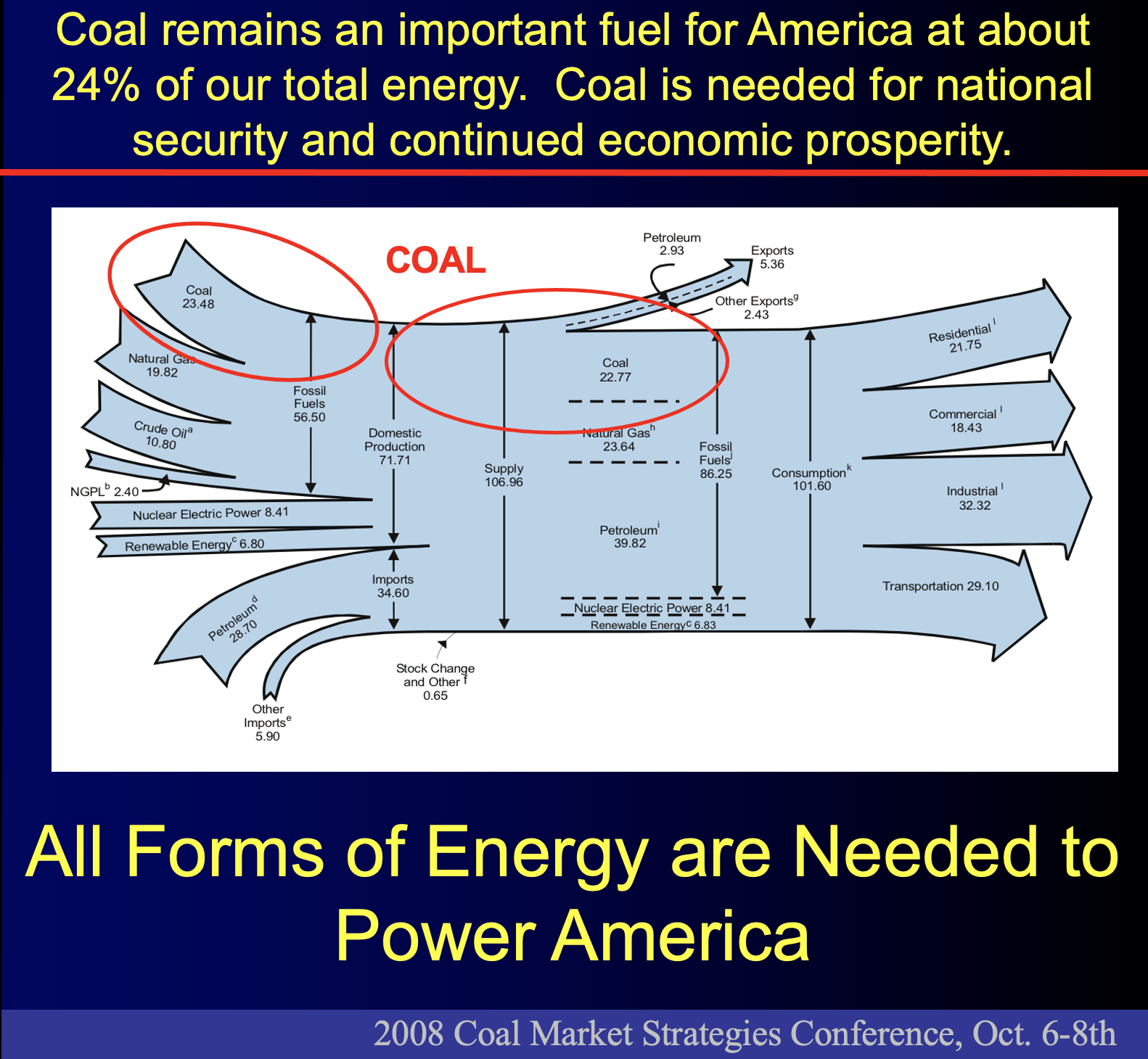
America uses about 100 Quadrillion Btu’s per year. This translates to about 830,000 to 1 Million Btu’s used each day by each American. This includes electricity, transportation, shipping, heating, industrial and commercial. Each individual citizen consumes roughly about a million British Thermal Units (BTU’s) per day, the chart below show the sources of those BTU’s and how they are used.

From U.S. Department of Energy, Lawrence Livermore Laboratory data

About 37% of America’s energy is used for electricity generation. The other 63% is also important and if everyone drove EV’s, then much more electricity demand will be required.

Each citizen uses almost a million Btu’s per day. Depending on employment type, home location in warmer or northern climate and life-styles, the amount of energy used will vary. But for me and my friends and our life-styles, I am sure we use over a million Btu’s per day. For the class, I prepared an illustration of just how an average person could use 866,000 to a million Btu’s each day.

Another illustration shows just how we depend on energy to carry on our daily living.

I have watched the use of total energy for the last twenty years or so and have seen it hover at about 100 Quadrillion Btu’s each year. This is the energy required to fuel our economy and the Freedom to travel and live our lives as Americans have enjoyed for many years. Disrupting this energy supply to fuel our economy and our life styles will create unnecessary hardship, pain and National security risks for all Americans.

The Democrats and the Biden Administration have America on a path to “Net Zero Carbon”. This is insane, foolish and simply not possible to attain. Not unless our standard of living and productive capacity as a nation are severely compromised. I refer you back to the first figure above, the Sankey Diagram that shows total Primary Energy Used in 2019. Of the 100 Quadrillion Btu’s used, only 3.8% came from wind and solar. This is after decades of tax subsidies to renewables. Only 3.8%. Now, for the “Net Zero America” path promoted by Princeton University and the Democrats, they want to change ALL of our ENERGY to Carbon Free. See the figure below:

After many years of subsidies, renewables can’t do better than 3.8% of our energy and the “Net Zero Carbon” proponents think that by throwing Billions and Billions of your tax dollars to connected, (D) Crony Capitalists, we will be able to replace Fossil Fuels and Nuclear with solar panels and wind turbines. This is simply not practical and it will harm America if it is tried. Why? Because we utilize and depend on 96.2% of our energy to come from conventional sources. Petroleum, Coal, Natural Gas and Nuclear. It is absolutely Nuts to have a “War on Carbon” when in fact, we depend on carbon based fuels for every day living. OK, I am a retired coal power engineer and some will say, I am biased toward Fossil Fuels. Imagine that. So to get past the bias, let’s take some real world examples of where large groups of citizens have been subjected to “Extreme Green” policies and take a look at the results. Certainly the politicians are smart enough to understand we should learn from the mistakes of others. You think? Four examples I will offer are:

  • Wind Power in the UK and resulting extreme costs
  • Emphasis of Solar and Wind in Germany and the escalating costs
  • Hawaii Electric’s highest price electricity of the 50 States due to the commitment to shut down a coal plant and depend on renewables
  • Texas Blackout Feb 2021 due to excessive solar and wind being included in their reserve generation

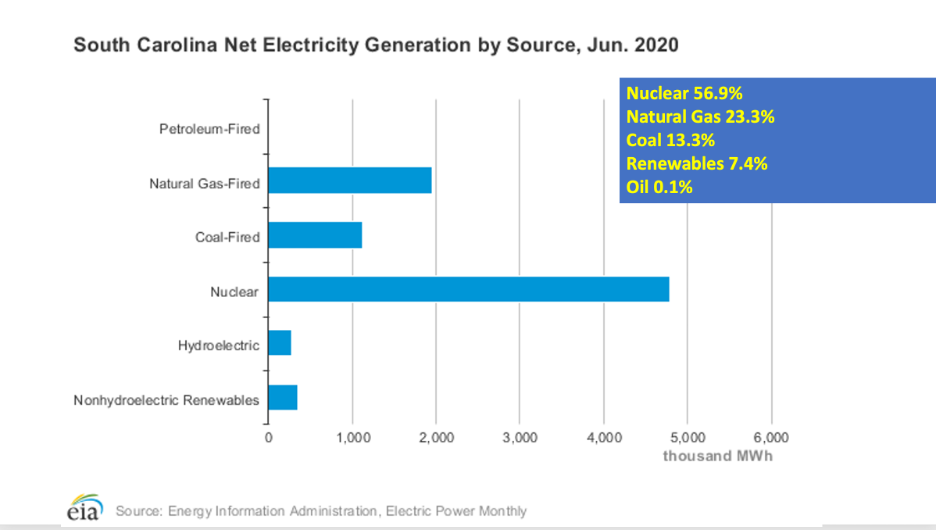
Are these examples of what “we the people” desire for all of America? How can we reshore American Manufacturing with electricity costs such as Hawaii now has? How can we remain the #1 Economy in the world if we depend on imported energy. Does anyone remember the 1974 Arab Oil Embargo and what it did to slow our way of life? Reminder, 96% of our energy is provided from conventional (including old nuclear plants) sources. Yes, old nuclear is good. My state of SC generates 55.8% of our electricity from nuclear plants, some of which are over 50 years old.

American Energy Policy Gets Dumber Each Month, Elected Officials should take notice of how these policies have worked out where tried:

From Wall Street Journal Oct. 6, 2021

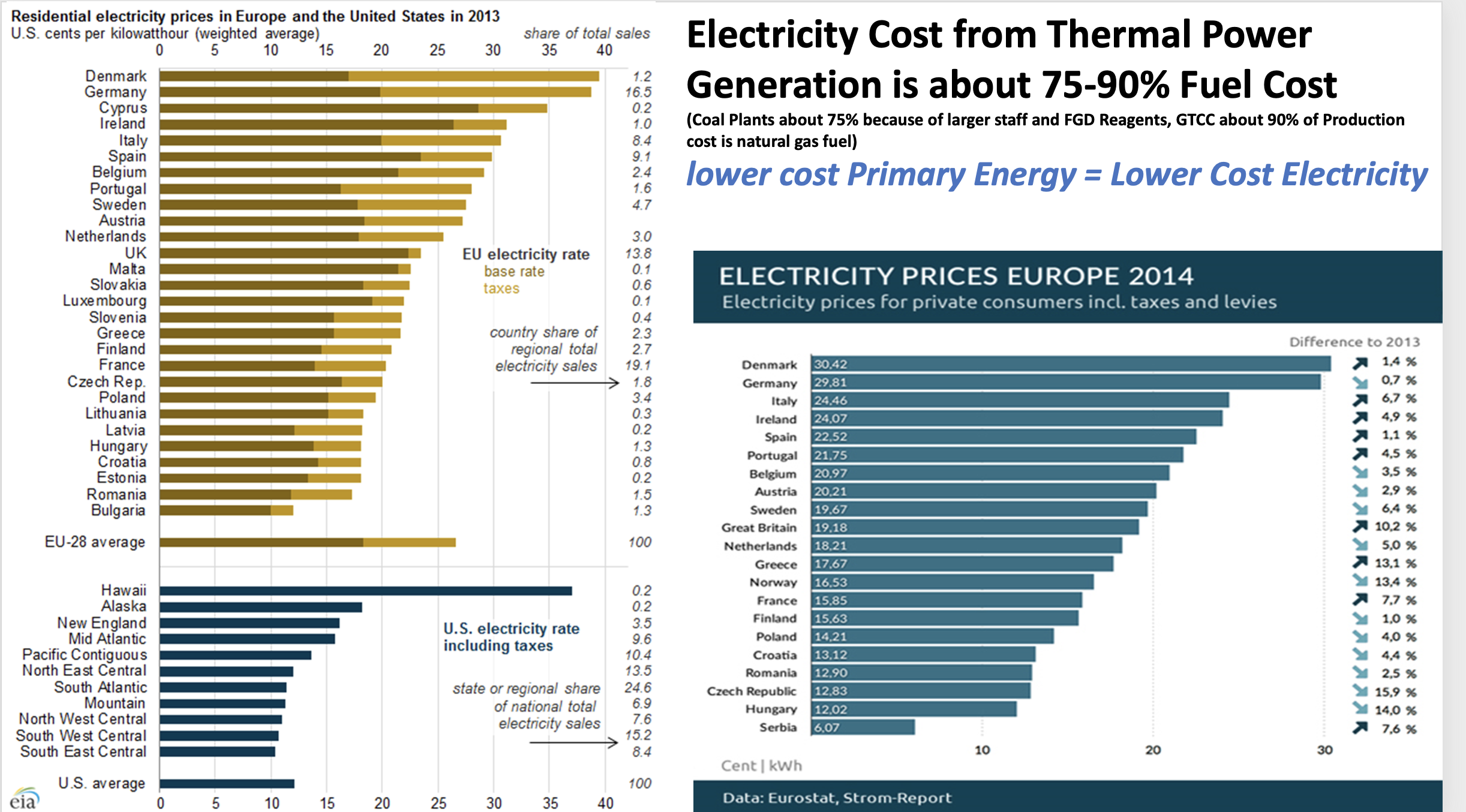
Hawaii has chosen their own version of the “Green New Deal” and it has earned them two first places. (1) They burn the highest cost fuel for generating electricity and not surprisingly, (2) they have the highest electric costs of the 50 U.S. States. Fortunately, Hawaii is not a major manufacturing state. These high costs of power do not bode well for manufacturing, especially primary metals like steel, copper and aluminum. However, it is important for my state of SC to continue with reasonable cost electricity. We do have NUCOR Steel and Century Aluminum and they depend on abundant and reasonable cost electricity. Hawaii can pass the costs on to Tourists and Government, SC cannot.

http://www.islandpulse.org and EIA Electricity cost data

The High Cost of Renewables is well established in the U.S.A. and in Europe

Dick Storm, October 13, 2021

References and Additional Study Materials to research the basis for my opinions as stated above:

  1. Santee-Cooper Flip Facts Sept 2021: https://www.flipsnack.com/santeecooper/2020-santee-cooper-fingertip-facts/full-view.html
  2. Santee-Cooper IRP, Dec 2020: https://www.santeecooper.com/About/Increasing-Value/ORS-Reports/_pdfs/Dec-23-Signed-Filed-IRP.pdf
  3. SC Dept of Energy :  http://www.energy.sc.gov/irp
  4. Dominion Energy SC IRP update, Feb 2021: https://dms.psc.sc.gov/Attachments/Matter/531e91d9-05ff-48e2-938f-adccf3548768
  5. Donn Dears Report on Hydrogenhttps://ddears.com/2021/06/01/special-report-on-hydrogen/
  6. WSJ  Japan and Hydrogen Commitment: https://www.wsj.com/articles/japans-big-bet-on-hydrogen-could-revolutionize-the-energy-market-11623607695?mod=searchresults_pos8&page=2
  7. America’s Power.org : https://www.americaspower.org/behind-the-plug-blog/
  8. References for further reading and research on Climate Change from Natural Forces:
  9. On Natu ral Climate Change (Not Carbon Dioxide) The Right Climate Stuff Team (Retired NASA Engineers): https://www.therightclimatestuff.com
  10. D. Roy Spencer website, “Is there a Climate Crisis?” : http://www.drroyspencer.com/wp-content/uploads/Introduction.pdf
  11. Watts Up With That Blog, “Follow the Money” By Dr. Paul Rossiter: https://wattsupwiththat.com/2019/10/06/understanding-the-climate-movement-part-3-follow-the-money/
  12. Judith Curry website, Climate.etc : https://judithcurry.com
  13. Science and Environment Policy Project  Website: http://www.sepp.org
  14. Princeton Physicist, Dr. William Happer, A key segment begins at minute 24 where the effects of CO2 are discussed. https://bit.ly/3zsXcS6
  15. Donn Dears Articles: https://ddears.com/donns-articles/
  16. Science and Environment Policy Project  Website: http://www.sepp.org
  17. Judith Curry, 15 slides to summarize Climate Change website: https://judithcurry.com/2021/09/03/15-minutes/#more-27827
  18. Global Warming Policy Foundation: https://www.thegwpf.org
  19. WSJ article on “Climate Change Agenda Goes Out With a Bang” July 15, 2021: https://www.wsj.com/articles/climate-change-summit-cop26-cost-esg-carbon-11626297240
  20. Armstrong Economics Climate Change Chart: https://www.armstrongeconomics.com/world-news/climate/reality-of-climate-change-v-people-believe-what-they-want-to-believe/
  21. Armstrong Economics on coming Ice Age: https://www.armstrongeconomics.com/world-news/climate/the-threat-of-an-ice-age-is-real/
  22.  Energy Facts from respected sources:
  23. Donn Dears Articleshttps://ddears.com/donns-articles/
  24. Nuclear Energy Institute, Land Area Required for Wind and Solar to replace a 1000 MW Nuclear Planthttps://www.nei.org/news/2015/land-needs-for-wind-solar-dwarf-nuclear-plants
  25. EPRI video: https://www.youtube.com/watch?v=42UqxqCCYs4  https://youtu.be/42UqxqCCYs4
  26. Real Time US Power Grid link to EIA (Energy Information Administration):https://www.eia.gov/electricity/gridmonitor/dashboard/electric_overview/US48/US48
  27. CA Grid Real Time Demand: https://www.caiso.com/TodaysOutlook/Pages/default.aspx
  28. PJM Operations: https://www.pjm.com
  29. MISO Operationshttps://www.misoenergy.org/markets-and-operations/real-time–market-data/real-time-displays/
  30. SPP (SW Power Pool) Market Generation by Fuel: https://marketplace.spp.org/pages/generation-mix
  31. ERCOT Grid (Electric Reliability Council of Texas): https://mis.ercot.com/public/dashboards
  32. John Shanahan (Excellent) Website: https://www.allaboutenergy.net/energy
  33. CONGRESSIONAL RESEARCH CENTER REPORT, PRIMER ON ENERGY (GOOD REFERENCE WITH EXCELLENT FIGURES) https://crsreports.congress.gov/product/pdf/R/R46723
  34. WUWT Blog on Global Fuels Use, July 11, 2021: https://wattsupwiththat.com/2021/07/11/2020-global-energy-data-shows-fossil-fuels-completely-dominate-world-energy-use/
  35. EIA Battery Storage as of August 2021https://www.eia.gov/todayinenergy/detail.php?id=49236
  36. Dick Storm Blog: https://wordpress.com/posts/dickstormprobizblog.wordpress.com
  37. Mark Mills, The Myth of Renewable Energy: https://www.manhattan-institute.org/the-myth-of-the-great-energy-transition
  38. WSJ, Wind Stops in Europe: https://www.wsj.com/articles/energy-prices-in-europe-hit-records-after-wind-stops-blowing-11631528258?mod=djem_EnergyJournal
  39. General Energy and Environmental References:

The War on Carbon Madness has Come to South Carolina, Check the IRP’s and Weep

The Great State of South Carolina is Following the Path of the Insane Net Zero Carbon Path Proposed by the D.C. Swamp

I am writing this post because as I see it, the usually conservative, level headed elected officials in SC have become “Woke” with regard to energy policy and planning. Worse yet, they have bought into Central Control from Washington, much like the CCP in Beijing.

During the last year I became active as an instructor for the local College Continuing Education Program. As part of my preparations for classes, I did some digging into my adopted state’s policies regarding electricity generation. What I found was enlightening, but not in a good way. 

The energy policy of South Carolina has gone, “Woke” and this great state is headed for higher electricity prices and reduced reliability. I copied the goals from the executive summary of Santee-Cooper’s IRP. They are……

From Santee-Cooper IRP December 2020

There is much written about increasing solar and other renewables and much emphasis on the importance of downsizing the coal fleet.  Yet, the projections to 2050 show a great reliance on coal fuel. I copied the chart below.

Once upon a time, (up till about the mid 1990’s) each state had a Public Utility Commission that would review such plans and approve new capacity additions. Not anymore. America has “Progressed” to being run by Central Control, much like the Chinese Communist Party rules electric power supply in China from the ruling class in Beijing. Yes, central control. The Democrats have downplayed the “Green New Deal” and rebranded it the “Clean Energy Plan”(6). Basically, it is a perfect world, fairy tale authored by Ivory Tower Professors who have never been involved with electric generation.  This is Princeton University’s “Net Zero America Plan” This is available at this link. https://cmi.princeton.edu/annual-meetings/annual-reports/year-2019/the-net-zero-america-project-finding-pathways-to-a-carbon-neutral-future/

Getting back to “Woke South Carolina”, Here are the links to the Integrated Resource Plans for Santee-Cooper and Dominion Energy SC.

https://dms.psc.sc.gov/Attachments/Matter/531e91d9-05ff-48e2-938f-adccf3548768

If you take some time to read these through you will see an emphasis on shutting down coal plants and ramping up renewables. I have written on my Blog about the experiences of California, Texas and Hawaii. All of which have taken the bait of low cost power from free fuel of sun and wind. The TX Blackouts of Feb 2021 are probably recent enough that you do not need a reminder. 

Perhaps I should digress to explain why I feel qualified to write on this topic. For those who do not know me, I will relate a summary of my experience and credentials. I also have strong feelings on why I think it is foolish to apply the ISO/RTO approach to electricity generation in South Carolina as most of the U.S.A. electric power is now controlled. I hate that word, “Controlled”, it reminds me again of the Swamp and the CCP. Kindly bear with me.

My Personal Experiences in the Power Industry

My career in the power industry began in the 1960’s. I worked at Babcock and Wilcox in Barberton Ohio first in nuclear and special products which included involvement with work on the design and construction of the Duke Power Company Oconee nuclear plant. Then I transferred to the Fossil Power Generation Division as a Results Engineer. As a Results Engineer, I did boiler acceptance testing and special tests on large steam generators for design engineering technologies all over the U.S.A. By 1970, I was a senior engineer involved with the startup of new coal plants for Riley Stoker Corp. My first foray into SC was as a startup engineer at the then new supercritical coal plant at Wateree Station, being built for South Carolina Electric and Gas Co. At this time, I was aware of the startup of the Westinghouse PWR at Robinson Station for Carolina Power and Light Co and of course the progress of the building of Oconee.  While employed by Riley I was also on the team that ran the acceptance test of the Santee-Cooper Jefferies coal plant. So, I do have some roots in SC. Later I worked for CP&L on the startup of Sutton and Roxboro plants and as a system “Boiler Engineer” working all across the NC plants.  I left CP&L in 1977 as Operations Superintendent of the four unit, 2,500 MW Roxboro Generating Plant. The lowest cost producer of CP&L’s power at the time.

Later I worked for a large Utility Contractor and started a Technical Services Department with about 20 engineers and technicians. This team worked as Field Engineers and Consultants solving coal, oil and gas steam power generation plant problems. We traveled the world. Much of my travel was working for the Aluminum Company of America (ALCOA) These worldwide experiences provided helpful insight into the interrelationships of reasonable cost, reliable energy to economic prosperity. Especially evident in South America, Guinee W. Africa, Jamaica and others. Wonderful and enlightening experiences as a contracting engineer for ALCOA and for other International facilities. In 1992, I founded  Storm Technologies, Inc. During the 20+ years I worked at Storm Technologies, I traveled to most states and hundreds of power plants in the U.S.A., also traveled the world to Indonesia, the Philippine Islands, South America and numerous island nations. 

My perspective of Electric Utilities could be said to be like the proverbial “Fly on the Wall”. I had an insider’s view of what was going on, some good, some not so good. Let me show some advantages of how small vertically integrated electric Utilities were better than the RTO/ISO approach to separating generation from transmission and Distribution.

The Advantages of Vertically Integrated Utilities that Include Both Generation and Transmission & Distribution

When I was at Wateree in 1970 and later Carolina Power and Light Company, 1973-1977, there was a healthy rivalry between Duke Power, SCE&G and CP&L as to who could produce the lowest cost power. These could really be called “The Good Old Days!” Imagine that, engineers and managers working hard to produce the lowest cost electricity.  Duke’s approach was to use supercritical steam plants and they built the Marshall and Bellew’s Creek plants which to this day are amongst the most efficient in the world with design heat rates below 9,000 Btu/kWh. CP&L took the approach of building 2400 PSI/1000/1000 degree F. sub critical units with the largest possible condenser and design heat rates of about 9,500 Btu/kWh. Bordering NC was SCE&G which had the McMeekin Plant near Columbia. This plant used cool condenser water from the Lake Murray Dam and a heat rate competitive with Duke’s. In 1968 SCE&G began the construction of the two-unit supercritical Wateree Station. In addition, each Utility kept sufficient power generation capacity to provide about 15% spinning (or fast start gas turbines) for power generation reserves. Two Key Points: “Dispatchable” and “Reserve Generation”

Wheeling of Power Is Perfected During Arab Oil Embargo’s

I remember during the Arab Oil Embargo of 1974 how CP&L “Wheeled Power” to VEPCO and the Northeastern States. Philadelphia Electric, VEPCO and other Northeastern Utilities  that had changed fuels from coal to oil as a result of the then new EPA requirements to reduce sulfur emissions. Back in 1972 coal and #6 oil were about the same cost/million Btu’s. Then, about $0.50/million Btu’s. The Arab Oil Embargo permanently changed that! A utility could meet the newly (The EPA began in 1970) regulated particulate and sulfur emissions by either firing heavy oil or by installing electrostatic precipitators and firing low sulfur coal. CP&L and Duke took the path of installing flue gas cleanup equipment. VEPCO and Philadelphia Electric switched much of their generation fuels to oil. Thus, when the Arab Oil Embargo’s resulted, there was fuel shortages for those dependent on oil fuel and an opportunity to “Wheel” high voltage, Bulk Power generated from U.S.A. mined coal, from NC northward.

Several hundred Megawatts of power was sent north during the crucial time that oil became scarce due to the Embargo. Coal looked very attractive back then. In fact, following the Arab Oil Embargo’s, (1974 and again 1980) there was a rush of orders for new coal plants across the U.S.A. Texas made a huge investment in switching from oil and gas fueled generation to coal plants. Coal was King for many years thereafter.

The Advent of ISO’s and RTO’s

Then in the 1990’s the Federal Energy Regulatory Commission and State Regulators became interested in separating generation from Transmission and Distribution to create competition for lower electric rates. Perhaps a good intention, but now it looks like a poor decision, from my viewpoint. The Independent System Operator and Regional Transmission Operator Model was initiated. The FERC Map of these RTO/ISO Regions are shown below.


From: FERC website: https://www.ferc.gov/electric-power-markets


Notice the Southeast does not have an RTO/ISO, yet. So far, so good. But after the 9 Billion Dollar debacle of the failed Summer Units 2 & 3 addition, some elected officials are likely to favor the RTO/ISO approach. I hope not! SC has amongst the lowest electricity costs in America and our power has been very reliable. About a third of SC’s electricity is used by industry which includes NUCOR Steel and Century Aluminum. Two industries that I think are vital for America to remain strong. That is besides the importance of providing jobs and economic advantages to the state.

Where can a person check to see what the planning is? I suggest that everyone check your Utility Integrated Resource Plan or IRP. I did this for Santee-Cooper and for Dominion Energy in SC.  Here below is a screen print of the generation plans for Dominion 2023-2049:

I know it is hard to read. If interested, check the actual website yourself to read the plans for more solar, shutdowns of coal plants and dependence on intermittent, non-Dispatchable generation.

Santee-Cooper’s dependence on solar additions and shutdown of coal plants is similar. 

Perhaps this is a good point to interject the current generation mix of SC according to the EIA. Over 55% of SC electricity is generated by nuclear plants. Mostly. Old nuclear plants. The great intention of building Summer Units #2 and 3 was a noble idea for carbon free Bulk Power into the future. But, SCR&G botched that. Check the figure below to understand the importance of nuclear power in SC.

Conclusions and Recommendations:

  1. The State owned Santee-Cooper Power Generation, in my view, is a treasure that should remain a public power generation entity.
  2. The Coal plants planned for retirement should be replaced with new plants capable of providing “Dispatchable Power”. Dispatchable means Natural Gas, Nuclear and Coal Plants. I know this is not popular but, coal is the fuel that is depended on during extreme winter weather. Also, check the 2035 generation projection in Santee-Cooper”s own IRP, Figure 1.1 above..
  3. Build more nuclear generation to replace the aging fleet of nuclear units in the state. 
  4. In whatever planning goes forward, make sure that at least 85% of peak Demand is capable of being generated by “Dispatchable Power”
  5. Electricity and Energy are in Vaclav Smil’s words, “The Universal Currency” Low cost, reliable electricity is vital to a thriving economy and living truly sustainable lives. Sustainable is moving forward not backward to living as the Pilgrims did in the 17th Century.

Dick Storm, October 1, 2021

References for Further Reasearch:

  1. Federal Energy Regulatory Commission Primer: https://www.ferc.gov/sites/default/files/2020-06/energy-primer-2020_0.pdf
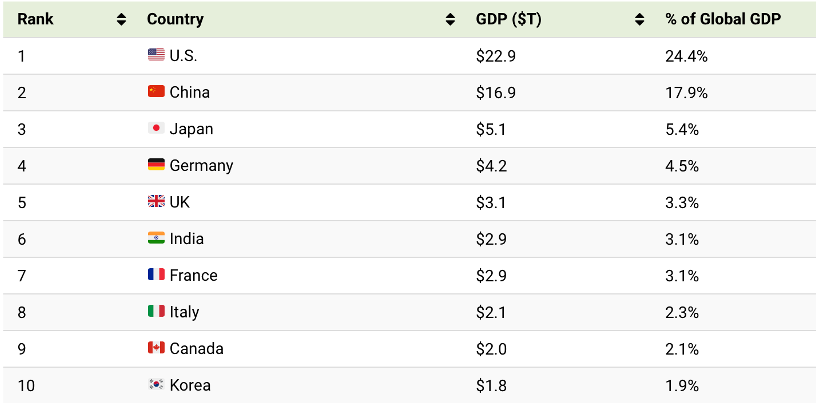
  2. Federal Regulatory Commission Map of RTO’s: https://www.ferc.gov/electric-power-markets
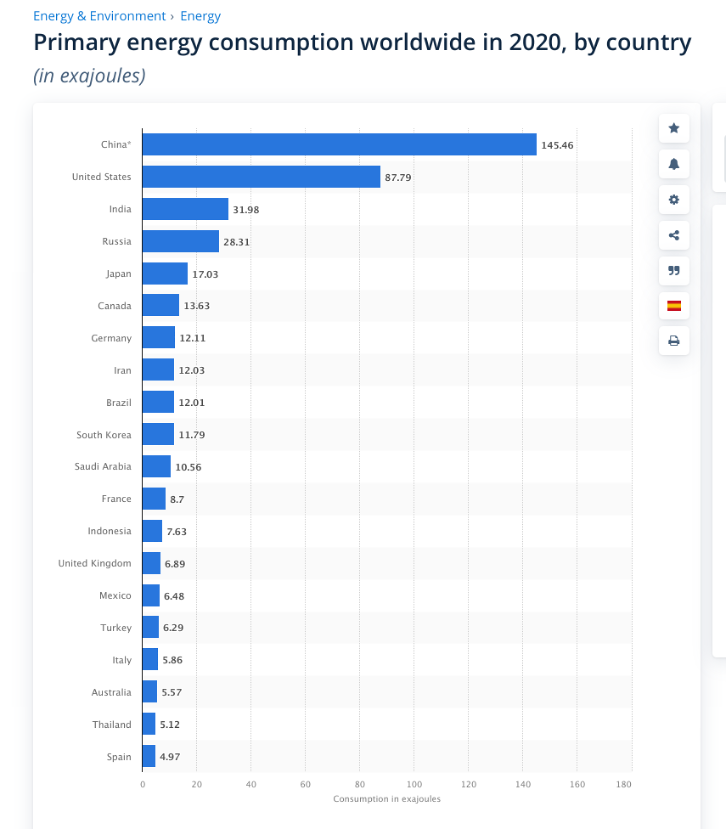
  3. Santee-Cooper IRP: https://www.santeecooper.com/About/Increasing-Value/ORS-Reports/_pdfs/Dec-23-Signed-Filed-IRP.pdf
  4. Dominion Energy revised, Feb 2021, IRP: : https://dms.psc.sc.gov/Attachments/Matter/531e91d9-05ff-48e2-938f-adccf3548768
  5. EIA State Energy Profile for SC: https://www.eia.gov/state/?sid=SC
  6. Utility Dive, Clean Energy Plan, Sept 17, 2021: https://www.utilitydive.com/news/house-committee-to-mark-up-150b-clean-electricity-performance-program-toda/606422/
  7. Donn Dears Book, “THE LOOMING ENERGY CRISIS, ARE BLACKOUTS INEVITABLE” Check Mr. Dears Blog: https://ddears.com/2020/09/01/about-the-looming-energy-crisis/