Category Archives: Regulations

Glasgow, COP-26 Elitists and Special Interests Promote China First, America Last, Why? Because Energy Savvy Engineers Were Not Successful In Educating The Public and Politicians on the True Facts

Well, that is at least one reason we have such a mess of energy policy now.

Once a “War on Carbon”, Has now Morphed into a “War on Freedom”, “War on our Rights”, “War on Capitalism” and an assault on much of What “We the People” Have Worked Hard For. The clowns in Scotland are spending our tax dollars and restricting our freedoms as best they can. Essentially putting China and the rest of the world first, America last. All on our dime.

Meanwhile, U.S.A. High Gas Prices, Super Market Shortages, Inflation , Oil and Gas Jobs are Killed and Winter Energy Supplies may be limited. The American people did not vote for this

America has been a leader by example in reducing carbon. The U.S.A. has reduced our carbon emissions by over 50% since 2005. How? By releasing the power of free markets and American innovation. At the end of President Trump’s term, America was energy independent. He did that in four years only to have Joe Biden reverse his policies.

The War on Fossil Fuels is not new and the intentions have always been to raise energy costs so that “Green Power” will become competitive. Yes, the intentions of President Biden, John Kerry, Al Gore and the rest of the Green Extremists (Reminder, the War on Coal started in the Clinton-Gore Administration. Obama just continued and accellerated anti American energy policies Clinton-Gore began) The war on carbon is intended to make Exploration, Development, Production and use of oil, gas, coal and even nuclear, more expensive and harder to use. All of this as the world’s people still depend on Fossil Fuels and nuclear together for almost 90% of our total energy. How can our leaders be so ignorant and insensitive? Well, back in the 1990’s when bill Clinton started the “War on Coal”, I did my best to educate the public and the students of public schools and several Colleges on energy and electricity generation. I am proud of my efforts, small as they seem in the grand scheme of things. There is still a need for Energy Engineers to become active in PR for Energy!

I copied the Oct. 2011 Commentary(Below) from POWER Magazine’s web page. Kindly note my last line: I sure wish the readers of POWER and many other engineers took the suggestion to educate the public on energy and electricity generation more seriously. If we had, perhaps we would not have the mess we have in Washington today.

(From Oct. 2011)

Shaping America’s Energy Policy

America’s energy and environmental policies have been dysfunctional for decades. Obsessively moving toward “green” has made America weaker and has damaged our economy. During POWER’ s first 100 years (1882–1982), the magazine chronicled the U.S. growing into the strongest industrialized economy in the world. America designed and built products for the world using raw materials and energy from within our own borders. Now we are in a recession and the U.S. Environmental Protection Agency’s (EPA) “War on Coal” continues. Does anyone get the connection? Ever-worsening regulations are killing jobs by the thousands.

Past Turning Points in U.S. Energy Production

Remember when America took risks and led the world in energy innovation? Let’s review some of the past milestones.

The pace-setting power stations Eddystone and Philo are ultrasupercritical power plants that were designed in the 1950s. Hailed as the most efficient coal power plants in the world when they were launched, these plants were designed for over-40% thermal efficiency.

Then Admiral Hyman G. Rickover and President Dwight D. Eisenhower followed through on the “Atoms for Peace Initiative” to commercialize the success of the Navy nuclear propulsion systems, which were to be applied to electricity generation for peaceful purposes. The Shippingport nuclear power plant began operations in the early 1960s, and larger commercial nuclear plants were on the drawing boards. By the mid-1960s, it was said that nuclear power was such a technological breakthrough that “electricity will be too cheap to meter.” America went on to build more than 100 commercial nuclear plants, most of which are still operational. U.S. nuclear plants remain economical and have earned an enviable safety record.

Then came oil embargos, followed by volatile natural gas prices. The high oil and gas prices resulted in a surge in building new coal plants from 1975 to 1985. The nuclear fleet grew until 1978, when the Three Mile Island accident created a major setback. In recent years, nuclear power morphed into the politically correct, carbon-free fuel. However, the tsunami in Japan in March and the resurgence of anti-nuclear groups around the world seem to have once more stalled future nuclear plant development.

The Need for Energy Policies That Promote Our Economy

U.S. energy policy should promote the use of all fuels. America is the Saudi Arabia of coal. If mining permits, EPA regulations, and common sense energy policies were practiced, then power engineers could replace our aging coal plants with new clean coal plants exceeding 40% thermal efficiency. This would be an efficiency improvement of about 7 percentage points above the existing coal fleet.

It is absurd that environmental activists can shape the U.S. energy policy based on ideology alone, with little concern for keeping electricity prices reasonable and our economy growing. Why don’t environmental activists embrace new, more efficient clean coal plants? America should be replacing our aging fleet with new, more efficient, clean coal plants. Will we ever learn?

My concern is that the same type of political correctness that nearly killed nuclear power after Three Mile Island may harm the future of clean coal plants. If the U.S. rebuilt the aging 300+ GW coal fleet with all new, clean ultrasupercritical coal plants, it would employ well over three million Americans. Jobs and a strong America are related to the utilization of homegrown energy, including the mining of coal and raw materials; construction; and the production of steel, cement, copper wire, generators, boilers, balance-of-plant equipment, and environmental controls. Compare the number of jobs created to build, operate, and maintain new coal plants with the “green jobs” of erecting foreign-built windmills or solar power facilities.

If we want to restore economic prosperity and renew manufacturing in America, then we need reasonably priced electricity to supply power to manufacturing plants. Keeping electricity costs reasonable for residential consumption is nice, but to restore manufacturing jobs in America, reasonably priced wholesale electricity, which is available on a 24/7 basis, is needed. This point seems to be forgotten in the national dialog on America’s energy future.

Educating the American Public About Electric Power Production

I think each of us who understands power production has a responsibility to educate our friends, neighbors, and elected officials. There are millions of citizens who believe reasonably priced, reliable electricity is an entitlement. The right thing for human advancement is to use the God-given natural resources that have made “living better electrically” a way of life in the developed world.

In my opinion, we should build green power where it is practical and economic to do so, such as on the roofs of buildings and parking garages. I support the building of nuclear plants and combined cycle gas plants, where economically justified. Energy engineers understand that when the sun sets and the wind is calm, the U.S. needs reasonably priced, dispatchable power to energize what is left of America’s manufacturing might.

I urge the readers of POWER to do your part in educating the public and our elected officials on the true facts of how we can continue to “live better electrically” and keep America strong. I promise to do my part. Will you?”

— Richard F. “Dick” Storm  (was in 2011 ) CEO/senior consultant of Storm Technologies Inc. in Albemarle, N.C.

Reference:

  1. POWER Magazine, Oct. 2011 Commentary: https://www.powermag.com/shaping-americas-energy-policy/#.YYIdCBf0vsM.linkedin
  2. Ron Clutz, Science Matters, Climate Change is 75% Naturally Caused by IPCC Data: https://rclutz.com/2021/11/06/ipcc-data-rising-co2-is-75-natural/#like-22392
The War on Carbon Madness has Come to South Carolina, Check the IRP’s and Weep

The Great State of South Carolina is Following the Path of the Insane Net Zero Carbon Path Proposed by the D.C. Swamp

I am writing this post because as I see it, the usually conservative, level headed elected officials in SC have become “Woke” with regard to energy policy and planning. Worse yet, they have bought into Central Control from Washington, much like the CCP in Beijing.

During the last year I became active as an instructor for the local College Continuing Education Program. As part of my preparations for classes, I did some digging into my adopted state’s policies regarding electricity generation. What I found was enlightening, but not in a good way. 

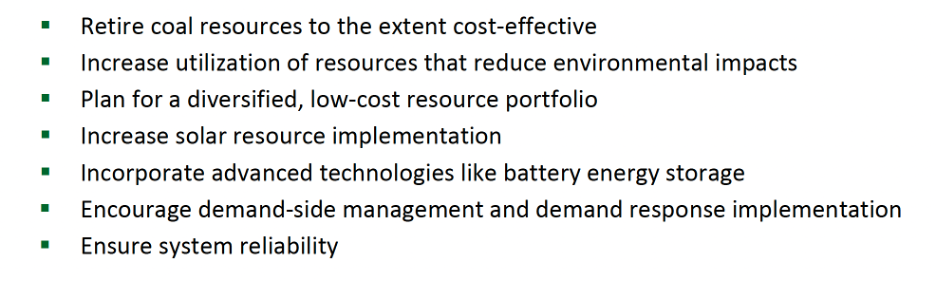
The energy policy of South Carolina has gone, “Woke” and this great state is headed for higher electricity prices and reduced reliability. I copied the goals from the executive summary of Santee-Cooper’s IRP. They are……

From Santee-Cooper IRP December 2020

There is much written about increasing solar and other renewables and much emphasis on the importance of downsizing the coal fleet.  Yet, the projections to 2050 show a great reliance on coal fuel. I copied the chart below.

Once upon a time, (up till about the mid 1990’s) each state had a Public Utility Commission that would review such plans and approve new capacity additions. Not anymore. America has “Progressed” to being run by Central Control, much like the Chinese Communist Party rules electric power supply in China from the ruling class in Beijing. Yes, central control. The Democrats have downplayed the “Green New Deal” and rebranded it the “Clean Energy Plan”(6). Basically, it is a perfect world, fairy tale authored by Ivory Tower Professors who have never been involved with electric generation.  This is Princeton University’s “Net Zero America Plan” This is available at this link. https://cmi.princeton.edu/annual-meetings/annual-reports/year-2019/the-net-zero-america-project-finding-pathways-to-a-carbon-neutral-future/

Getting back to “Woke South Carolina”, Here are the links to the Integrated Resource Plans for Santee-Cooper and Dominion Energy SC.

https://dms.psc.sc.gov/Attachments/Matter/531e91d9-05ff-48e2-938f-adccf3548768

If you take some time to read these through you will see an emphasis on shutting down coal plants and ramping up renewables. I have written on my Blog about the experiences of California, Texas and Hawaii. All of which have taken the bait of low cost power from free fuel of sun and wind. The TX Blackouts of Feb 2021 are probably recent enough that you do not need a reminder. 

Perhaps I should digress to explain why I feel qualified to write on this topic. For those who do not know me, I will relate a summary of my experience and credentials. I also have strong feelings on why I think it is foolish to apply the ISO/RTO approach to electricity generation in South Carolina as most of the U.S.A. electric power is now controlled. I hate that word, “Controlled”, it reminds me again of the Swamp and the CCP. Kindly bear with me.

My Personal Experiences in the Power Industry

My career in the power industry began in the 1960’s. I worked at Babcock and Wilcox in Barberton Ohio first in nuclear and special products which included involvement with work on the design and construction of the Duke Power Company Oconee nuclear plant. Then I transferred to the Fossil Power Generation Division as a Results Engineer. As a Results Engineer, I did boiler acceptance testing and special tests on large steam generators for design engineering technologies all over the U.S.A. By 1970, I was a senior engineer involved with the startup of new coal plants for Riley Stoker Corp. My first foray into SC was as a startup engineer at the then new supercritical coal plant at Wateree Station, being built for South Carolina Electric and Gas Co. At this time, I was aware of the startup of the Westinghouse PWR at Robinson Station for Carolina Power and Light Co and of course the progress of the building of Oconee.  While employed by Riley I was also on the team that ran the acceptance test of the Santee-Cooper Jefferies coal plant. So, I do have some roots in SC. Later I worked for CP&L on the startup of Sutton and Roxboro plants and as a system “Boiler Engineer” working all across the NC plants.  I left CP&L in 1977 as Operations Superintendent of the four unit, 2,500 MW Roxboro Generating Plant. The lowest cost producer of CP&L’s power at the time.

Later I worked for a large Utility Contractor and started a Technical Services Department with about 20 engineers and technicians. This team worked as Field Engineers and Consultants solving coal, oil and gas steam power generation plant problems. We traveled the world. Much of my travel was working for the Aluminum Company of America (ALCOA) These worldwide experiences provided helpful insight into the interrelationships of reasonable cost, reliable energy to economic prosperity. Especially evident in South America, Guinee W. Africa, Jamaica and others. Wonderful and enlightening experiences as a contracting engineer for ALCOA and for other International facilities. In 1992, I founded  Storm Technologies, Inc. During the 20+ years I worked at Storm Technologies, I traveled to most states and hundreds of power plants in the U.S.A., also traveled the world to Indonesia, the Philippine Islands, South America and numerous island nations. 

My perspective of Electric Utilities could be said to be like the proverbial “Fly on the Wall”. I had an insider’s view of what was going on, some good, some not so good. Let me show some advantages of how small vertically integrated electric Utilities were better than the RTO/ISO approach to separating generation from transmission and Distribution.

The Advantages of Vertically Integrated Utilities that Include Both Generation and Transmission & Distribution

When I was at Wateree in 1970 and later Carolina Power and Light Company, 1973-1977, there was a healthy rivalry between Duke Power, SCE&G and CP&L as to who could produce the lowest cost power. These could really be called “The Good Old Days!” Imagine that, engineers and managers working hard to produce the lowest cost electricity.  Duke’s approach was to use supercritical steam plants and they built the Marshall and Bellew’s Creek plants which to this day are amongst the most efficient in the world with design heat rates below 9,000 Btu/kWh. CP&L took the approach of building 2400 PSI/1000/1000 degree F. sub critical units with the largest possible condenser and design heat rates of about 9,500 Btu/kWh. Bordering NC was SCE&G which had the McMeekin Plant near Columbia. This plant used cool condenser water from the Lake Murray Dam and a heat rate competitive with Duke’s. In 1968 SCE&G began the construction of the two-unit supercritical Wateree Station. In addition, each Utility kept sufficient power generation capacity to provide about 15% spinning (or fast start gas turbines) for power generation reserves. Two Key Points: “Dispatchable” and “Reserve Generation”

Wheeling of Power Is Perfected During Arab Oil Embargo’s

I remember during the Arab Oil Embargo of 1974 how CP&L “Wheeled Power” to VEPCO and the Northeastern States. Philadelphia Electric, VEPCO and other Northeastern Utilities  that had changed fuels from coal to oil as a result of the then new EPA requirements to reduce sulfur emissions. Back in 1972 coal and #6 oil were about the same cost/million Btu’s. Then, about $0.50/million Btu’s. The Arab Oil Embargo permanently changed that! A utility could meet the newly (The EPA began in 1970) regulated particulate and sulfur emissions by either firing heavy oil or by installing electrostatic precipitators and firing low sulfur coal. CP&L and Duke took the path of installing flue gas cleanup equipment. VEPCO and Philadelphia Electric switched much of their generation fuels to oil. Thus, when the Arab Oil Embargo’s resulted, there was fuel shortages for those dependent on oil fuel and an opportunity to “Wheel” high voltage, Bulk Power generated from U.S.A. mined coal, from NC northward.

Several hundred Megawatts of power was sent north during the crucial time that oil became scarce due to the Embargo. Coal looked very attractive back then. In fact, following the Arab Oil Embargo’s, (1974 and again 1980) there was a rush of orders for new coal plants across the U.S.A. Texas made a huge investment in switching from oil and gas fueled generation to coal plants. Coal was King for many years thereafter.

The Advent of ISO’s and RTO’s

Then in the 1990’s the Federal Energy Regulatory Commission and State Regulators became interested in separating generation from Transmission and Distribution to create competition for lower electric rates. Perhaps a good intention, but now it looks like a poor decision, from my viewpoint. The Independent System Operator and Regional Transmission Operator Model was initiated. The FERC Map of these RTO/ISO Regions are shown below.


From: FERC website: https://www.ferc.gov/electric-power-markets


Notice the Southeast does not have an RTO/ISO, yet. So far, so good. But after the 9 Billion Dollar debacle of the failed Summer Units 2 & 3 addition, some elected officials are likely to favor the RTO/ISO approach. I hope not! SC has amongst the lowest electricity costs in America and our power has been very reliable. About a third of SC’s electricity is used by industry which includes NUCOR Steel and Century Aluminum. Two industries that I think are vital for America to remain strong. That is besides the importance of providing jobs and economic advantages to the state.

Where can a person check to see what the planning is? I suggest that everyone check your Utility Integrated Resource Plan or IRP. I did this for Santee-Cooper and for Dominion Energy in SC.  Here below is a screen print of the generation plans for Dominion 2023-2049:

I know it is hard to read. If interested, check the actual website yourself to read the plans for more solar, shutdowns of coal plants and dependence on intermittent, non-Dispatchable generation.

Santee-Cooper’s dependence on solar additions and shutdown of coal plants is similar. 

Perhaps this is a good point to interject the current generation mix of SC according to the EIA. Over 55% of SC electricity is generated by nuclear plants. Mostly. Old nuclear plants. The great intention of building Summer Units #2 and 3 was a noble idea for carbon free Bulk Power into the future. But, SCR&G botched that. Check the figure below to understand the importance of nuclear power in SC.

Conclusions and Recommendations:

  1. The State owned Santee-Cooper Power Generation, in my view, is a treasure that should remain a public power generation entity.
  2. The Coal plants planned for retirement should be replaced with new plants capable of providing “Dispatchable Power”. Dispatchable means Natural Gas, Nuclear and Coal Plants. I know this is not popular but, coal is the fuel that is depended on during extreme winter weather. Also, check the 2035 generation projection in Santee-Cooper”s own IRP, Figure 1.1 above..
  3. Build more nuclear generation to replace the aging fleet of nuclear units in the state. 
  4. In whatever planning goes forward, make sure that at least 85% of peak Demand is capable of being generated by “Dispatchable Power”
  5. Electricity and Energy are in Vaclav Smil’s words, “The Universal Currency” Low cost, reliable electricity is vital to a thriving economy and living truly sustainable lives. Sustainable is moving forward not backward to living as the Pilgrims did in the 17th Century.

Dick Storm, October 1, 2021

References for Further Reasearch:

  1. Federal Energy Regulatory Commission Primer: https://www.ferc.gov/sites/default/files/2020-06/energy-primer-2020_0.pdf
  2. Federal Regulatory Commission Map of RTO’s: https://www.ferc.gov/electric-power-markets
  3. Santee-Cooper IRP: https://www.santeecooper.com/About/Increasing-Value/ORS-Reports/_pdfs/Dec-23-Signed-Filed-IRP.pdf
  4. Dominion Energy revised, Feb 2021, IRP: : https://dms.psc.sc.gov/Attachments/Matter/531e91d9-05ff-48e2-938f-adccf3548768
  5. EIA State Energy Profile for SC: https://www.eia.gov/state/?sid=SC
  6. Utility Dive, Clean Energy Plan, Sept 17, 2021: https://www.utilitydive.com/news/house-committee-to-mark-up-150b-clean-electricity-performance-program-toda/606422/
  7. Donn Dears Book, “THE LOOMING ENERGY CRISIS, ARE BLACKOUTS INEVITABLE” Check Mr. Dears Blog: https://ddears.com/2020/09/01/about-the-looming-energy-crisis/