How many products have you bought lately that have a “Made in America” label on them? This article is to provide some background on the importance of conventional fossil fuels to provide the fuel for over 53,000 ocean transport ships. The MV Dali collision with the Francis Scott Key Bridge in Baltimore provides a wakeup call regarding the immensity of world trade. The MV Dali is reported to have a fuel capacity of 1.8 million gallons of fuel. Its engine is an MAN-B&W Diesel rated at 41,480 MW or 55,6260 Horsepower.(2) There are thousands of other large ocean transport ships like her that we depend on each day to distribute raw materials and products to the people of the world, 99% are powered by fossil fuels.

Sometimes, it takes a tragedy to stir the public’s attention. Before the Dali collision and subsequent collapse of the Francis Scott Key Bridge, many folks may not have given much thought to the number of huge ships like this that are delivering raw materials and manufactured products throughout the world.
My main point is, the motive force to propel these ships through the water represents a lot of primary energy. According to the IEA, about 8.7 Exajoules (8.2 Quadrillion BTUs). About 25% of the world’s total energy consumption is used for transportation, when all ships, trains, motor vehicles and aircraft are considered.

How Much Fuel Does one Large Ship Consume?
One of the largest container ships to call on the U.S., the CMA CGM Benjamin Franklin, carries approximately 4.5 million gallons of fuel oil. The smaller Dali about 1.8 million gallons.

The CMA CGM Benjamin Franklin is considered an ultra-large container ship, as it can carry the equivalent of 18,000 twenty-foot equivalent units (TEUs) in containers. Ultra-large container ships are more frequently used to bring goods from Asia to Europe.
Container ships that can go through the old Panama Canal locks are called Panamax ships and can generally hold up to 5,000 TEUs. Those vessels typically hold between 1.5 million and 2 million gallons of fuel. (The Dali was carrying 4,680 containers when it struck the Key Bridge)
Many container ships that call on the U.S. now are considered post-Panamax or New Panamax, named so because they are larger and can go through the newer, larger locks on the Panama Canal. Those ships are generally in the 8,000- to 14,000-TEU range. Ships in that size range can carry between 2.5 million and 4.5 million gallons of fuel.
The amount of fuel actually to be used on a trip depends primarily on the ship’s speed. Most ship engines have been designed for top speeds ranging between 20 and 25 knots per hour, which is between 23 and 28 miles per hour. A Panamax container ship can consume 63,000 gallons of marine fuel per day at that speed. This is a lot of fuel however, when expressed as fuel per ton mile, ocean transport is more efficient and uses less fuel/ton of cargo than any other method of shipping.
How Many Ships?
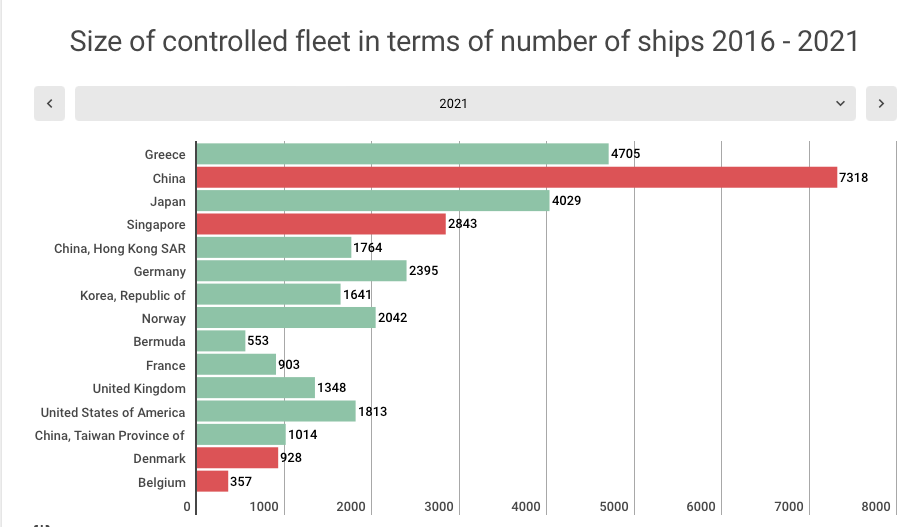
There are over 53,000 merchant ships registered to sail the oceans. This according to “Info Maritime” (1) The top 15 countries for numbers of vessels is shown on the chart below.
Closing Summary
Ocean transport is important to supply the people of the world with the products, food and raw materials needed to live sustainable lives. (Sustainable to me means, living the high quality of life that we enjoy now)
I should mention that this article was inspired by Ron Stein’s article in “America Out Loud”, which made mention of petroleum products making possible 6,000 products, 50,000 military aircraft, 50,000 ships and 20,000 commercial airplanes that the people of the world all depend.(7)
Fossil Fuels in the U.S.A.
Fossil Fuels used in the U.S.A. are shown below by the EIA for the year 2023. The world use of maritime fuel was stated by the IEA at 8.2 Quadrillion BTUs. The U.S. portion uses 26.1 Quadrillion BTUs of petroleum products for all transportation (34% of total fossil fuels), as shown below by the EIA chart. (If Exajoules and Quadrillion BTUs seem abstract, then think “Billions of gallons”.)

Conclusions
Ocean transport is important to sustain our quality of life. Including transport of food. Billions of gallons of Fossil fuels are used for shipping and this reasonable cost and abundant fuel is extremely important to keep international shipping costs reasonable.
The marine industry is under pressure to Decarbonize.(9) This is not only ludicrous but also it will be very expensive. The large and truly magnificent reciprocating internal combustion engines, a couple examples are discussed above are versatile and with some modifications, can be converted to use hydrogen, Methanol or ammonia. However, the production of hydrogen as a fuel requires much more energy, up to four times as much for production as is provided by the burning of the resulting hydrogen as fuel. Therefore a quick back of the envelope calculation would indicate that changing to hydrogen fuel will cost 4 times as much as current marine Diesel or Bunker fuel. Have you bought any hydrogen lately?
Large reciprocating engines similar to those used for ocean transport have been successfully used on land in stationary power generation power plants. They have the operations flexibility for fast starting and a quick shut down.(10, 11, 12) Operational flexibility that is ideal for backing up intermittent renewable solar and wind. The next article will feature these derivatives of large marine engines that are used for backup of Variable electricity generation renewables.
Yours truly,
Dick Storm August 7, 2024
References and Information for Further Research
- Info-Maritime 53,000+ Ships of the world info: http://infomaritime.eu/index.php/2021/08/22/top-15-shipowning-countries/#:~:text=In%20total%20the%20world%20merchant,UNCTAD%20statistics%20data%20from%202021.
- Dali Accident Report by NTSB (accident March 2024, Report May 14, 2024) : https://www.ntsb.gov/investigations/Documents/DCA24MM031_PreliminaryReport%203.pdf
- Wikipedia Container Ship Propulsion system jpg: https://commons.wikimedia.org/wiki/File:Marine-propulsion-system.jpg
- Fuel carried by largest Container Ship, Benjamin Franklin example, 4.5 million gallons: https://www.freightwaves.com/news/how-many-gallons-of-fuel-does-a-container-ship-carry
- EIA Report on Petroleum Use for year 2023, 77.2 Quads: https://www.eia.gov/totalenergy/data/monthly/pdf/flow/fossil_fuel_2023.pdf
- Maritime Executive, Transport Uses 25% of World Energy: https://maritime-executive.com/article/transport-uses-25-percent-of-world-energy
- Ron Stein article,Published February 19 ,2024 at America Lout Loud NEWS, “Are policymakers oblivious to the importance of crude oil, or are they intentionally sending us back to the 18th century?“
https://www.americaoutloud.news/are-policymakers-oblivious-to-the-importance-of-crude-oil-or-are-they-intentionally-sending-us-back-to-the-18th-century/ - Interesting reference book on much about Geography and Shipping: https://transportgeography.org/contents/chapter5/maritime-transportation/
- United Nations report on Decarbonization pressures on Maritime Industry: https://www.unctad.org/system/files/official-document/rmt2023ch3_en.pdf
- Denton Texas, 225 MW Reciprocating Engine Power Plant, using Wartsilla Gas Engines: https://www.crosstimbersgazette.com/2018/06/11/denton-energy-center-to-begin-operations-next-month/
https://www.wartsila.com/media/news/21-09-2016-wartsila-supplies-225-mw-power-plant-to-the-city-of-denton-texas-usa
https://www.cityofdenton.com/335/Denton-Energy-Center-DEC - Wartsilla Marine Engines and Generating Sets:
https://www.wartsila.com/marine/products/engines-and-generating-sets - POWER Magazine article on Wartsilla Gas Engine Plant in Michigan: https://www.powermag.com/new-gas-fired-plants-come-online-in-michigan/
 Dick Storm's Thoughts on Energy, Education, Economic Prosperity & Environmental Blog
